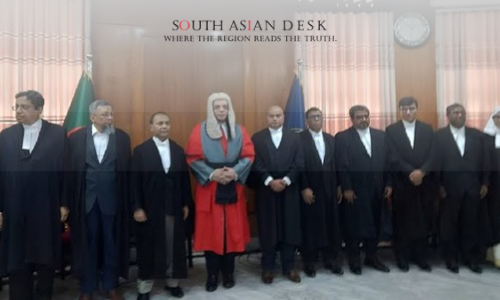
25 new HC judges took the oath to address Bangladesh’s case backlog. On Tuesday, August 26, 2025, 25 new judges were sworn into the High Court Division of Bangladesh’s Supreme Court, marking a significant step to strengthen the judiciary and tackle a mounting backlog of cases. The oath-taking ceremony, held at 1:30 PM in the Judges’ Lounge, was administered by Chief Justice Syed Refaat Ahmed, with the appointments raising the High Court’s judicial strength to 113.
Ceremony and Appointments
The swearing-in ceremony, conducted by High Court Registrar Md Moazzem Hossain, was attended by notable figures, including judges from both the High Court and Appellate Divisions, Attorney General Md Asaduzzaman, Supreme Court Bar Association President AM Mahbub Uddin Khokon, and Secretary Mahfuzut Rahman Milon. President Mohammed Shahabuddin approved the appointments on Monday, August 25, 2025, under Article 98 of the Constitution, with the Law and Justice Division issuing a gazette notification the same day.
The new judges, appointed for a two-year term effective from the oath-taking date, include a mix of senior judicial officers, deputy attorneys general, and practising Supreme Court advocates. Notable appointees include Md Nurul Islam, District and Sessions Judge of Chattogram; Md Zakir Hossain, Dhaka Metropolitan Sessions Judge; Aziz Ahmad Bhuiyan, Supreme Court Registrar General; and Murad-e-Maola Sohel, Judicial Service Commission Secretary. Prominent lawyers elevated include Md Anwarul Islam (Shahin), Rajiuddin Ahmed, Faisal Hasan Arif, and others. From the Attorney General’s office, appointees include Dihidar Masum Kabir, Md Monjur Alam, and Md Lutfar Rahman, among others.
Jesmin Ara Begum, District and Sessions Judge of Habiganj, is the sole female appointee from the subordinate judiciary, joined by two female advocates, Fatema Anwar and Urmi Rahman. This diverse cohort reflects an 80:20 ratio of advocates to judicial officers, as per constitutional norms for additional judge appointments.
Addressing Judicial Backlog
The 25 new HC judges appointments are a strategic move to address Bangladesh’s judicial backlog, with over 431,000 cases pending in the High Court Division as of July 2017, according to a report by International IDEA. Supreme Court spokesman Md Muajjem Hussain described this as “one of the largest single batches of appointments in recent years, aimed at reducing the backlog of cases and strengthening the judiciary.” The initiative aligns with the Supreme Court Judge Appointment Ordinance, 2025, published on January 21, 2025, which established an independent council led by the Chief Justice to enhance judicial independence and reduce executive influence.
The High Court Division, a critical component of Bangladesh’s judiciary, handles appeals from lower courts, writ petitions, and original jurisdiction cases under Article 102 of the Constitution. With the addition of these 25 new HC judges, the division’s capacity to process cases is expected to improve, addressing a chronic issue in the region’s judicial systems.
Regional Significance
In South Asia, where judicial backlogs and executive influence over appointments have long plagued legal systems, Bangladesh’s move is noteworthy. The establishment of an independent appointment council marks a shift towards greater judicial autonomy, a model that could influence neighbouring countries like India and Pakistan, where similar challenges persist. The appointments also come at a time of transition, following the resignation of former Chief Justice Obaidul Hasan on August 10, 2024, amid political changes, underscoring the judiciary’s role in maintaining stability.
Background
The Supreme Court of Bangladesh, comprising the High Court and Appellate Divisions, is the country’s highest judicial authority, established under Part VI, Chapter I of the Constitution. As of August 2024, the High Court Division had 78 judges, with 76 permanent and two additional. The new appointments, effective under Article 98, are temporary for two years, after which the Chief Justice may recommend permanent appointments under Article 95. The judiciary faces ongoing challenges, including a shortage of judges—1,268 for over 2.7 million cases in lower courts as of 2017—and historical concerns over political interference.
What’s Next
The 25 new HC judges will begin their duties immediately, focusing on expediting case resolutions. The Supreme Court is expected to monitor the impact of these appointments on case backlogs, with potential for further reforms to strengthen judicial independence. The Law and Justice Division is also working on establishing a separate judicial secretariat to enhance administrative efficiency.
Published in SouthAsianDesk, August 26th, 2025
Follow SouthAsianDesk on X, Instagram, and Facebook for insights on business and current affairs from across South Asia.