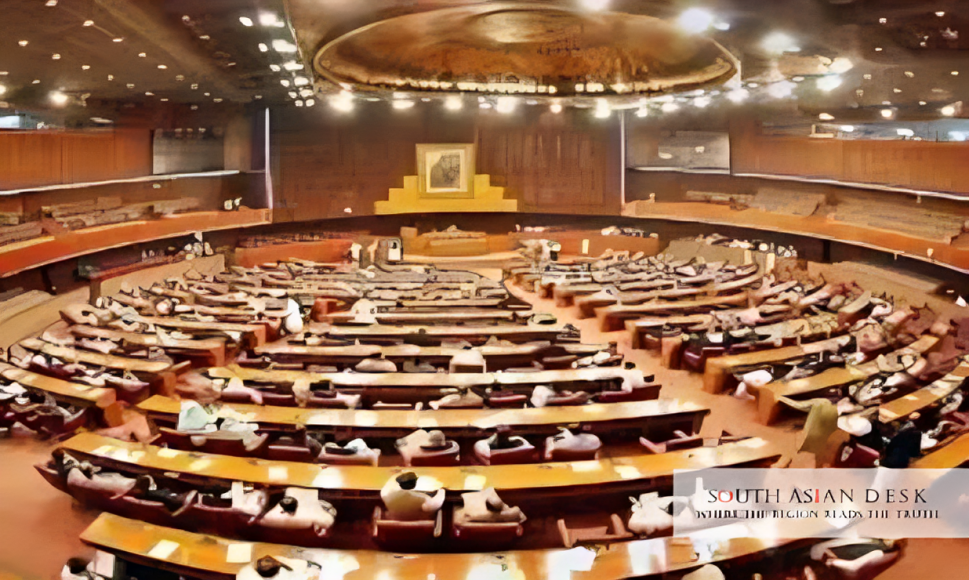
The Pakistan 27th constitutional amendment bill, tabled in the Senate on November 8, 2025, outlines changes to armed forces command and judicial appointments. Law Minister Azam Nazeer Tarar presented the draft after federal cabinet approval. The bill was referred to a joint parliamentary committee for review. Opposition parties have voiced concerns, announcing protests starting November 9.
This amendment reflects ongoing efforts to update Pakistan’s constitutional framework, originally enacted in 1973. It addresses coordination in defence and judicial efficiency, matters central to national stability. In South Asia, such reforms influence regional dynamics by shaping internal power balances that affect cross-border relations and security cooperation. With Pakistan’s economy facing challenges, including a 12 per cent inflation rate and defence spending at PKR 2.1 trillion in the 2025 budget, these changes could impact resource allocation and policy focus.
Provisions on 27th Amendment Army Chief Powers Pakistan
The Pakistan 27th constitutional amendment includes modifications to Article 243, which governs armed forces. The draft proposes establishing the position of Chief of Defence Forces (COFD), to be held by the Chief of Army Staff. This role would oversee the army, navy, and air force, aiming to enhance unified command. The post of Chairman Joint Chiefs of Staff Committee would end on November 27, 2025, coinciding with the current holder’s term conclusion.
Law Minister Tarar explained during a media briefing that the COFD would report to the prime minister while maintaining operational autonomy. “This structure promotes efficiency in national defence,” Tarar said. The amendment specifies a five-year initial term for the COFD, with provisions for extension. It also recognises the rank of Field Marshal for the current Chief of Army Staff, General Asim Munir, following his promotion in May 2025 after border tensions. This rank carries lifetime privileges but no command authority post-tenure, subject to parliamentary review.
Ministry of Defence data from 2024 joint exercises shows coordination delays of up to 48 hours in multi-service operations, which proponents cite as justification for the change. The bill requires parliamentary approval for appointments, preserving civilian oversight.
The joint parliamentary committee, comprising members from Senate and National Assembly standing committees on Law and Justice, met on November 8 to begin deliberations. Discussions focused on balancing military needs with constitutional checks. Coalition partners, including Pakistan Peoples Party (PPP) and Muttahida Qaumi Movement-Pakistan (MQM-P), have indicated support after consultations.
Opposition Protests 27th Amendment Pakistan: Calls for Action
Opposition to the Pakistan 27th constitutional amendment emerged quickly after tabling. The Tehreek Tahafuz Ayeen-e-Pakistan (TTAP) alliance, including Pakistan Tehreek-e-Insaf (PTI), Pashtunkhwa Milli Awami Party (PkMAP), Majlis Wahdat-e-Muslimeen (MWM), and others, announced a nationwide protest movement commencing November 9. TTAP coordinator Mahmood Khan Achakzai stated in a video message, “This amendment shakes the foundations of the Constitution. We must protect it through public action.”
MWM chief Allama Raja Nasir Abbas added, “Democratic institutions have been paralysed. The nation must step up against these changes.” PTI Senator Ali Zafar criticised the process, noting, “We received the draft only on November 8 and have not fully reviewed it. Constitutional amendments require broad consensus.” PTI plans to boycott committee meetings, demanding fresh elections before further legislation.
Protests began in cities like Islamabad, Lahore, and Karachi on November 8 evening, with gatherings at public squares. Reports indicate hundreds participated, calling for withdrawal of the bill. Police monitored events without major incidents. Interior Ministry spokesperson Mohsin Naqvi urged peaceful expression, stating, “The government respects dissent but prioritises public order.”
The opposition argues the 27th amendment army chief powers Pakistan could undermine civilian control, echoing debates from the 18th and 26th amendments. TTAP vows sit-ins if the bill advances to voting, scheduled potentially for November 14 in the Senate.
27th Constitutional Amendment Bill & Judicial Reforms Pakistan
The Pakistan 27th constitutional amendment extends to judicial structures, proposing a Federal Constitutional Court (FCC) to handle constitutional matters. This would limit the Supreme Court’s suo motu powers and original jurisdiction in such cases. The FCC would consist of seven judges, appointed by a parliamentary committee for balanced representation.
Additional reforms include a unified seniority list for high court judges and provisions for transfers without consent, managed by the Judicial Commission of Pakistan (JCP). Tarar highlighted, “These steps address the backlog of over 2.2 million cases as of October 2025, per Law Ministry records. We project a 30 per cent reduction in two years.” The bill also adjusts Senate election ties to census data and revises provincial cabinet size thresholds.
PPP Chairman Bilawal Bhutto-Zardari noted his party’s agreement in principle, saying on November 3, “We support forming constitutional courts, as discussed in prior amendments.” Bar councils have called for consultations, with preliminary feedback from 60 per cent of members favouring efficiency gains but seeking safeguards against politicisation.
These 27th amendment judicial reforms Pakistan build on the 26th amendment’s judicial tweaks from July 2024. The joint committee reviewed these clauses on November 8, with Jamiat Ulema-e-Islam-Fazl (JUI-F) members raising concerns over discarded provisions from earlier drafts.
Background: Evolution of Constitutional Changes
Pakistan has amended its 1973 Constitution 26 times since inception, averaging one every two years. The 18th amendment in 2010 devolved powers to provinces, enhancing federalism. The 21st in 2015 expanded military courts temporarily. The 26th in 2024 addressed civilian trials and judicial appointments amid political tensions.
The 27th amendment draft, finalised after PML-N consultations with allies, spans 15 clauses on defence, justice, and fiscal shares. Prime Minister Shehbaz Sharif, addressing the cabinet via video from Azerbaijan on November 8, said, “This strengthens Centre-province ties and national interests.” It requires a two-thirds majority in both houses for passage.
What’s Next: Committee Review and Potential Passage
The joint committee reconvenes on November 9 at 2 PM to examine remaining clauses, including Field Marshal recognition. Full Senate debate could follow by November 14, with National Assembly alignment needed. Presidential assent would activate changes immediately. Opposition escalation, including potential Article 190 petitions to courts, looms if consensus fails.
Government sources indicate willingness for amendments based on committee input. As deliberations proceed, the Pakistan 27th constitutional amendment remains a focal point for balancing institutional reforms with democratic principles.
Published in SouthAsianDesk, November 9th, 2025
Follow SouthAsianDesk on X, Instagram, and Facebook for insights on business and current affairs from across South Asia.