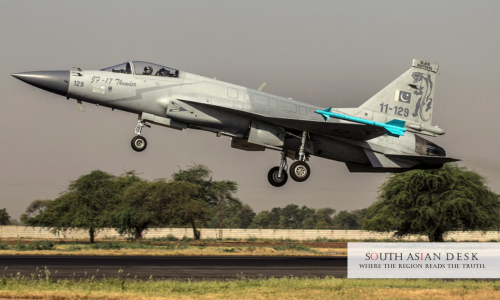
Pakistan and Indonesia advanced talks on a major defense deal during a meeting in Islamabad on 12 January 2026, where Indonesia’s defense minister discussed acquiring over 40 JF-17 jets and Shahpar drones with Pakistan’s air force chief. Sources indicate that the agreement could include air defence systems and training programs.
This Pakistan-Indonesia defence deal holds strategic importance for South Asia, bolstering Pakistan’s defence export ambitions amid regional security dynamics and enhancing Indonesia’s military modernization efforts. As Pakistan seeks to expand its arms industry footprint, such collaborations could reshape defence partnerships in the Indo-Pacific, influencing the balance of power and economic ties across the region.
JF-17 Jets Indonesia: Key Components
Discussions centred on the sale of JF-17 jets to Indonesia, a multi-role combat aircraft co-developed by Pakistan and China. Three security officials familiar with the talks confirmed Indonesia’s interest in procuring more than 40 units. The jets would support Indonesia’s air force fleet renewal amid ageing equipment.
The JF-17 Thunder features advanced avionics and can perform air-to-air and air-to-ground missions. Pakistan has promoted the platform internationally following its performance in a 2025 border skirmish with India.
In addition to jets, the Pakistan-Indonesia defence deal encompasses air defence systems. These could include ground-based radar and missile technologies to enhance Indonesia’s territorial surveillance capabilities.
Training forms a crucial element. The agreement proposes programs for junior, mid-level, and senior Indonesian Air Force officials, along with engineering staff. This would facilitate technology transfer and operational integration.
Pakistan Shahpar Drones in Focus
Pakistan Shahpar drones, designed for surveillance and precision strikes, emerged as a focal point in the negotiations. Developed by Global Industrial Defence Solutions, the Shahpar series offers medium-altitude, long-endurance capabilities with real-time video feeds and payload options for reconnaissance or combat operations.
Sources reported that Indonesia intends to acquire these unmanned aerial vehicles to enhance border security and maritime patrols. The drones have seen deployment in Pakistan’s counter-terrorism operations, demonstrating reliability in challenging environments.
Indonesia Pakistan military cooperation extends to joint exercises and knowledge sharing. The proposed deal aligns with Indonesia’s strategy to diversify its defence suppliers beyond traditional partners, such as France and Turkey.
Indonesia-Pakistan Military Cooperation: Meeting Insights
Indonesia’s Defence Minister, Sjafrie Sjamsoeddin, met with Pakistan Air Chief Marshal Zaheer Ahmed Baber Sidhu in Islamabad on 12 January 2026. The Indonesian Defence Ministry spokesperson Brigadier General Rico Ricardo Sirait stated: “The meeting focused on discussing general defence cooperation relations, including strategic dialogue, strengthening communication between defence institutions, and opportunities for mutually beneficial cooperation in various fields in the long term.”
He added that no concrete decisions had resulted yet. Pakistan’s military confirmed the encounter in a statement, noting discussions on mutual interests and regional security dynamics.
Sjamsoeddin also met Pakistan’s Chief of Defence Forces, Field Marshal Syed Asim Munir. The Inter-Services Public Relations release read: “The meeting focused on matters of mutual interest, evolving regional and global security dynamics, and exploration of avenues for enhancing bilateral defence cooperation.”
The Indonesian minister praised the professionalism of Pakistan’s armed forces and expressed a desire to expand ties across multiple domains. Munir reaffirmed commitment to a long-term partnership based on shared values and strategic interests.
This Indonesia-Pakistan military cooperation builds on a visit by Indonesian President Joko Widodo, also known as Prabowo Subianto, to Pakistan last month, aimed at improving bilateral relations, including defense.
Background
Pakistan’s defence industry has grown since the 1990s, with the JF-17 programme launching in 2003. Over 150 units serve the Pakistan Air Force, with exports to Myanmar, Nigeria, and Azerbaijan. A $4 billion weapons pact with Libya’s National Army and a nearly $1.5 billion deal with Sudan’s army highlight recent successes.
Indonesia maintains one of Southeast Asia’s largest militaries, with a defence budget of IDR 134 trillion in 2025. It ordered 42 Rafale jets from France for USD 8.1 billion in 2022 and 48 KAAN jets from Turkey last year. Talks are ongoing regarding China’s J-10 and the US F-15EX aircraft.
Bilateral ties date to 1950, with trade reaching USD 4.2 billion in 2025. Defence pacts remain limited, but recent geopolitical shifts, including tensions in the South China Sea, drive Jakarta’s diversification.
Pakistan’s arms exports totaled USD 500 million in 2025, according to Stockholm International Peace Research Institute data. The Pakistan-Indonesia defence deal could add significantly, supporting Pakistan’s economy amid fiscal challenges.
What’s Next
Negotiations may conclude in the coming months, with potential announcements at defence expos or bilateral summits. Delivery timelines remain unspecified, but training could commence within a year, pending agreement.
Indonesia and Pakistan’s military cooperation might extend to naval assets or cyber defense. Pakistan is eyeing similar deals with Bangladesh and Saudi Arabia, potentially worth USD 2 billion to USD 4 billion.
As talks progress, the Pakistan-Indonesia defence deal could mark a pivotal step in regional alliances, fostering stability through shared capabilities.
Published in SouthAsianDesk, January 13th, 2026
Follow SouthAsianDesk on X, Instagram and Facebook for insights on business and current affairs from across South Asia.