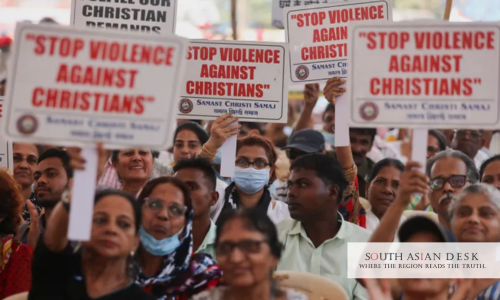
Christian persecution in India intensified in 2025, with over 700 documented attacks on Christians in India reported nationwide. Incidents peaked during Christmas, including mob assaults in Chhattisgarh and Madhya Pradesh, where Hindu extremists targeting Christians disrupted celebrations and vandalised decorations. Rights groups attribute the rise to inflammatory religious hate speech in India and anti-conversion laws enforced in 12 states.
The surge matters for South Asia’s stability, as India’s religious divisions risk spilling over borders, affecting minority rights in neighbouring Pakistan and Bangladesh, where similar communal tensions persist.
Rising Attacks on Christians in India
Data from the United Christian Forum recorded 834 attacks on Christians in India during 2024, rising sharply to over 950 incidents from January to May 2025 alone. By year’s end, advocacy groups like Open Doors documented more than 700 cases of Christian persecution in India, including physical assaults, church vandalism, and arrests under anti-conversion statutes.
In Raipur, Chhattisgarh, on 24 December 2025, a mob armed with sticks stormed a mall, destroying Christmas displays. Police registered a case against 30-40 unidentified individuals but made only six arrests, with the accused released on bail amid public celebrations. Similar disruptions occurred in Madhya Pradesh, where a BJP leader led an assault on a Christmas event for visually impaired children.
Hindu extremists targeting Christians often cite forced conversions as justification, despite limited evidence. The Evangelical Fellowship of India’s Religious Liberty Commission verified 334 incidents from January to July 2025, with Uttar Pradesh and Chhattisgarh accounting for 54% of these incidents.
Religious Hate Speech in India Fuels Violence
Religious hate speech in India reached 1,318 events in 2025, a 13 percent increase from 2024, according to India Hate Lab. Ninety-eight percent targeted Muslims and Christians, with a 41 percent rise in anti-Christian rhetoric. Conspiracy theories like “love jihad” and “population jihad” dominated, inciting calls for boycotts and attacks.
Eighty-eight percent of these events occurred in BJP-ruled states, with figures like Uttar Pradesh Chief Minister Yogi Adityanath and Uttarakhand Chief Minister Pushkar Singh Dhami implicated in multiple instances. Experts link the escalation to the BJP’s 2024 electoral setbacks, which emboldened Hindu nationalists.
The Rashtriya Swayamsevak Sangh, the BJP’s ideological parent, promotes India as a Hindu nation, viewing Christians as threats. Founded in 1925, its ideology labels minorities as internal enemies, fueling Christian persecution in India.
Legal Framework and Enforcement Gaps
Anti-conversion laws in states like Rajasthan, enacted in September 2025, led to over 75 incidents by August, including arrests on fabricated charges. The United States Commission on International Religious Freedom highlighted these laws in its November 2025 report, noting they disproportionately target Christians and enable mob violence.
India’s criminal justice system shows biases, with 70 percent of inmates in pre-trial detention, including disproportionate numbers of religious minorities. The Foreign Contribution Regulation Act and Unlawful Activities Prevention Act further restrict Christian organisations.
Government responses remain inadequate. Prime Minister Narendra Modi visited a church in Delhi on 25 December 2025, but did not condemn the violence. The Ministry of External Affairs has rejected international critiques, calling them biased.
Background: Historical Context of Christian Persecution in India
Christians comprise 2.3 percent of India’s population, according to data from the Pew Research Center from 1951 to 2011. Persecution escalated after the BJP’s rise to power in 2014, coinciding with the introduction of stricter anti-conversion measures. Human Rights Watch documented similar patterns in its 2025 World Report, noting vigilante assaults on minorities.
In Manipur, 2023 ethnic clashes displaced 60,000, destroying over 250 places of worship, mostly churches. Such violence underscores how ethnic and religious lines blur, exacerbating attacks on Christians in India.
Release International’s Persecution Trends 2026 report predicts further deterioration, with daily incidents averaging 50, though only 5 percent are reported. United Christian Forum data aligns, showing Chhattisgarh and Uttar Pradesh as hotspots for Hindu extremists targeting Christians.
What’s Next
As elections approach in key states, analysts foresee intensified religious hate speech in India to polarise voters. Advocacy groups urge judicial reforms and federal oversight to curb impunity. Without intervention, Christian persecution in India risks further entrenchment, threatening communal harmony.
International bodies, such as the US State Department, continue to monitor and recommend India as a Country of Particular Concern due to systematic violations. Domestically, Christian leaders call for unity among minorities to counter rising threats from Hindu extremists targeting Christians.
Published in SouthAsianDesk, January 14th, 2026
Follow SouthAsianDesk on X, Instagram and Facebook for insights on business and current affairs from across South Asia.