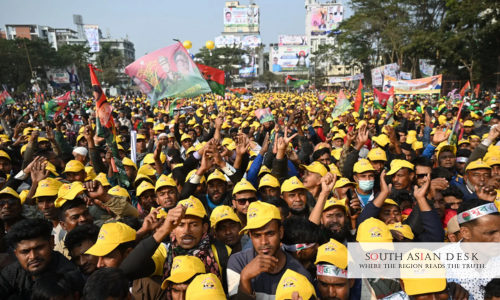
DHAKA – Bangladesh election 2026 officially entered the active campaign phase on Thursday when the Bangladesh Nationalist Party (BNP) organised a grand public meeting in Sylhet featuring a high-profile Tarique Rahman rally. Simultaneously, Jamaat-i-Islami and the newly formed National Citizen Party (NCP) held their opening rallies in Dhaka. These events signal the start of intense nationwide mobilisation ahead of the February 12 election, widely regarded as the first post-Hasina election following the student-led uprising that forced former Prime Minister Sheikh Hasina to flee the country in August 2024.
The rallies drew tens of thousands of supporters who waved party flags, chanted slogans and filled streets leading to the venues. Political leaders used the platforms to outline their visions for a reformed Bangladesh, emphasise anti-corruption pledges and appeal directly to voters disillusioned by years of alleged authoritarian rule.
Tarique Rahman Rally Mobilises Supporters In Sylhet
The Tarique Rahman rally took place at the historic Alia Madrasa ground in Sylhet, a stronghold for the BNP. Party workers and local residents began arriving the previous night to secure spots near the stage. Digital screens displayed BNP theme songs while supporters waved the sheaf-of-paddy flag and chanted “Victory for Tarique” and “Bangladesh Zindabad”.
Tarique Rahman, acting chairman of the BNP and son of late former Prime Minister Khaleda Zia, reached the venue by road after offering prayers at the shrine of Hazrat Shah Jalal. He was received with loud cheers and flower petals. Senior BNP leaders addressed the crowd first, stressing that the current interim administration under Muhammad Yunus has created a level playing field after 17 years of alleged electoral manipulation.
One prominent BNP candidate from Sylhet declared that the party aims to win all 19 parliamentary seats in the division. Another leader highlighted the return of democratic space and urged voters to reject past regimes responsible for enforced disappearances and extrajudicial killings. Attendees expressed strong optimism, with many saying Tarique Rahman would honour the legacy of his father Ziaur Rahman and mother Khaleda Zia, who passed away in December 2025 at the age of 80 after prolonged illness.
The Tarique Rahman rally also featured emotional tributes to victims of the 2024 protests. Families of students killed during the uprising were invited on stage, reinforcing the BNP’s narrative of standing with the youth who brought down the previous government.
First Post-Hasina Election Marks Historic Turning Point
This first post-Hasina election represents a pivotal moment for Bangladesh’s democracy. After nearly 16 years of Awami League dominance marked by three consecutive disputed national polls (2014, 2018 and 2024), the country now holds its most anticipated and open contest in decades. The interim government, led by Nobel laureate Muhammad Yunus since August 2024, has promised free, fair and inclusive voting under international observation.
The Election Commission formally announced the February 12 date after extensive consultations. European Union observers described the forthcoming polls as potentially the largest democratic exercise of 2026, given Bangladesh’s population of over 170 million. The Commission has already completed voter list updates and distribution of national identity cards to new eligible voters.
Despite the optimistic atmosphere, challenges persist. Interim government chief adviser Muhammad Yunus publicly warned citizens about the dangers of disinformation campaigns on social media platforms. He accused both foreign and domestic actors of spreading fake news designed to destabilise the transition process. Security forces have been placed on high alert to prevent any violence during the campaign period.
February 12 Election To Include Key Referendum
The February 12 election will not only decide the composition of the next parliament but will also feature a simultaneous referendum on the July National Charter of Reforms. Chief Adviser Yunus strongly endorsed a “Yes” vote during a televised address on January 19. He described the charter as the foundation for a new Bangladesh free from authoritarian tendencies.
Key reform proposals in the charter include strict term limits for the prime minister, independent oversight of the armed forces and police, greater judicial autonomy, and stronger safeguards against future power grabs. Supporters argue these changes will prevent a repeat of the alleged abuses seen under the previous administration.
Major political parties have already published detailed manifestos. The BNP emphasises its past record of economic liberalisation and infrastructure development during the 2001–2006 period. Jamaat-i-Islami, which was banned from political activity until recently, focuses on Islamic governance principles and social welfare. The NCP, born directly from the 2024 protest movement, positions itself as the voice of a new, youth-driven politics.
Background Of Bangladesh Election 2026
The Bangladesh election 2026 arrives after a turbulent transition. Sheikh Hasina’s government collapsed in August 2024 amid massive street protests triggered by a controversial job quota system. The uprising resulted in hundreds of deaths, thousands of injuries and widespread allegations of excessive force by security agencies.
Hasina fled to India, where she has remained since. In absentia trials have convicted her on multiple charges, including crimes against humanity. Her party, the Awami League, faces severe restrictions and a potential ban on participation in future politics.
Tarique Rahman returned to Bangladesh in December 2025 after 17 years of self-imposed exile in London. His homecoming galvanised BNP supporters who view him as the natural successor to his parents’ political legacy. Khaleda Zia’s death the same month added emotional weight to the campaign narrative.
The interim government has worked to rebuild public institutions damaged by years of politicisation. It appointed new leadership in the Election Commission, Anti-Corruption Commission and key ministries. International partners, including the United Nations and European Union, have offered technical assistance for voter education and poll monitoring.
What’s Next For Bangladesh Election 2026
Campaigning will intensify over the coming weeks with door-to-door canvassing, television debates, social media drives and additional public meetings scheduled across all 300 constituencies. Parties must submit final candidate lists by the deadline set by the Election Commission. The referendum campaign will run parallel, with both pro- and anti-charter groups expected to increase visibility.
The outcome of the Bangladesh election 2026 will determine not only the next civilian government but also the direction of constitutional and institutional reforms. A smooth and credible process could restore public faith in democracy and strengthen Bangladesh’s standing in South Asia.
Published in SouthAsianDesk, January 22nd, 2026
Follow SouthAsianDesk on X, Instagram and Facebook for insights on business and current affairs from across South Asia.