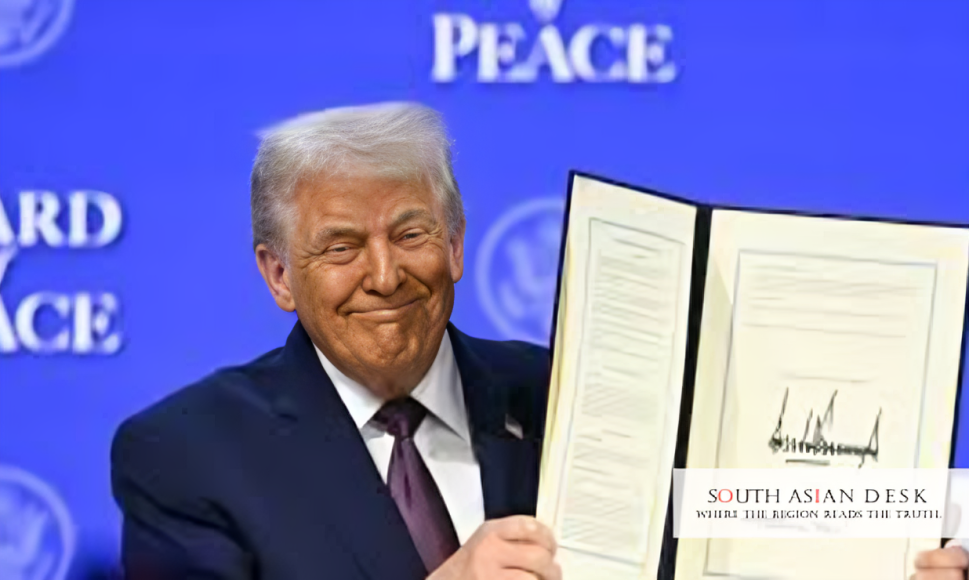
Pakistan’s Prime Minister Shehbaz Sharif among signatories to new international body aimed at Gaza reconstruction and global conflict resolution. Prime Minister Shehbaz Sharif joined US President Donald Trump and leaders from 18 other nations in Davos on Thursday to sign the charter establishing the Trump Board of Peace, a new organisation focused on overseeing Gaza’s post-war recovery and addressing wider international disputes. The event, held during the World Economic Forum, marks a key step in Trump’s 20-point plan to end the Gaza conflict.
The signing underscores Pakistan’s commitment to regional stability amid ongoing Middle East tensions. With a $1 billion entry fee for permanent members, the Trump Board of Peace aims to mobilise resources for demilitarisation, governance and rebuilding in Gaza, while potentially expanding to other conflicts. Critics, including Amnesty International, have labelled it a challenge to UN mechanisms.
Shehbaz Sharif Board of Peace Involvement
Prime Minister Shehbaz Sharif represented Pakistan at the Davos Board of Peace signing, adding his signature to the charter alongside Trump, who chairs the body. Sharif’s participation highlights Islamabad’s diplomatic outreach in South Asia and beyond, aligning with efforts to support Palestinian recovery after Israel’s two-year military campaign in Gaza.
The Pakistani government confirmed the move through an official statement from the Prime Minister’s Office, noting it as a platform for sustainable peace. Sharif, seated among leaders from countries like Saudi Arabia, the UAE and Jordan, engaged briefly with Trump during the ceremony. This follows Pakistan’s acceptance of a formal US invitation earlier in the week.
The Trump Board of Peace requires permanent members to contribute $1 billion, a sum that has sparked debate over accessibility and influence. Pakistan’s involvement positions it to influence Gaza’s reconstruction, including plans for new infrastructure and economic zones.
Davos Board of Peace Signing Details
The Davos Board of Peace signing took place on 22 January 2026, with Trump presiding over the event. Leaders from Argentina, Armenia, Azerbaijan, Bahrain, Bulgaria, Hungary, Indonesia, Jordan, Kazakhstan, Kosovo, Mongolia, Morocco, Paraguay, Qatar, Saudi Arabia, Turkiye, the UAE and Uzbekistan joined Pakistan in endorsing the charter.
Trump described the gathering as a assembly of “stars” committed to peace, stating: “Every one of them are friends of mine. I like every single one of them.” He emphasised the body’s role in ensuring Gaza is “demilitarised, properly governed and beautifully rebuilt.”
US Secretary of State Marco Rubio highlighted the Trump Board of Peace as a “board of action,” focused on enduring peace in Gaza. Jared Kushner, Trump’s son-in-law and a key advisor, presented a master plan for “New Gaza,” featuring seafront developments and demilitarisation by Hamas.
The ceremony included announcements on Gaza’s immediate future, such as the reopening of the Rafah border crossing next week, as stated by Ali Shaath, the US-backed Gaza administrator: “Opening Rafah signals that Gaza is no longer closed to the future and the world.”
Pakistan Joins Board of Peace: Regional Implications
Pakistan joins Board of Peace amid South Asia’s complex geopolitical landscape, where Islamabad has historically advocated for Palestinian rights. The decision aligns with Pakistan’s foreign policy priorities, including strengthening ties with the US and Arab states involved in the initiative.
The Trump Board of Peace emerges from Trump’s comprehensive plan, endorsed by UN Security Council Resolution 2803 in 2025. It positions the body to coordinate humanitarian aid, attract investments and support a technocratic Palestinian administration.
In South Asia, this could enhance Pakistan’s role in multilateral forums, potentially aiding economic partnerships. However, domestic critics in Pakistan have raised concerns over the $1 billion fee and the body’s US-centric structure, calling it “morally indefensible” without broader consultation.
Amnesty International criticised the Trump Board of Peace as a “brazen disregard for international law,” arguing it undermines UN efforts and favours political interests.
Background
The Trump Board of Peace stems from the Gaza ceasefire’s Phase 1, which delivered aid and facilitated captive releases. Trump’s plan, outlined in October 2025, includes 20 points for ending the conflict, with the board as a cornerstone for Phase 2.
Invitations extended to figures like Israel’s Benjamin Netanyahu and Russia’s Vladimir Putin have fueled controversy. Netanyahu confirmed Israel’s intent to join, while Putin is reviewing the offer. No UN Security Council permanent members besides the US have committed, with France declining and Britain opting out for now.
Trump referenced US strikes on Iranian sites in June 2025, noting Tehran’s willingness to negotiate, which could broaden the board’s scope.
What’s Next
As Pakistan joins Board of Peace, focus shifts to operationalising the body. The Trump Board of Peace will prioritise Gaza’s disarmament and funding mobilisation in the coming months, potentially setting a model for South Asian conflict resolution. Trump concluded: “Once this board is completely formed, we can do pretty much whatever we want to do.”
Published in SouthAsianDesk, January 23rd, 2026
Follow SouthAsianDesk on X, Instagram and Facebook for insights on business and current affairs from across South Asia.