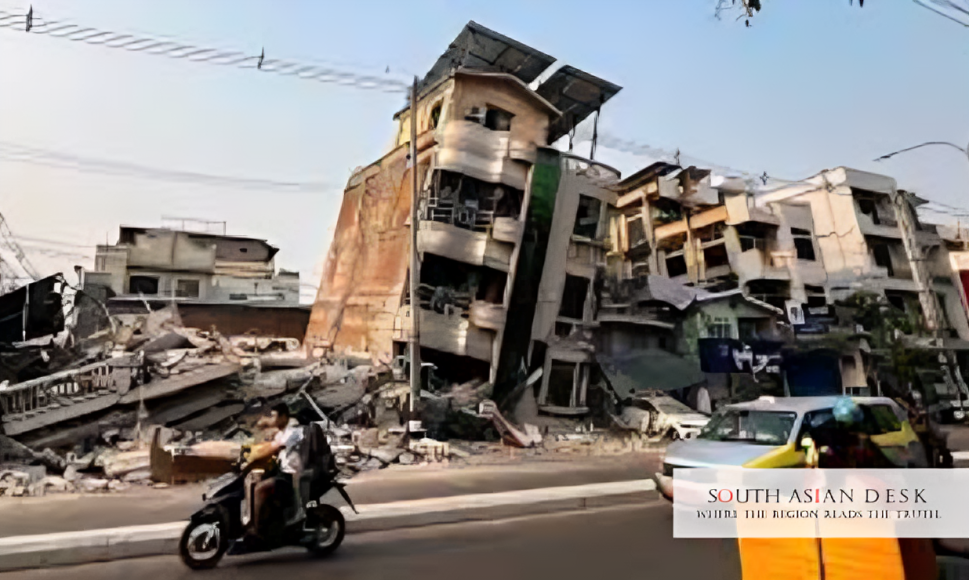
Strong tremors rippled across eastern India and Bangladesh after a 5.9-magnitude quake hit Myanmar.
A 5.9-magnitude earthquake struck Myanmar on Tuesday, 3 February 2026, at about 9:05 PM IST. The epicentre lay in Magway Region, roughly 95 km west of Yenangyaung. Tremors reached Kolkata in India and Dhaka in Bangladesh. No casualties or damage emerged from initial reports.
This Myanmar earthquake highlights the seismic vulnerabilities in South Asia, where tectonic shifts along plate boundaries often trigger cross-border effects. Such events underscore the need for regional preparedness in densely populated areas.
Earthquake in Myanmar: Details of the Quake
The United States Geological Survey recorded the earthquake in Myanmar at magnitude 5.9, with a depth of 63 km. Coordinates placed the epicentre at 20.47°N and 93.96°E. The German Research Centre for Geosciences reported a similar magnitude of 6.0 at a shallower 10 km depth, while India’s National Centre for Seismology noted depth at 27 km.
The quake occurred amid a series of seismic activities. It marked the third event in Myanmar within 71 hours, per European-Mediterranean Seismological Centre data. Earlier, a 4.1-magnitude quake hit Bangladesh at 150 km depth.
Residents in affected zones described brief but intense shaking. In Kolkata, people in high-rises felt buildings sway. Office workers evacuated temporarily. Similar accounts came from Dhaka, where the tremors lasted seconds.
India Meteorological Department officials confirmed the epicentre in Myanmar. “We are ascertaining the details,” an IMD spokesperson stated. No tsunami alerts issued, given the inland location.
Tremors in Kolkata: Local Impact
Tremors in Kolkata prompted quick responses from authorities. West Bengal disaster management teams monitored the situation. Police in the city reported no calls for structural issues. Hospitals stayed on standby, but no injuries surfaced.
This incident recalls past events where Myanmar earthquakes affected eastern India. The region’s geology amplifies distant quakes due to soft soil in the Bengal basin. Seismologists note that shallow to intermediate depths, like this one, allow waves to travel far.
Local media captured resident reactions. One Kolkata resident told PTI: “The chair shook, and we rushed outside.” Such anecdotes reflect public anxiety in quake-prone zones.
Bangladesh Earthquake Effects: Cross-Border Reach
The Bangladesh earthquake aspect involved tremors felt nationwide, including the capital. Bangladesh Meteorological Department echoed IMD findings, attributing shakes to the Myanmar source.
Dhaka residents reported mild vibrations in apartments. No disruptions to power or transport occurred. This followed the earlier 4.1 quake in Bangladesh, heightening alertness.
South Asia’s interconnected seismicity means Myanmar earthquakes often impact neighbours. The Indian plate’s northward push against the Eurasian plate drives activity here. Myanmar sits on the Sagaing fault, a major strike-slip zone.
Historical data shows Myanmar hosted over 20 quakes above magnitude 5 in the past year. The 2016 Chauk quake, magnitude 6.8, caused damage in central areas. Current event, though smaller, serves as a reminder.
Experts from USGS emphasise monitoring. “Shallow quakes can be felt widely,” a report noted. No aftershocks exceeded magnitude 3 by press time.
Regional cooperation remains key. SAARC frameworks allow data sharing among India, Bangladesh, and Myanmar. Yet, Myanmar’s political situation limits real-time coordination.
Background: Seismic Risks in the Region
Myanmar earthquakes stem from its position on the Alpine-Himalayan belt. The country experiences frequent tremors, with Magway Region seeing periodic activity.
India’s northeast and Bangladesh face amplified risks from sediment-filled deltas. Kolkata, built on alluvial soil, experiences liquefaction potential in stronger events.
Government data from India’s Ministry of Earth Sciences shows over 50% of the country in high seismic zones. Bangladesh’s dense population adds vulnerability.
Preparedness includes building codes. West Bengal enforces seismic-resistant designs in new structures. Bangladesh updated its national plan post-2015 Nepal quake.
Public education campaigns stress “drop, cover, hold on.” Apps like USGS Earthquake Notifications provide alerts.
This Myanmar earthquake fits a pattern. EMSC logs show increased activity in the Andaman Sea arc. Climate links, like reservoir-induced seismicity, require study, but no evidence here.
What’s Next: Monitoring and Preparedness
Authorities in India and Bangladesh continue surveillance for aftershocks. USGS forecasts low probability of larger events but advises caution.
Myanmar earthquake recovery focuses on assessment. With no reported damage, focus shifts to resilience building.
This event reinforces calls for improved early warning systems across South Asia.
Published in SouthAsianDesk, February 4th, 2026
Follow SouthAsianDesk on X, Instagram and Facebook for insights on business and current affairs from across South Asia.