India has cleared the initial proposal for the India Rafale deal, approving the purchase of 114 Rafale jets from Dassault Aviation. The Defence Acquisition Council granted Acceptance of Necessity on Thursday, 12 February 2026, in New Delhi, amid preparations for French President Emmanuel Macron’s visit. This move addresses the Indian Air Force’s depleting squadrons.
The approval for the India Rafale deal forms part of a larger 3.6 trillion INR ($40 billion) military procurement package. It underscores India’s push to modernise its defence capabilities against regional threats, particularly from neighbours like Pakistan and China. In South Asia, where air superiority plays a critical role in security dynamics, this acquisition could shift the balance of power and prompt responses from other nations.
Details of the IAF Rafale Purchase
The Defence Acquisition Council, chaired by Defence Minister Rajnath Singh, accorded Acceptance of Necessity to multiple proposals worth 3.6 trillion INR. The India Rafale deal constitutes the bulk, estimated at 3.25 trillion INR for 114 Rafale jets. According to official statements, this procurement will enhance the Indian Air Force’s ability to undertake air dominance roles across conflict spectrums and boost deterrence through long-range offensive strikes.
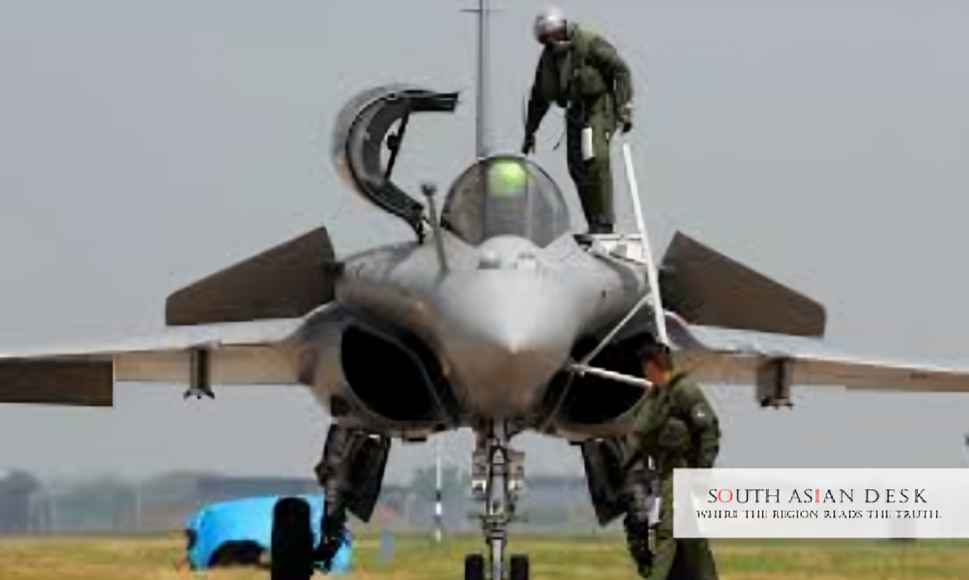
The Indian Air Force currently operates 36 Rafale fighters, inducted following a 2016 agreement. The navy recently signed for 26 Rafale Marine variants for carrier operations on INS Vikrant and INS Vikramaditya. With this new IAF Rafale purchase, the total Rafale fleet in India could exceed 170 units once deliveries complete.
Plans indicate that 90 of the 114 Rafale jets will be manufactured in India, with close to 50 per cent indigenous content. This aligns with Prime Minister Narendra Modi’s emphasis on domestic defence production. The remaining 24 jets may arrive in fly-away condition from France. The Dassault India deal builds on existing technology transfer arrangements, potentially involving Hindustan Aeronautics Limited as a local partner.
The Indian Air Force faces a squadron shortfall. Its strength has dropped to 29 squadrons against an authorised 42. Older aircraft like MiG-21s were retired in September 2025, while MiG-29s, Jaguars, and Mirage 2000s approach end-of-service. The IAF Rafale purchase aims to plug this gap, providing multi-role capabilities including air-to-air combat, ground strikes, and reconnaissance.
Broader Military Upgrades in the Package
Beyond the India Rafale deal, the approvals include Boeing P-8I reconnaissance aircraft for the navy, combat missiles for the air force and army, anti-tank missiles, and airship-based high-altitude pseudo satellites. The navy will acquire six additional P-8Is, enhancing maritime surveillance in the Indian Ocean region.
A separate deal was cleared for eight Dornier 228 aircraft for the Indian Coast Guard, produced by Hindustan Aeronautics. These procurements reflect India’s strategy to diversify suppliers, reducing reliance on Russian equipment amid global shifts.
The timing coincides with heightened border tensions. India has faced standoffs with China in Ladakh since 2020 and maintains vigilance along the Pakistan border. The Dassault India deal could deter potential aggressions by strengthening strike ranges.
Background on Rafale in India
The Rafale’s entry into India dates to 2012, when Dassault won a tender for 126 medium multi-role combat aircraft. That process faced delays and allegations of irregularities, leading to a scaled-down 36-jet purchase in 2016 for 590 billion INR. The agreement included offsets, where Dassault committed to invest 50 per cent of the contract value in India.
Controversies arose over pricing and selection, with opposition parties questioning transparency. However, audits by the Comptroller and Auditor General found no major lapses. The Supreme Court dismissed related petitions in 2019.
The current India Rafale deal revives the multi-role fighter aircraft requirement, originally for 114 jets. It follows extensive trials and negotiations, with Rafale outperforming competitors like Eurofighter Typhoon and Boeing F/A-18.
Dassault Aviation has established a joint venture with Reliance Defence for offsets, though production ramp-up has been gradual. The IAF Rafale purchase will leverage existing infrastructure, including bases in Ambala and Hasimara.
Implications for South Asian Security
In South Asia, air power remains pivotal. Pakistan operates F-16s and JF-17s, while China’s J-20 stealth fighters pose advanced threats. The 114 Rafale jets could provide India with qualitative edges in beyond-visual-range engagements and electronic warfare.
This development may accelerate arms races in the region. Pakistan has sought upgrades from the US, and China continues indigenous developments. Analysts note that the Dassault India deal reinforces Indo-French strategic ties, part of India’s multi-alignment foreign policy.
Economically, the deal supports jobs in aerospace. Dassault’s investments could spur technology transfers, aiding India’s Tejas programme. However, delays in Tejas Mk-1A deliveries due to engine issues highlight import dependencies.
What’s Next for the India Rafale Deal
The Acceptance of Necessity paves the way for commercial negotiations. Final contracts could be signed during Macron’s visit from 17 to 19 February 2026, where he will meet Prime Minister Modi in Mumbai. Discussions may focus on localisation and pricing.
Deliveries might start in 2029, with full induction by 2035. The government aims for 75 per cent indigenous content in future phases. Monitoring regional responses will be key, as the IAF Rafale purchase alters defence equations.
This India Rafale deal marks a milestone in modernising the armed forces, ensuring readiness for evolving threats.
Published in SouthAsianDesk, February 13th, 2026
Follow SouthAsianDesk on X, Instagram and Facebook for insights on business and current affairs from across South Asia.