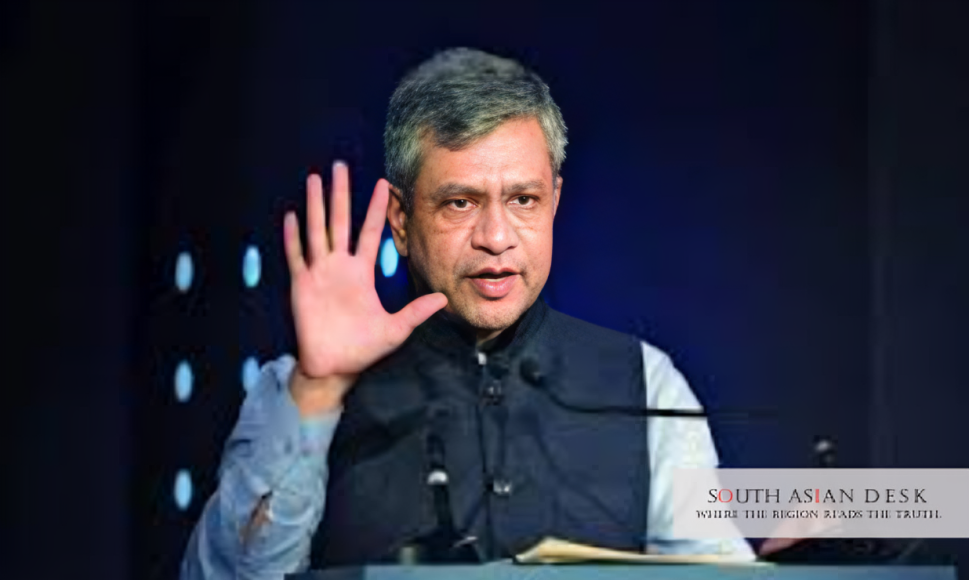
India’s cabinet approved projects worth INR 1.6 trillion (USD 18 billion) for infrastructure, urban development and startups on Saturday, February 14, 2026, as announced by Information Minister Ashwini Vaishnaw. The approvals cover rail lines, highways, a metro extension, an underwater tunnel and dedicated funds for urban and startup sectors.
The decisions strengthen India’s economic framework amid regional growth demands. In South Asia, enhanced India infrastructure projects facilitate cross-border trade and investment flows, supporting connectivity with neighbours like Pakistan and Bangladesh through improved logistics.
India Infrastructure Projects Overview
The cabinet sanctioned multiple initiatives under India infrastructure projects, totalling INR 1.6 trillion. These include transport upgrades and funding schemes aimed at efficiency and growth.
Key allocations feature the Urban Challenge Fund at INR 100,000 crore in central assistance, expected to mobilise projects worth INR 400,000 crore. The Startup India Fund of Funds 2.0 receives INR 10,000 crore to bolster venture capital.
Transport components encompass rail multitracking at INR 18,509 crore, highway upgradations exceeding INR 11,000 crore, a metro extension at INR 2,254 crore and an underwater tunnel at INR 18,662 crore.
Urban Challenge Fund Details
The Urban Challenge Fund shifts focus to market finance and private sector inclusion. It covers cities with over 1 million population, all state capitals, major industrial hubs above 100,000 residents, Tier-II and Tier-III cities, Northeast regions and hilly states.
A INR 5,000 crore Credit Repayment Guarantee Scheme aids Tier-II/III cities, Northeast and hilly areas. Verticals include creative city redevelopment, cities as growth hubs and water-sanitation improvements.
Central aid covers up to 25% of costs, with states and local bodies sourcing the rest externally. This Urban Challenge Fund drives market-led urban transformation, addressing rapid urbanisation in India.
Startup India Fund Enhancements
The Startup India Fund of Funds 2.0 expands the venture capital ecosystem. It prioritises deep tech, innovative manufacturing and early growth-stage startups.
Operational flexibilities allow higher government contributions for deep tech and high-tech manufacturing alternative investment funds. The scheme encourages long-term investing and patient capital.
Developed through stakeholder consultations, the Startup India Fund strengthens domestic venture capital. It builds on the 2016 Fund 1.0, which invested INR 25,500 crore and supported 1,370 startups.
Ashwini Vaishnaw Projects in Rail
Ashwini Vaishnaw projects include three rail multitracking efforts covering 389 km at INR 18,509 crore. These enhance the Indian Railways network across Delhi, Haryana, Maharashtra and Karnataka.
The Kasara-Manmad third and fourth line spans 131 km at INR 10,154 crore. It quadruples capacity on the Mumbai-Howrah route, boosting freight by 46.1 million tonnes per annum. Districts covered are Thane and Nashik.
Annual savings reach INR 1,207 crore in logistics costs, with 54 crore kg CO2 reduction, equivalent to planting 2.2 crore trees. It connects to sites like Trimbakeshwar Jyotirlinga and Bhavli Dam.
The Delhi-Ambala third and fourth line covers 194 km at INR 5,983 crore. It serves Sonipat, Panipat, Karnal, Kurukshetra, Ambala and Delhi districts. Freight increases by 24.6 million tonnes per annum.
Savings include INR 952 crore annually in logistics, with 43 crore kg CO2 cut, equal to 1.7 crore trees. It links to tourist hubs like Shri Mata Vaishno Devi Katra and Shimla.
The Ballari-Hosapete third and fourth line is 65 km at INR 2,372 crore. Covering Ballari and Vijayanagara districts, it strengthens the southern corridor. Annual logistics savings are INR 323 crore, with 14 crore kg CO2 reduction.
It supports steel plants, mining clusters and sites like Hampi UNESCO World Heritage and Tungabhadra Dam. Projects generate 26.5 million human-days of employment.
Ashwini Vaishnaw Projects in Roads and Metro
Ashwini Vaishnaw projects extend to highways and metro. The Noida Metro Aqua Line extension from Botanical Garden to Sector 142 is 11.6 km at INR 2,254 crore. It adds eight elevated stations, expanding the Noida-Greater Noida network beyond 61 km.
It integrates with Delhi-Noida links and the upcoming Multi-Modal Transport Hub at Boraki. This aids middle-class and youth productivity.
The Ghoti-Trimbak-Palghar NH-160A upgrade is 154 km at INR 3,320 crore. It strengthens to two/four lanes with paved shoulders, covering Palghar and Nashik districts.
It links to Delhi-Mumbai Expressway and Samruddhi Mahamarg, promoting inclusive development in tribal areas.
The Dhamasiya-Bitada and Nasarpore-Malotha NH-56 four-laning is 108 km at INR 4,584 crore. Covering Narmada, Tapi and Surat districts, it reduces travel time by 40% from 2.5 hours to 1.5 hours.
It boosts connectivity to Statue of Unity and tribal districts, strengthening the Bodeli-Vapi corridor for farms and industries.
The Gudebellur-Mahabubnagar NH-167 four-laning is 80 km at INR 3,175 crore on the Hyderabad-Panaji corridor. It cuts travel time by 50% from three hours to 1.5 hours, covering Mahabubnagar, Narayanpet and Raichur districts.
It integrates with pharma clusters and SEZs in Hyderabad, generating 1.44 million human-days of employment.
Ashwini Vaishnaw Projects in Tunnels
A flagship among Ashwini Vaishnaw projects is India’s first underwater twin-tube road-rail tunnel under River Brahmaputra. The 34 km project at INR 18,662 crore connects Gohpur to Numaligarh in Assam.
It features four lanes, reducing distance from 240 km to 34 km and travel time from six hours to 20 minutes. It strengthens the Northeast as a gateway to Act East policy.
The alignment integrates with NH-15, NH-715 and railway lines like Rangia-Mukongselek and Furkating-Mariani. It enhances border connectivity, cross-border trade and tourism.
The project connects 11 economic nodes, three social nodes, two tourist nodes and eight logistic nodes. It generates 8 million human-days of employment.
This would be India’s first underwater road-rail tunnel and the world’s second.
Background
India infrastructure projects have accelerated under recent policies. The approvals align with PM Gati Shakti for multi-modal connectivity and logistic efficiency.
Commodities like coal, steel, iron ore, cement and foodgrains benefit from reduced congestion. The initiatives support sustainable growth, cutting oil imports and emissions.
In South Asia, these India infrastructure projects bolster regional stability by improving trade routes and economic ties.
What’s Next
Future phases may expand the Urban Challenge Fund and Startup India Fund. Monitoring implementation will ensure timely benefits.
India infrastructure projects continue to drive national and regional progress.
Published in SouthAsianDesk, February 15th, 2026
Follow SouthAsianDesk on X, Instagram and Facebook for insights on business and current affairs from across South Asia.