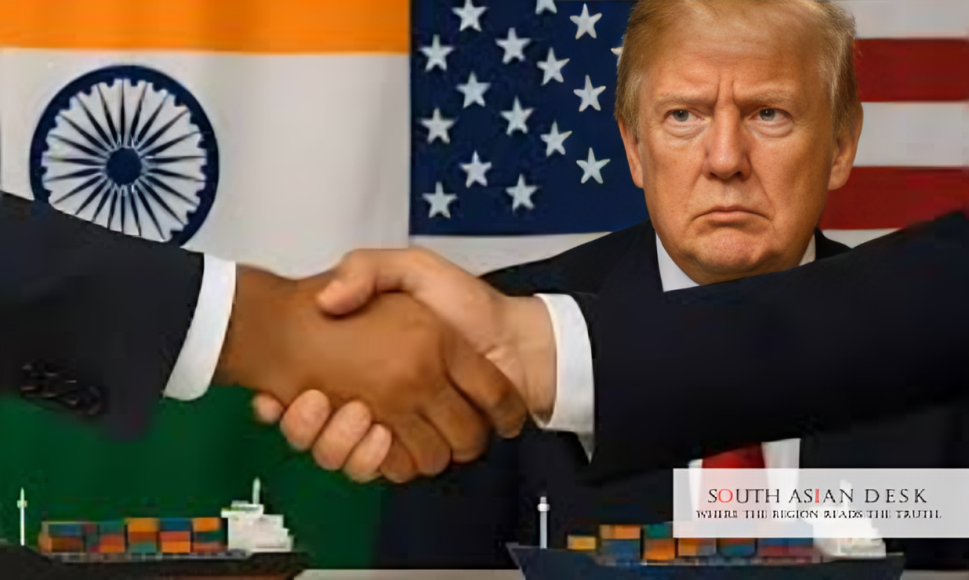
India has concluded landmark India EU US trade deals that mark a decisive shift from decades of protectionism, sealing the “mother of all trade deals” with the European Union on January 27, 2026, and an interim agreement with the United States on February 6, 2026.
These pacts, India’s 10th free trade agreement since 2014, open vast markets while highlighting persistent India FTA challenges, particularly low FTA utilization India.
For South Asia, the developments carry direct implications. Pakistan, Bangladesh and other regional exporters compete fiercely in textiles, apparel, leather and gem sectors that stand to gain zero-duty access to the EU under the new deal. Any surge in Indian shipments could reshape market shares and pressure competitors to accelerate their own reforms.
The Scale of India EU US Trade Deals
The EU-India Free Trade Agreement creates a free-trade zone spanning two billion people and a combined market worth over USD 24 trillion. Bilateral merchandise trade reached USD 136.54 billion in 2024-25, with India exporting USD 75.85 billion in goods and USD 83.10 billion in services.
Under the agreement, India secures preferential access across 97 percent of tariff lines covering 99.5 percent of export value. Immediate duty elimination applies to 70.4 percent of lines (90.7 percent by value) in labour-intensive sectors including textiles, apparel, leather, footwear, gems and jewellery, certain marine products, tea, coffee and spices.
European Commission President Ursula von der Leyen described the pact as historic: “We have created a free trade zone of 2 billion people, with both sides set to gain economically. We have sent a signal to the world that rules-based cooperation still delivers great outcomes.”
The US interim agreement lowers the reciprocal tariff on Indian originating goods to 18 percent and removes additional punitive tariffs linked to third-country oil purchases. In return, India commits to eliminate or reduce tariffs on all US industrial goods and a wide range of agricultural products, while pledging to purchase USD 500 billion of US energy, aircraft, technology products and coking coal over the next five years.
The White House joint statement called the framework “a historic milestone in our countries’ partnership, demonstrating a common commitment to reciprocal and balanced trade”.
India FTA Challenges: Low Utilization Remains the Core Issue
Despite the headline gains, India FTA challenges centre on execution. Historical data shows India’s FTA utilization rate hovers at about 25 percent, far below the 70-80 percent seen in developed economies.
Between 2017 and 2022, Indian exports to FTA partners grew 31 percent while imports surged 82 percent, a pattern experts describe as an alarming imbalance.
The new EU deal introduces self-certification of origin, shifting legal and financial risk from government agencies to exporters. Small and medium enterprises, which dominate labour-intensive sectors, often lack the systems to prove substantial transformation under complex Rules of Origin.
Non-tariff barriers, testing, labelling, inconsistent customs and high documentation costs further erode competitiveness. Many exporters who technically qualify for lower tariffs still pay full duties because proving eligibility proves too slow or expensive.
India Trade Deals 2026: Execution Will Determine Success
India trade deals 2026 arrive at a pivotal moment. Recent pacts with Australia and the UAE since 2023 have shown improved export performance where infrastructure, dispute resolution and supply-chain integration were strengthened.
The EU factsheet highlights immediate zero-duty access for over INR 2.87 lakh crore (USD 33 billion) in current exports facing 4-26 percent duties. Gems and jewellery, marine products and textiles are expected to benefit most.
Yet experts caution that tariff parity alone will not deliver market share. Vietnam’s merchandise exports, once a third of India’s in 2010, now approach parity despite a GDP one-tenth the size, thanks to speed, predictability and deep integration.
The US deal includes rules of origin designed to ensure benefits accrue primarily to the two parties and commits both sides to address non-tariff barriers within defined timelines, including India’s review of standards for US medical devices and ICT goods within six months.
Background
India relaunched EU negotiations in 2022 after a nine-year suspension. The 14th and final formal round occurred in October 2025. The US interim framework builds on Bilateral Trade Agreement talks launched by President Donald J Trump and Prime Minister Narendra Modi on February 13, 2025.
India has simultaneously agreed to begin negotiations with the six-nation Gulf Cooperation Council, which accounts for 15 percent of its global trade.
What’s Next
Implementation timelines, legal scrubbing and ratification will determine when preferential rates take effect. Both the EU and US agreements include dedicated SME support chapters and mechanisms for ongoing dialogue on standards and barriers.
India aims to reach USD 1 trillion in annual exports. Success hinges on raising low FTA utilization India through simplified procedures, digital portals and exporter training, the very India FTA challenges that have limited past gains.
As India EU US trade deals move from signing to operation, the focus shifts from negotiation to delivery. The coming months will reveal whether South Asia’s largest economy can convert paper access into sustained export growth and job creation.
Published in SouthAsianDesk, February 18th, 2026
Follow SouthAsianDesk on X, Instagram and Facebook for insights on business and current affairs from across South Asia.