

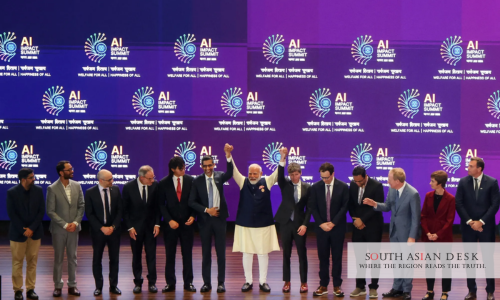
The New Delhi AI Summit concluded on February 21, 2026, with 70 countries signing a significant declaration aimed at shaping the future of AI governance. The Indian government anticipates this number to exceed 80 by the summit’s end on Saturday.
IT Minister Ashwini Vaishnaw highlighted the broad consensus achieved, stating that all major nations involved in AI development participated. The declaration, while not legally binding, serves as a framework for future AI policy and regulation.
Historically, this summit has garnered more signatories than previous ones held in Bletchley Park, Seoul, and Paris, which saw 30, 11, and 58 signatories respectively. Notably, the United States, which previously refrained from signing at the Paris Summit due to regulatory concerns, has endorsed the New Delhi declaration.
Key Highlights from the New Delhi AI Summit
The summit, described as a grand success by Vaishnaw, attracted over five lakh visitors and yielded investment commitments of $250 billion for infrastructure and $150 billion for deep-tech ventures. The vision of ‘MANAV AI’—AI for the people—was well received.
Looking ahead, India plans to launch India AI Mission 2.0, focusing on next-generation models and safety. The country aims to expand its GPU capacity to 100,000 by the end of 2026, marking a significant step in AI development.
Published in SouthAsianDesk, February 21st, 2026
Follow SouthAsianDesk on X, Instagram and Facebook for insights on business and current affairs from across South Asia.
