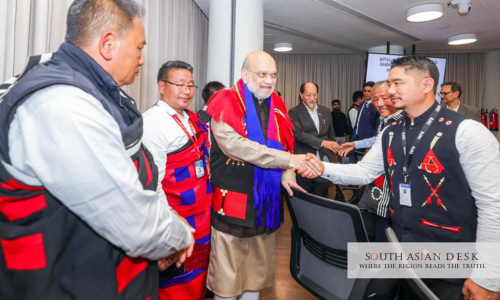
On February 5, 2026, the Indian government signed a significant tripartite agreement with the Nagaland government and the Eastern Nagaland Peoples’ Organisation (ENPO) to establish the Frontier Nagaland Territorial Authority (FNTA). This initiative grants substantial administrative and financial autonomy to six eastern districts, namely Kiphire, Longleng, Mon, Noklak, Shamator, and Tuensang.
The ENPO’s primary demand was for a separate state, a notion rooted in the historical context of British-era policies that left these regions as un-administered frontiers. This lack of governance fostered a developmental gap that persisted after Nagaland’s formation in 1963. The dissatisfaction among the eight Naga tribes in these districts grew, leading to a movement for independence from the perceived dominance of western Naga tribes.
The Indian government’s intervention was driven by strategic and political needs. Despite attempts to mollify the ENPO with a ₹500-crore package, the core political aspirations remained unaddressed. Tensions peaked in 2024 when the ENPO called for a boycott of the Lok Sabha elections, highlighting the region’s strategic importance as a buffer zone bordering Myanmar, where security risks are heightened by the presence of armed groups across the porous border.
Eastern Nagaland Autonomy and Its Historical Context
The FNTA is designed as a strategic solution to stabilize the frontier and align it with national interests. A mini-Secretariat will be established, led by a high-ranking officer to decentralize governance and reduce reliance on Kohima. The FNTA will have legislative and executive powers over 46 subjects, allowing local leaders to tailor decisions to tribal needs without altering Article 371(A) of the Constitution.
This model raises questions about its applicability to the Kuki-Zo community in Manipur, where demands for separate administration persist amid conflict. While the FNTA offers a middle ground between statehood and district administration, the situation in Manipur is complicated by ongoing tensions and lack of consensus among diverse groups.
Published in SouthAsianDesk, February 22nd, 2026
Follow SouthAsianDesk on X, Instagram and Facebook for insights on business and current affairs from across South Asia.