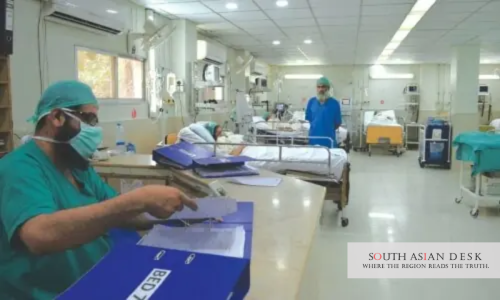
Pakistan budget 2026-27 health allocation has reached Rs53.3 billion across federal health projects including the Public Sector Development Programme, according to budget documents released on Saturday, though the Pakistan Medical Association has responded by declaring the country to be in a full-blown public health emergency driven by misplaced spending priorities and rampant inflation.
Of the Rs22 billion earmarked for the Ministry of National Health Services, Rs20.7 billion will be financed through domestic resources and Rs1.3 billion through foreign assistance. Under the PSDP, the government has proposed Rs24.3 billion for the health and nutrition sector, a notable increase on the previous fiscal year, when the health sector was initially allocated Rs16.5 billion and subsequently revised downward to Rs14 billion.
The health sector’s share of the overall social sector development budget stands at 2.2 per cent of the total Rs187.2 billion social sector allocation for FY2026-27.
Pakistan Budget 2026-27 Health Projects: Islamabad and Rawalpindi in Focus
Among the key projects included in the budget, the government has proposed Rs1.5 billion for cardiovascular research and disease prevention at the National Institute of Heart Diseases (NIHD) in Rawalpindi. A further Rs1 billion has been earmarked for the expansion and upgrading of the Armed Forces Institute of Cardiology and the NIHD, aimed at enhancing specialised cardiac care capacity in the twin cities.
The budget also includes initial funding for a significant longer-term infrastructure project. The National University of Medical Sciences has been allocated funds to acquire land from the Capital Development Authority for the establishment of a proposed medical city in Islamabad. The allocation covers only the land acquisition phase, with the broader development expected to unfold over subsequent fiscal years.
PMA Rejects Priorities, Warns of Systemic Collapse
Despite the overall increase in the headline figure, the Pakistan Medical Association issued a sharply critical response to the budget’s health provisions. PMA Secretary General Dr Abdul Ghafoor Shoro said the Rs53.3 billion allocation continued to favour visible infrastructure at the expense of the essential mechanisms needed to confront what he described as a silent, nationwide maternal and child nutrition crisis.
Dr Shoro highlighted several individual line items as evidence of structural neglect. The One Health Workforce Development programme has been allocated Rs99.9 million, a figure he described as negligible and one that leaves the country exposed to active disease threats including Mpox, measles, dengue, and polio. The Common Management Unit for tuberculosis, HIV/AIDS, and malaria has received Rs500 million despite Pakistan carrying one of the world’s heaviest tuberculosis burdens and an expanding hepatitis C epidemic estimated to affect 10 million people. The Drug Control Section has been allocated just Rs144 million.
Dr Shoro said that ongoing federal health schemes carry throw-forward liabilities exceeding Rs121 billion, effectively tying the hands of future policymakers and locking public capital into infrastructure projects for years to come. He added that approximately 70 per cent of healthcare resources were being directed towards brick-and-mortar operations and specialised tertiary care, with prevention, disease surveillance, and nutrition defence left largely unfunded.
“The reality on the ground remains catastrophic for the average citizen,” Dr Shoro said, “validating the medical fraternity’s long-standing warning that Pakistan’s healthcare infrastructure is entering a state of systemic collapse due to structural neglect.”
The PMA drew particular attention to the interaction between health spending and economic inflation, arguing that rising food prices were stripping families of the ability to afford basic nutrition at the same moment the federal government was choosing to concentrate its health resources on large capital projects rather than frontline disease prevention and public health systems.
Published in SouthAsianDesk, June 14, 2026
Follow SouthAsianDesk on X, Instagram and Facebook for insights on business and current affairs from across South Asia.