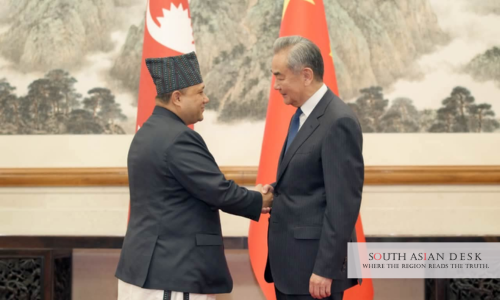
Foreign Minister Shisir Khanal’s visit to China in 2026 began on Saturday when he departed Kathmandu for Beijing on a four-day official trip at the invitation of Chinese Foreign Minister Wang Yi, arriving just one week after concluding his first bilateral visit to New Delhi in a deliberately sequenced diplomatic exercise that reflects the Rastriya Swatantra Party-led government’s effort to maintain equal footing with both of Nepal’s giant neighbours.
Khanal, visiting China from 14 to 17 June, is scheduled to hold bilateral talks with Wang Yi over dinner in Beijing and meet senior Communist Party of China leaders including Liu Haixing. Nepal’s Ministry of Foreign Affairs described the visit as an opportunity to discuss matters of mutual interest for “further strengthening Nepal-China relations and advancing deeper cooperation.”
Officials close to the minister said Khanal’s China visit in 2026 was partly aimed at addressing what Kathmandu characterises as misperceptions among sections of the Chinese leadership and policy circles about the foreign policy orientation of Nepal’s current government, which came to power under Prime Minister Balendra Shah on a platform explicitly positioned as a break from the country’s traditional political parties.
India First, Then China: The Sequencing That Says Everything
The decision to visit India before China is itself the most significant diplomatic signal of Khanal’s opening weeks as foreign minister. During his three-day New Delhi visit, Khanal met External Affairs Minister S Jaishankar and National Security Adviser Ajit Doval, covering development cooperation, connectivity, energy trade, transit arrangements, and people-to-people ties. The two sides concluded agreements including a cross-border digital payment systems arrangement.
Nepal’s India China foreign policy balance has long rested on the convention that New Delhi receives the first significant courtesy from any incoming Nepali government, an expectation grounded in the open border, centuries of shared religion and culture, and an economic interdependence that no infrastructure loan from Beijing can readily displace. By travelling to India first, the RSP-led government signalled its awareness of those conventions.
That said, senior RSP figures including Khanal and party president Rabi Lamichhane had told their Indian hosts that the new government does not carry the “baggage” of traditional Nepali parties, a framing intended to signal fresh thinking rather than ideological discontinuity. How the same language plays in Beijing, where some in the Chinese diplomatic establishment already hold concerns about Nepal’s current government tilting toward the West, will be closely watched.
BRI Projects, the Kerung to Kathmandu Railway and What Khanal Is Pushing For
The substantive agenda of Khanal’s China visit in 2026 centres on converting long-standing agreements into deliverable projects. Discussions in Beijing are expected to cover Nepal’s Belt and Road Initiative project portfolio, the Trans Himalayan Multi Dimensional Connectivity Network, and the status of the Kerung to Kathmandu railway, a flagship project included in successive bilateral frameworks but not yet advanced to construction.
Khanal is expected to press for what officials described as “tangible projects” rather than broad memoranda of understanding, and may seek revisions to the specific project lists agreed during then-Prime Minister KP Sharma Oli’s 2025 Beijing visit, reflecting the new government’s assessment of what is genuinely implementable within Nepal’s fiscal and technical constraints.
Former Nepali ambassador to China Krishna Prasad Oli has argued that Nepal should push, under the Trans Himalayan connectivity framework, for four cross-Himalayan corridors and two high-voltage transmission lines as its immediate priorities. Reducing Nepal’s persistent and widening trade deficit with China, improving the volume of Nepali exports entering the Chinese market, and developing cross-border movement and tourism infrastructure are also expected to feature in the talks.
Reassuring Beijing Without Abandoning Neutrality
A significant dimension of Khanal’s China visit in 2026 is reassurance. China has been watching Nepal’s new government cautiously, and Khanal is expected to reiterate Nepal’s commitment to the One-China policy, affirm that Nepali territory will not be used for activities against China, and restate an independent and non-aligned foreign policy. Before departing, he told the Chinese ambassador in Kathmandu that Nepal upholds “both the letter and spirit” of its constitution and foreign policy doctrine.
Nepal’s annual budget for 2026-27 states that the government will strengthen balanced foreign relations based on mutual benefit, national dignity, and sovereign interests. Prime Minister Shah has repeatedly said the government will adhere to Nepal’s longstanding principles of non-alignment. That framing allows the RSP-led administration to signal openness to both partners simultaneously without formally subordinating one relationship to the other, which is precisely what the Nepal equal distance policy demands in practice.
Whether applying an equal distance approach means revising the BRI project list to reflect genuinely Nepali priorities, or agreeing to the existing list to satisfy Beijing’s expectations, is one of the core decisions the Khanal China visit in 2026 may resolve.
What Nepal Can Realistically Expect from Each Neighbour
Nepal’s relationship with India rests on foundations that decades of Chinese infrastructure lending have not displaced: an open border, vast remittance flows, electricity export revenues, and a social fabric woven through shared pilgrimage routes and migration patterns. China offers something structurally different, the prospect of a second transit corridor through the Kerung to Kathmandu railway that would end Nepal’s landlocked dependence on Indian ports, but that project remains unbuilt after years of agreements and assessments.
The RSP-led government inherited a full BRI portfolio, an unfinished connectivity framework, and the political task of convincing both New Delhi and Beijing simultaneously that Kathmandu’s friendship is genuine and its neutrality is principled. Khanal’s paired visits, India then China, are the opening move in what will be a sustained and difficult balancing exercise, one in which the sequencing of meetings signals intent, but the delivery of concrete outcomes in infrastructure, trade, and investment will determine whether Nepal’s India China foreign policy balance is durable or merely diplomatic choreography.
Published in SouthAsianDesk, June 16, 2026
Follow SouthAsianDesk on X, Instagram and Facebook for insights on business and current affairs from across South Asia.