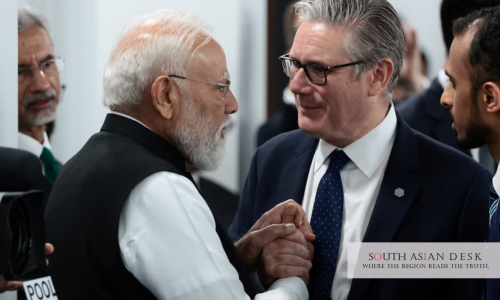
Evian, Wednesday, June 17, 2026 —The India UK Free Trade Agreement will enter into force on July 15, 2026, with Prime Minister Narendra Modi describing the landmark pact as a “historic milestone” for bilateral relations. The announcement came on the sidelines of the G7 Summit in Evian, France, where both Modi and British Prime Minister Keir Starmer are in attendance.
The British High Commissioner to India, Lindy Cameron, confirmed the implementation date on Wednesday, saying the countdown had begun and describing the development as “an historic moment for the modern UK-India partnership, unlocking a new era of growth for both our economies.”
Modi, posting on his X, said the agreement would “significantly boost bilateral trade and investment” and contribute meaningfully to India’s long-term development vision of Viksit Bharat 2047, unlocking opportunities for Indian farmers, workers, MSMEs, startups and innovators.
What the India UK Free Trade Agreement Delivers
The deal, officially known as the Comprehensive Economic and Trade Agreement (CETA), was signed in July 2025 during Modi’s visit to the United Kingdom and aims to boost bilateral trade between the two nations by GBP 25.5 billion annually. It is described as both India’s most comprehensive trade deal to date and the United Kingdom’s most economically significant bilateral agreement since leaving the European Union.
The agreement is forecast to boost the UK’s GDP by GBP 4.8 billion each year and has already secured over GBP 6 billion in new investment and export deals, supporting more than 2,200 British jobs across the country.
British workers are projected to gain a collective GBP 2.2 billion in annual wage uplift, with potential savings on a range of everyday goods including clothing, footwear, and food products.
Tariff Reductions Across Key Sectors
The deal includes substantial tariff reductions on goods such as textiles, whisky, and cars, making Indian exports more competitive in the UK market and vice versa. Indian businesses will gain greater access to the UK market, with the UK offering 99.1 percent of tariff lines covering 100 percent of trade value, mostly at zero duty immediately upon enforcement.
According to India’s Ministry of Commerce and Industry, 90.2 percent of India’s exports to the UK are set to become duty-free under the agreement. The trade pact further aims to expand market access, reduce tariffs, and double bilateral trade by 2030. Sectors set to benefit prominently include textiles, leather, footwear, sports goods, engineering, artificial intelligence, aerospace, and dairy products.
One of the landmark features of the agreement is its pioneering standalone financial services chapter, described as a significant first for India, which locks in long-term market access worth GBP 13.6 billion for UK financial services firms.
G7 Sidelines: India’s Multi-Alignment Paying Off
The Evian announcement forms part of a broader diplomatic moment for India at the G7. Modi noted that both he and Starmer were “naturally very happy with the significant momentum being added to economic ties,” speaking from the G7 venue.
Separately, an India-Canada joint statement issued following a bilateral meeting noted satisfaction with progress in negotiations towards a Comprehensive Economic Partnership Agreement and reaffirmed a shared objective of concluding those negotiations in 2026. European Commission and European Council leadership also indicated that the EU-India Free Trade Agreement is on track to be signed before the end of the year.
Talks on the UK-India pact were concluded in May 2025 after three years of stop-start negotiations, with both sides accelerating efforts to finalise the agreement against the backdrop of global tariff uncertainty.
Published in SouthAsianDesk, June 18, 2026
Follow SouthAsianDesk on X, Instagram and Facebook for insights on business and current affairs from across South Asia.