Pakistan urges restraint in US-Iran conflict as renewed fighting threatens to derail the diplomatic process Islamabad helped establish between Washington and Tehran.
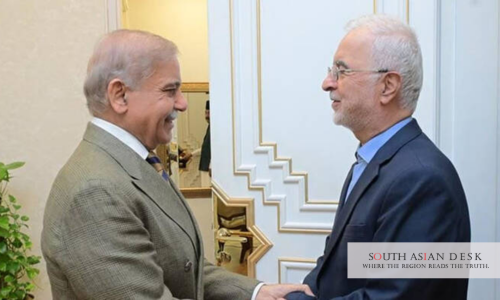
Prime Minister Shehbaz Sharif conveyed Pakistan’s concern over the latest escalation during a meeting with Iranian Interior Minister Eskandar Momeni in Islamabad on July 21.
Sharif urged all parties to avoid actions that could further destabilise the region and said Pakistan would continue acting as an “honest and sincere mediator and facilitator”, according to a statement issued by the Prime Minister’s Office.
The meeting formed part of Momeni’s official visit to Pakistan, which also included talks on regional security, border management, transport links and efforts to increase bilateral trade.
Momeni thanked Pakistan’s civilian and military leadership for its mediation efforts, which led to the Islamabad Memorandum of Understanding between Iran and the United States in June.
Pakistan urges restraint in US-Iran conflict
Sharif told the Iranian delegation that Pakistan remained committed to regional peace and stability despite the renewed military escalation in the Gulf.
The Prime Minister’s Office did not announce a new diplomatic initiative or provide a date for further talks between Washington and Tehran. It said Pakistan would continue its mediation and facilitation efforts.
Momeni expressed appreciation for the role played by Sharif, Deputy Prime Minister and Foreign Minister Ishaq Dar and Chief of Army Staff and Chief of Defence Forces Field Marshal Syed Asim Munir in facilitating the earlier agreement.
The Iranian minister also thanked Sharif for travelling to Tehran earlier in July to attend the funeral of Iran’s late supreme leader, Ayatollah Ali Khamenei.
Momeni said his delegation had travelled to Pakistan to strengthen bilateral relations. Senior Pakistani officials attending the meeting included Dar, Interior Minister Mohsin Naqvi, Information Minister Attaullah Tarar and Minister of State for Interior Talal Chaudhry.
Islamabad agreement faces renewed pressure
Pakistan’s current mediation effort is based on the Islamabad Memorandum of Understanding reached between Iran and the United States on June 17.
The agreement was intended to halt military operations and begin negotiations on a broader settlement. It established a maximum 60-day period for the parties to negotiate a final agreement, subject to an extension by mutual consent.
The document also addressed the passage of commercial vessels through the Strait of Hormuz, sanctions against Iran, the future of Tehran’s nuclear programme, Iranian oil exports and the release of frozen Iranian assets.
Its provisions included an undertaking by Iran and the United States to refrain from further military action against each other. It also called for an implementation mechanism to monitor compliance and resolve disputes.
The text published by the American Presidency Project was labelled as a draft document. Pakistan and Iran have nevertheless publicly referred to the Islamabad Memorandum of Understanding as the basis of the diplomatic process.
Switzerland talks established negotiating mechanism
Representatives of Iran and the United States subsequently met in Bürgenstock, Switzerland, on June 21, with Pakistan and Qatar participating as mediators.
A joint statement issued by Pakistan and Qatar after the meeting said the parties had established a high-level committee to provide political oversight of the negotiations.
Working groups were created to address nuclear issues, sanctions, monitoring and dispute resolution. A separate communication channel was also established to reduce the risk of incidents and misunderstandings affecting commercial shipping through the Strait of Hormuz.
The parties agreed on a roadmap aimed at reaching a final agreement within 60 days. Technical-level discussions were expected to continue after the first high-level meeting.
Renewed fighting has since interrupted the negotiating timetable. Pakistan has maintained that its diplomatic efforts have not ended, even though the ceasefire arrangements are under severe pressure.
Neither Iran nor the United States had formally notified the mediators that it was withdrawing from the agreement, according to regional officials cited by the Associated Press. However, officials acknowledged that the 60-day negotiating process had stalled.
Strait of Hormuz remains central dispute
Disagreements over the Strait of Hormuz have emerged as a major obstacle to the implementation of the memorandum.
The waterway connects the Persian Gulf with the Gulf of Oman and is a critical route for global oil and gas shipments.
The June memorandum called on Iran to make arrangements for the safe passage of commercial vessels without charge for 60 days. It also referred to the removal of technical and military obstacles and the restoration of commercial traffic.
The subsequent Pakistan-Qatar statement said a communication channel had been created specifically to reduce incidents and miscommunication involving shipping through the strait.
The United States and Iran have since presented differing interpretations of the arrangements governing commercial passage.
Iran has maintained that it retains authority to establish navigation arrangements in the strait, while the United States has called for vessels to be allowed to pass freely.
The dispute has contributed to renewed military action and wider concern about disruption to global energy supplies and maritime trade.
Momeni meets Pakistan’s military chief
Momeni also met Field Marshal Asim Munir at the General Headquarters in Rawalpindi.
The two officials discussed regional and bilateral security, effective border management and other matters of mutual interest, according to a statement attributed to the military’s media wing.
Momeni praised Pakistan’s diplomatic role in reducing regional tensions and encouraging de-escalation.
The meeting concluded with both sides reaffirming their intention to maintain close coordination and cooperative mechanisms for regional security and mutual economic interests.
No new security agreement or border management mechanism was announced following the meeting.
Iranian delegation seeks wider bilateral cooperation
Momeni arrived in Islamabad on July 20 at the head of a senior Iranian delegation.
The delegation included officials from Iran’s interior and foreign ministries, the Ministry of Roads and Urban Development, the Ministry of Agriculture, the Law Enforcement Command and the customs administration.
The composition of the delegation reflected a broader agenda extending beyond the US-Iran conflict.
Iranian officials said discussions would cover border cooperation, trade, transit, agriculture and economic relations. Momeni travelled to Pakistan at the invitation of Interior Minister Mohsin Naqvi.
Naqvi received Momeni on arrival and held an initial meeting with him. Pakistani officials said the visit was expected to strengthen bilateral relations, but no detailed agreements were announced after the first meeting.
Pakistan and Iran maintain $10bn trade target
Pakistan and Iran are also seeking to increase annual bilateral trade from about $3 billion to $10 billion.
Iranian officials have linked the target to President Masoud Pezeshkian’s directive to expand economic relations with Pakistan.
The discussions during Momeni’s visit were expected to cover border infrastructure, transport connections, customs cooperation and cargo movement.
Iranian officials have said stronger transit and cross-border infrastructure will be required to reach the $10 billion target. The target represents a stated objective rather than an achieved trade volume, and neither government has announced a firm deadline for reaching it.
Security concerns, insufficient transport infrastructure and restrictions affecting formal banking and trade have complicated economic relations between the neighbouring countries.
The presence of Iranian transport, agricultural, customs and law enforcement officials in Momeni’s delegation indicated that the two governments intended to discuss several of those operational issues.
No new trade agreement, financing package or infrastructure project was formally announced during Sharif’s meeting with Momeni.
Pakistan continues mediation despite stalled talks
Momeni’s visit came as Pakistan sought to keep diplomatic communication open while the US-Iran negotiating process remained stalled.
Islamabad’s official position is that the dispute must ultimately be resolved through negotiations and that further military escalation could destabilise the wider region.
The meetings in Islamabad confirmed that Pakistan and Iran remain in direct contact on the conflict, border security and bilateral trade.
They did not produce an announced date for renewed US-Iran negotiations or a revised timetable for implementing the Islamabad Memorandum of Understanding.
Pakistan’s immediate diplomatic position remains centred on restraint, de-escalation and the resumption of talks under the framework established in June.
Published in SouthAsianDesk, July 22, 2026
Follow SouthAsianDesk on X, Instagram and Facebook for insights on business and current affairs from across South Asia.