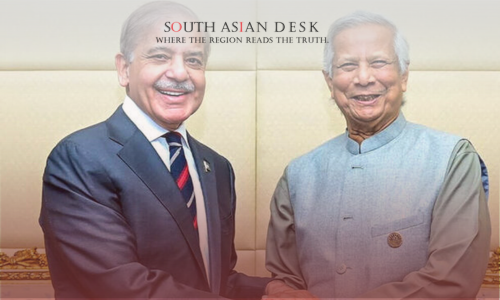
In the wake of the 2024 protests that led to the ousting of former Prime Minister Sheikh Hasina, Bangladesh has undergone a significant diplomatic realignment, fostering closer ties with Pakistan and China. This shift has strained relations with India, which has historically maintained strong influence in Dhaka due to its support during Bangladesh’s 1971 liberation war. The evolving geopolitical landscape in South Asia has sparked debates about regional stability and the balance of power.
The protests, initially sparked by demands to reform the public service quota system, escalated into a broader anti-government movement, culminating in Hasina’s removal. Her ousting, which India viewed as a setback due to her close alignment with New Delhi, prompted Bangladesh to pivot toward China and Pakistan. This realignment was evident in a June 2025 trilateral meeting in Kunming, China, where officials from Bangladesh, Pakistan, and China discussed forming a new regional grouping to enhance connectivity and cooperation, potentially as an alternative to the South Asian Association for Regional Cooperation (SAARC), which has been dormant since India’s boycott in 2016 over security concerns.
Bangladesh’s growing engagement with China includes exploring opportunities to join the China-Pakistan Economic Corridor (CPEC) and the Belt and Road Initiative, signaling a strategic move to diversify its economic and diplomatic partnerships. Posts on X reflect public sentiment, with some users noting Bangladesh’s acceptance of a joint China-Pakistan offer to integrate into these initiatives, further distancing itself from India’s sphere of influence.
India, wary of China’s expanding footprint in South Asia, has expressed concerns over Bangladesh’s warming ties with Pakistan, its long-standing rival. Tensions have been exacerbated by India’s decision to review the Ganges Water Sharing Treaty, set to expire in 2026, and its earlier suspension of the Indus Waters Treaty with Pakistan, signaling a broader reassessment of regional agreements. Additionally, India’s accusations of Pakistan’s involvement in militant activities, contrasted with Pakistan’s denials, have further complicated the regional dynamic.
Analysts, including regional expert Kabir, have advised Bangladesh to approach these new alliances cautiously, emphasizing the need for balanced multilateral relations to avoid deepening polarization ahead of the 2026 elections. Despite the shift, some cooperation with India persists, though the warmth in bilateral ties has noticeably faded.
This diplomatic pivot underscores Bangladesh’s attempt to assert greater autonomy in its foreign policy while navigating complex regional rivalries. As South Asia’s geopolitical landscape evolves, the implications of this trilateral axis could reshape economic and security dynamics, with smaller nations like Nepal and Sri Lanka also being courted by the China-Pakistan partnership.
Published in SouthAsianDesk, July 8th, 2025
Follow SouthAsianDesk on X, Instagram and Facebook for insights on business and current affairs from across South Asia.