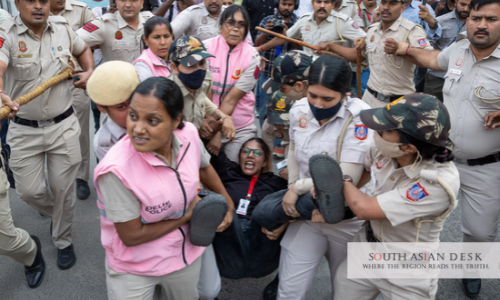
India’s Election Commission is under scrutiny for alleged voter roll manipulation, raising concerns about its impartiality. India’s Election Commission (ECI), a cornerstone of the nation’s democracy, is facing a severe test of its credibility amid allegations of voter fraud and electoral roll inconsistencies. On Friday, August 22, 2025, opposition parties, led by Congress leader Rahul Gandhi, escalated their criticism, accusing the ECI of colluding with the ruling Bharatiya Janata Party (BJP) to manipulate voter lists in Bihar ahead of state elections. The ECI has denied these claims, but public trust is waning, as evidenced by recent surveys.
Why This Matters in South Asia
The ECI’s credibility crisis has far-reaching implications for South Asia, where India serves as a democratic model. If trust in electoral processes erodes, it could undermine confidence in governance across the region, potentially destabilising democratic institutions in neighbouring countries like Pakistan and Bangladesh, where electoral integrity is already a contentious issue.
Allegations of Voter Roll Manipulation
The controversy centres on the ECI’s Special Intensive Revision (SIR) of electoral rolls in Bihar, conducted between June and July 2025. The revised draft, published on Thursday, August 1, 2025, omitted 6.5 million voters, prompting accusations of disenfranchisement.
Opposition leaders, including Rahul Gandhi, allege that the process disproportionately targeted migrant and marginalised voters, citing errors such as incorrect gender assignments and deceased individuals remaining on rolls. Gandhi, who launched a 16-day Voter Rights March in Bihar on 17th August, claimed over 100,000 fake voters were added in a Karnataka constituency during the 2024 general elections, based on ECI data. The ECI dismissed these allegations as “false and misleading,” asserting that the SIR was a routine update to remove duplicates and deceased voters.
Supreme Court Intervention
On Thursday, August 14, 2025, India’s Supreme Court ordered the ECI to publish a searchable list of excluded voters and provide reasons for their omission, highlighting “procedural failures.” The court’s directive followed reports of scanned physical voter lists, which opposition parties argued were difficult to verify independently. The ECI complied, but critics, including Congress MP Randeep Surjewala, accused the commission of “suppressing scrutiny” by delaying data release until after election results, a claim the ECI refuted in a press conference on Saturday, August 17, 2025.
Declining Public Trust
A Lokniti-CSDS survey, published in August 2025, revealed a sharp decline in public trust in the ECI. In Uttar Pradesh, distrust rose from 11% in 2019 to 31% in 2025. Across six surveyed states, the percentage of voters with “high trust” in the ECI plummeted, a trend Sanjay Kumar, director of CSDS, called “a big worry” for the commission. Former Chief Election Commissioner SY Quraishi, writing in the Indian Express, noted that “the perception of impartiality is as important as its reality,” urging the ECI to reinforce public confidence through transparency.
ECI’s Defence
Chief Election Commissioner Gyanesh Kumar, in a rare weekend press conference on Saturday, August 17, 2025, defended the ECI’s impartiality, stating, “When more than seven crore voters stand with the Election Commission, its credibility cannot be questioned.” Kumar cited a 2019 Supreme Court ruling to argue that machine-readable voter lists could violate privacy, challenging Gandhi to provide an affidavit proving his allegations or apologise. Critics, including Congress spokesperson Pawan Khera, described Kumar’s tone as “adversarial,” likening it to that of a BJP spokesperson.
Political Implications
The ECI’s credibility crisis is set to dominate Bihar’s upcoming state elections, with opposition parties vowing to make it a central campaign issue. Senior journalist Smita Gupta told BBC Hindi that the controversy “will definitely be an issue” in the polls. The BJP, led by Anurag Thakur, dismissed the allegations as “baseless,” attributing them to the opposition’s fear of electoral defeat.
Background
The ECI, established under Article 324 of India’s Constitution, has historically been lauded for conducting free and fair elections. Figures like T.N. Seshan (1990–1996) bolstered its reputation through robust reforms. However, recent years have seen growing accusations of bias, particularly over delayed responses to Model Code of Conduct violations and electoral roll revisions, eroding its once-unquestioned standing.
What’s Next
As Bihar’s elections approach, the ECI must address transparency concerns to restore its credibility. Implementing real-time voter data publication and independent oversight, as suggested by the Law Commission’s 255th Report, could rebuild trust. Failure to act risks further erosion of public faith in India’s electoral system, threatening the Election Commission’s legacy as a democratic pillar.
Published in SouthAsianDesk, August 23rd, 2025
Follow SouthAsianDesk on X, Instagram, and Facebook for insights on business and current affairs from across South Asia.