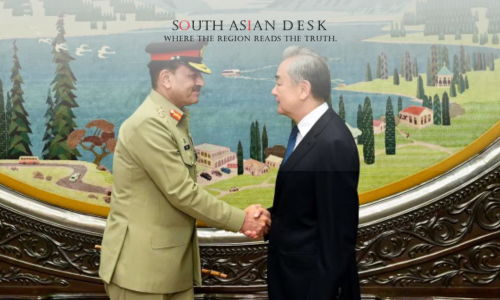
China pledges support for Pakistan’s national security during Foreign Minister Wang Yi’s visit to Islamabad. Beijing reaffirmed its support for Islamabad’s national security efforts on Wednesday, August 20, 2025, during Chinese Foreign Minister Wang Yi’s visit to Pakistan, where he met leaders to strengthen ties amid regional instability, according to China’s Foreign Ministry.
Why It Matters for South Asia
Beijing’s backing of Islamabad’s national security strengthens the China-Pakistan strategic partnership, a key geopolitical axis in South Asia. This support influences regional dynamics, particularly amid tensions with India, and underscores the importance of the China-Pakistan Economic Corridor (CPEC) for economic and security cooperation.
China’s Pledge to Pakistan’s Security
During his visit to Islamabad, Wang Yi met with President Asif Ali Zardari, Prime Minister Shehbaz Sharif, Army Chief General Asim Munir, and Foreign Minister Ishaq Dar. A statement from China’s Foreign Ministry on August 21, 2025, highlighted Beijing’s commitment to supporting Pakistan’s territorial integrity and national security. Wang praised the Pakistani military as a “ballast of national stability” and a defender of China-Pakistan friendship, noting its role in implementing agreements to deepen strategic trust and advance CPEC’s “Version 2.0.”
“China will continue to support Pakistan in safeguarding its territorial integrity and national security, and welcomes Pakistan to play a greater role in international affairs,” Wang stated, according to the Chinese Foreign Ministry. Pakistan’s leadership, including General Munir and Prime Minister Sharif, vowed to ensure the safety of Chinese citizens and projects, particularly those under CPEC, a USD 65 billion component of China’s Belt and Road Initiative.
Counterterrorism and CPEC Security
The visit follows a series of attacks on Chinese nationals in Pakistan, including an October 2024 car bombing in Karachi that killed two Chinese engineers. Beijing has expressed frustration over these incidents, pushing for enhanced security measures. Pakistan’s military committed to bolstering counterterrorism cooperation, with General Munir assuring efforts to protect Chinese personnel, projects, and institutions. A Chinese Foreign Ministry spokesperson on August 19, 2025, emphasized joint efforts to develop CPEC’s second phase, terming the China-Pakistan partnership “unbreakable.”
Pakistan’s Foreign Office, in a statement on August 21, 2025, reiterated its commitment to counterterrorism, noting ongoing dialogues with China to ensure CPEC’s safety. The discussions also addressed regional security, with Pakistan seeking Chinese assistance to improve intelligence and surveillance capabilities rather than allowing Chinese security personnel on the ground, as reported by Reuters on November 12, 2024.
Regional Geopolitical Context
Beijing’s support comes amid heightened regional tensions, particularly following the 2025 India-Pakistan conflict during Operation Sindoor. Indian officials alleged China provided Pakistan with real-time intelligence and 44 satellites to track Indian military movements, a claim Pakistan and China have not officially confirmed. Wang’s visit, which included a trilateral meeting with Afghan and Pakistani foreign ministers, aimed to extend CPEC into Afghanistan, highlighting Beijing’s broader regional ambitions.
Background
The China-Pakistan relationship, described as an “all-weather strategic partnership,” has deepened through CPEC since 2013, focusing on infrastructure, energy, and trade. However, security challenges, including attacks by the Baloch Liberation Army (BLA) on Chinese projects, have strained ties. Pakistan’s military maintains over 10,000 personnel, including two dedicated divisions, to protect CPEC assets. Beijing’s growing security concerns have led to proposals for joint security mechanisms, though Pakistan prefers technical assistance over direct Chinese involvement, as noted in a Reuters report on November 12, 2024.
China’s role as Pakistan’s largest defense supplier and its support on issues like Kashmir at the UN Security Council further cement bilateral ties. Pakistan’s economic reliance on China, including a USD 2 billion loan rollover in March 2025, underscores the strategic partnership’s importance amid Pakistan’s financial challenges.
What’s Next
Beijing and Islamabad are expected to deepen counterterrorism and security cooperation, potentially through joint military exercises like the planned Warrior-VIII drill in late November 2025. Strengthening CPEC security will remain a priority as both nations navigate the India-China water conflict and regional instability, ensuring Beijing’s continued support for Islamabad’s national security.
Published in SouthAsianDesk, August 25th, 2025
Follow SouthAsianDesk on X, Instagram, and Facebook for insights on business and current affairs from across South Asia.