HRSS seven demands urge Bangladesh to implement reforms to end enforced disappearances and ensure justice. On Thursday, August 28, 2025, the Human Rights Support Society (HRSS) announced seven demands to end enforced disappearances in Bangladesh at a National Press Club discussion in Dhaka, urging swift justice and systemic reforms ahead of the International Day of the Victims of Enforced Disappearance.
HRSS Seven Demands for Reform
The HRSS, led by Secretary General Muniruzzaman, presented a comprehensive set of demands to tackle enforced disappearances, a persistent human rights issue in Bangladesh. The primary demand calls for full implementation of the International Convention for the Protection of All Persons from Enforced Disappearance, which Bangladesh acceded to on August 29, 2024. Families of missing persons must be promptly informed of their relatives’ whereabouts, and each case requires thorough investigation with perpetrators facing exemplary punishment.
The organisation also demanded strengthening the independent commission established on August 27, 2024, under retired Justice Moinul Islam Chowdhury to investigate 1,752 cases, with 330 individuals still missing. HRSS seven demands urged making this commission permanent and effective, ensuring evidence preservation and victim protection. Additional demands include legal, financial, and psychological support for victims’ families, access to long-term missing persons’ bank accounts and assets, mandatory human rights training for law enforcement, and parliamentary oversight for accountability.
Voices for Justice and Accountability
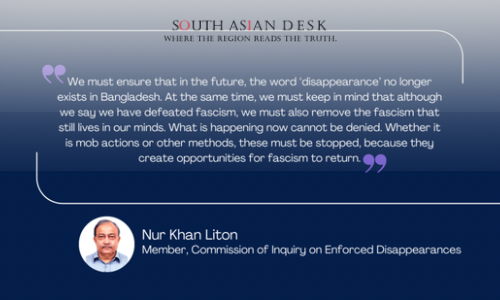
At the Dhaka event, Nur Khan Liton, a commission member, emphasised the need to eradicate the term “disappearance” from Bangladesh’s future. He stated, “We must ensure the word ‘disappearance’ no longer exists in Bangladesh,” highlighting the commission’s goal to clarify case statuses by December 2025. Barrister Sara Hossain, a human rights activist, underscored the systemic nature of the issue, saying, “This is not only the problem of one party or ideology. It is the problem of all.” She cautioned against rushed justice, warning that false implications would perpetuate injustice.
Huma Khan, from the UN High Commissioner for Human Rights, urged immediate action to alleviate families’ suffering, particularly on issues like accessing bank accounts and resolving fabricated charges. She criticised the draft Enforced Disappearance Prevention and Redress Ordinance 2025, noting its misalignment with international standards and the government’s rejection of UN technical assistance. “Harsh punishments alone are not a guarantee of justice,” Khan said, advocating for an impartial justice system over the death penalty, already applicable to 33 crimes in Bangladesh with low conviction rates.
Scale of Enforced Disappearances
Data from multiple sources underscores the crisis’s severity. HRSS reported 392 cases from 2015 to 2024, while Odhikar documented 708 cases from 2009 to June 2024. The International Federation for Human Rights noted 709 cases in the same period, with 471 individuals resurfacing, 83 found dead, and 155 still missing. Ain o Salish Kendra recorded 629 disappearances from 2007 to 2023. These figures highlight a systemic issue, often targeting political opponents and activists, with secret detention centres like the DGFI’s “Aynaghar” implicated in torture and isolation.
Background from HRSS Seven Demands
Enforced disappearances in Bangladesh surged under the Awami League’s rule from 2009 to 2024, with security forces like the Rapid Action Battalion (RAB) and Directorate General of Forces Intelligence (DGFI) frequently accused. The interim government’s formation of the inquiry commission and accession to the UN convention mark significant steps, but challenges like evidence destruction and institutional resistance persist.
What’s Next
The inquiry commission’s progress, due to conclude by December 2025, will be pivotal. The HRSS seven demands to end enforced disappearances in Bangladesh hinge on the government’s commitment to transparent investigations, legislative reforms, and international cooperation to ensure justice and prevent recurrence.
Published in SouthAsianDesk, August 29th, 2025
Follow SouthAsianDesk on X, Instagram, and Facebook for insights on business and current affairs from across South Asia.