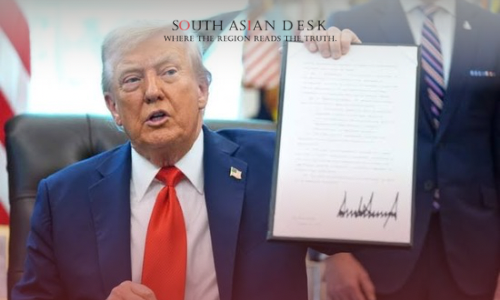
US President Donald Trump announced plans for an executive order mandating voter ID law for all elections, sparking debate.
Trump’s Voter ID Law Proposal
On Saturday,symptoms, August 31, 2025, US President Donald Trump declared via his Truth Social platform his intent to sign an executive order requiring voter identification for every vote in US elections, stating, “Voter I.D. Must Be Part of Every Single Vote. NO EXCEPTIONS!” The announcement, made at 10:08 AM PKT, aims to overhaul the US electoral system, citing unproven claims of widespread fraud in the 2020 election.
According to Trump on Truth Social, the order will also restrict mail-in voting and eliminate electronic voting machines.
Why It Matters
While the Trump voter ID law primarily targets US elections, its implications resonate in South Asia, where countries like India employ biometric voter identification. The policy could influence global discussions on election integrity, particularly in nations like Pakistan and India, where voter fraud concerns persist. South Asian democracies may observe the US approach to assess its applicability to their electoral systems.
Details of the Proposed Executive Order:
Voter ID Requirements
Trump’s proposed order mandates that every voter present government-issued identification, such as a US passport, REAL ID-compliant document, or military ID indicating citizenship. This follows his March 2025 executive order requiring proof of citizenship for voter registration.
The White House stated on Tuesday, March 26, 2025, that this aims to “protect the integrity of American elections” by preventing non-citizen voting, which is already illegal and rare. Critics argue this could disenfranchise millions, particularly those without easy access to such documents.
Restrictions on Voting Methods
The order seeks to limit mail-in voting to only those who are seriously ill or serving in the military abroad. Trump also advocates for paper ballots and hand counts, claiming electronic voting machines are less reliable. Election officials counter that hand counting is time-consuming, costly, and prone to errors. The order further directs that only ballots received by Election Day be counted, potentially affecting states with more flexible deadlines.
Legal and Practical Challenges
Legal experts question the president’s authority to enforce such changes, as the US Constitution delegates election oversight to Congress and states. A similar March 2025 order was largely blocked by a federal judge in June 2025, who ruled it exceeded executive powers. According to the Brennan Center for Justice, approximately 21.3 million US citizens lack readily available proof of citizenship, raising concerns about voter suppression, particularly among marginalized groups.
Background
Trump’s push for voter ID laws builds on long-standing Republican efforts to strengthen election security, often citing unverified claims of fraud. His 2020 election loss to Joe Biden fuelled these narratives, despite multiple investigations finding no significant fraud. In contrast, South Asian nations like India and Pakistan have implemented voter ID systems, with India tying voter IDs to a biometric database, a model Trump references.
However, South Asian systems also face criticism for accessibility issues, mirroring US concerns. In Pakistan, marginalized groups such as persons with disabilities, women, flood-affected individuals and nomadic communities face significant barriers to voter ID access and polling station entry. Many polling stations lack ramps or accessible entryways, making it difficult for wheelchair users to vote . Flood-affected voters in Sindh and Balochistan often lack valid CNICs and face damaged or distant polling facilities, further limiting participation
What’s Next
The proposed Trump voter ID law faces likely legal challenges, with states like Arizona already preparing lawsuits, arguing it infringes on state authority. The policy’s impact on the 2026 US midterm elections will depend on court rulings and state compliance. South Asian nations may monitor these developments to inform their own electoral reforms, balancing security with accessibility in the Trump voter ID law debate.
Published in SouthAsianDesk, August 31st, 2025
Follow SouthAsianDesk on X, Instagram, and Facebook for insights on business and current affairs from across South Asia.