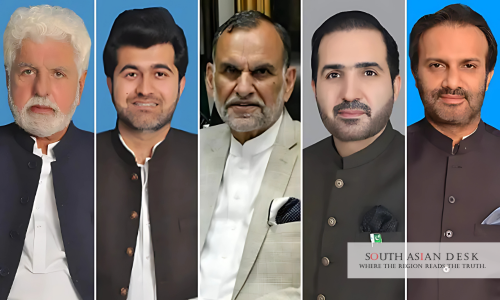
Several Pakistan Tehreek-e-Insaf (PTI) senators have stepped down from Senate standing committees, signalling escalating tensions within Pakistan’s political landscape amid ongoing legal challenges faced by the party’s leadership. Five PTI senators including Dost Muhammad, Zeeshan Khanzada, Mirza Muhammad Afridi, Muhammad Azam Khan Swati, and Aon Abbas Buppi—resigned from their Senate standing committees on Thursday, September 11, 2025, in Islamabad, following direct orders from incarcerated PTI founder Imran Khan, as a protest against perceived democratic erosion and the disqualification of party lawmakers.
This wave of PTI senators resignation 2025 underscores deepening political divisions in Pakistan, a key South Asian nation, potentially disrupting legislative oversight on critical issues like economic affairs and human rights, while highlighting broader concerns over judicial independence and electoral integrity that could influence regional stability.
Details of the Resignations
The resignations mark a significant escalation in PTI’s strategy to disengage from parliamentary processes, coming just weeks after similar actions in the National Assembly. According to reports, the senators cited Imran Khan’s instructions as the primary reason for their decision, framing it as a voluntary act of protest against the “disintegration of democratic norms” and the ongoing incarceration of their leader.
Imran Khan, who has been imprisoned since August 2023 at Adiala Jail in Rawalpindi, is serving a sentence in a £190 million corruption case and faces additional trials under the Anti-Terrorism Act related to the May 9, 2023, protests. The senators’ letters, as reviewed by multiple outlets, emphasise their inability to continue serving on committees while the state, in their view, undermines the rights these bodies are designed to protect.
In one such letter, Senator Muhammad Azam Khan Swati stated: “I can no longer in good conscience serve on Senate committees when the state is the foremost violator of the very rights and protections these committees are meant to safeguard.” He further criticised recent disqualifications of PTI lawmakers, attributing them to a “deeply flawed judgment” by Justice Qazi Faez Isa that stripped the party of its electoral symbol—the bat—and alleged abuses during the 2024 general elections involving Form-47. Swati described the resignation as “an act of protest” to uphold the party’s leadership, the law, and the Constitution of Pakistan.
Senators Zeeshan Khanzada and Dost Muhammad echoed similar sentiments, noting in their letters: “The deliberate denial of justice has compelled both him and myself to take this step as an expression of protest.” Meanwhile, Aon Abbas Buppi and Mirza Muhammad Afridi explicitly mentioned resigning in line with Imran Khan’s directions.
The affected committees span a wide range of portfolios, reflecting PTI’s previous influence in Senate oversight:
- Swati resigned from the cabinet secretariat, economic affairs, law and justice, national health services, regulation and coordination, and rules of procedure and privileges.
- Dost Muhammad stepped down from government assurances, human rights, national food security and research, poverty alleviation and social safety, and railways.
- Khanzada quit the overseas Pakistanis and human resource department, foreign affairs, finance, commerce, and privatisation.
- Afridi left commerce, federal education and professional training, inter-provincial coordination, industrial and production, and power.
- Buppi resigned from industries and production, poverty alleviation and social safety, religious affairs and interfaith harmony, defence production, and information and broadcasting.
This development follows a pattern observed in the lower house, where PTI claimed around 30 lawmakers resigned from parliamentary committees two weeks prior, though the National Assembly Secretariat confirmed only 20 such submissions.
Background
The PTI senators resignation 2025 is rooted in a series of events beginning with Imran Khan’s ouster in 2022 and intensifying after his arrest in 2023. Last month, on August 27, 2025, PTI lawmakers in the National Assembly began resigning from standing committees and chairmanships, prompted by the Election Commission of Pakistan’s (ECP) disqualifications of numerous party members and leaders in July and August 2025. These disqualifications stemmed from convictions related to the May 9, 2023, riots that erupted following Khan’s arrest, which PTI has described as a “false flag operation” to suppress the party.
Sources indicate that Khan issued directives for the Senate resignations on Wednesday, September 10, 2025, during interactions with party leaders, building on his earlier instructions for National Assembly members. This move aligns with PTI’s broader boycott of by-elections and parliamentary engagement, viewed as a refusal to legitimise what the party perceives as a flawed electoral and judicial system.
According to the Ministry of Information and Broadcasting, no official government statement has been issued yet on the Senate resignations, but parliamentary sources confirm the submissions have been received by the Senate Secretariat.
Implications for PTI and Parliament
The collective PTI senators resignation 2025 from these key committees could hamper the Senate’s ability to scrutinise government policies effectively, particularly in areas like finance, human rights, and foreign affairs. With PTI holding significant representation, the vacancies may lead to reassignments, potentially favouring the ruling coalition and altering the balance of power in legislative deliberations.
Party insiders suggest this is part of a larger strategy to pressure institutions for Khan’s release and fair trials, amid ongoing disqualifications that have sidelined figures like former opposition leaders Omar Ayub and Shibli Faraz. However, some analysts warn that such disengagement risks further isolating PTI, echoing past instances where mass resignations, like those from the National Assembly in 2022, yielded limited political gains.
As the dust settles on this latest round of PTI senators resignation 2025, the focus shifts to how the Senate will adapt and whether more lawmakers will follow suit in compliance with Imran Khan’s orders.
In the coming days, further PTI senators resignation 2025 actions could reshape Pakistan’s upper house dynamics, underscoring the party’s commitment to protest amid unresolved legal battles.
Published in SouthAsianDesk, September 11th, 2025
Follow SouthAsianDesk on X, Instagram, and Facebook for insights on business and current affairs from across South Asia.