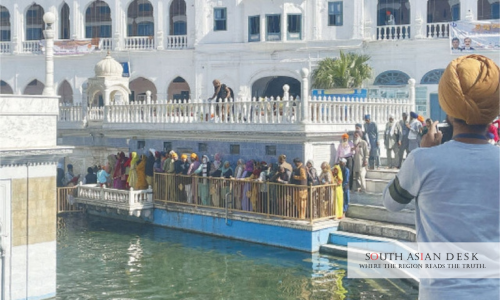
Over 2,100 Indian Sikh pilgrims returned to Gurdwara Punja Sahib on Friday for rituals marking the 556th birth anniversary of Guru Nanak, the first such crossing since deadly border clashes in May closed the Wagah route. The group, led by Shiromani Gurdwara Parbandhak Committee officials, arrived in Hassanabdal under tight security at 4:35 PM local time.
This event highlights renewed commitments to interfaith harmony and cultural ties between India and Pakistan. In South Asia, where geopolitical strains often disrupt minority rights and religious freedoms, the pilgrimage serves as a bridge for peace. It reaffirms Guru Nanak’s teachings of equality and brotherhood, drawing thousands amid calls for sustained border access.
Pakistan Border Reopening for Sikh Devotees Signals Thaw in Relations
Pakistan reopened the border for Sikh devotees on Tuesday, allowing the jatha to enter after a five-month suspension. The Evacuee Trust Property Board (ETPB) coordinated the 10-day tour, issuing over 2,400 visas to Indian applicants. Officials from the Pakistan Ministry of Religious Affairs confirmed the arrangements, including langar services and accommodation at state-run facilities.
The pilgrims, comprising families from Punjab, Haryana, and beyond, travelled by bus from Amritsar. Security forces lined the route, with no incidents reported. ETPB Chairman Syed Ata-ur-Rehman stated in a press note that the board allocated PKR 50 million for gurdwara upkeep this year, ensuring sites like Punja Sahib remain pristine for visitors.
Kuldeep Singh Gurgaj, leader of the Akal Takht contingent, praised the hospitality. “We receive respect and love here. The care for our holy places by the Pakistani government, especially the ETPB, is deeply appreciated,” he said upon arrival. His remarks echoed sentiments from over 500 overseas Sikhs who joined from the US, Canada, and Australia.
Guru Nanak Birth Anniversary Pilgrims from Pakistan Flock to Historic Site
Gurdwara Punja Sahib, nestled in the hills of Hassanabdal near Taxila, holds profound significance. Legend recounts Guru Nanak quelling a boulder with his hand during a 16th-century visit, leaving an imprint visible today. Devotees performed Akhand Paath recitations and Matha Tekna on Friday, followed by sacred bathing in the nearby stream.
Bibi Gurinder Kaur, a leader of the SGPC, addressed the congregation. “This land embodies the spirit of our Guru. It is as holy to us as Makkah and Madina to Muslims,” she declared. The gathering pledged adherence to Nanak’s principles of honest living and sharing, amid Shabad Kirtan performances that drew local Pakistani Sikhs.
Permeet Kaur, a pilgrim from Ludhiana, highlighted government support. “Pakistan invests millions yearly in decorating Sikh gurdwaras, unmatched elsewhere.” Tarnjeet Kaur, 62, from Amritsar, added a personal note. “Weeks ago, post-clashes, this seemed impossible. Now, it feels like a dream realised.”
Data from the Indian Ministry of External Affairs show that 2,100 visas were approved after the revocation of a post-conflict ban in October. The SGPC welcomed the decision, with President Harjinder Singh Dhami noting its importance for Sikh unity. “The birth anniversary of Sri Guru Nanak Sahib transcends borders,” he said in an official release.
India-Pakistan Sikh Pilgrimage 2025 Revives Suspended Traditions
The May 2025 clashes, which killed 47 along the Line of Control, prompted India to halt all cross-border pilgrimages. June events at Nankana Sahib and Kartarpur were cancelled, affecting 5,000 devotees. Diplomatic talks in October led to a reversal, with both nations agreeing to a visa-on-arrival policy for select groups.
ETPB records indicate Pakistan maintains 16 major gurdwaras, spending PKR 500 million annually on preservation. This year’s pilgrimage aligns with broader efforts, including the Kartarpur Corridor, which has seen 1.2 million visitors since its opening in 2019, despite ongoing tensions.
Dr Sardar Balvinder Singh, a community elder, urged further openings. “Normalised relations should extend the Kartarpur corridor fully.” Local authorities in Attock District reported an economic boost, with hotels booking at 80% capacity.
Pilgrims visited adjacent sites, such as Gurdwara Pari Sahib, reciting the Sukhmani Sahib. Evening sessions featured discussions on Nanak’s travels across undivided Punjab, fostering dialogues with Pakistani counterparts.
Background of Indian Sikh Pilgrims
Tensions peaked in May when artillery exchanges followed a terror attack in Pahalgam, Kashmir. India suspended the Indus Waters Treaty talks and pilgrimages, citing security. Pakistan denied involvement, blaming “non-state actors.” By September, backchannel diplomacy via neutral envoys eased restrictions.
The 1974 Protocol on Visits to Religious Shrines, renewed in 2023, underpins these exchanges. Past years saw 10,000 annual crossings; 2025 projections aim for recovery to 8,000.
ETPB’s role expanded post-2019, with digital visa portals reducing processing to 48 hours. SGPC data confirms 90% approval rates for Sikh jathas.
What’s Next: Sustaining the Momentum
The upcoming Baisakhi in April 2026 is expected to see 6,500 visas, according to figures from the Pakistan High Commission. Both governments eye full corridor extensions and joint heritage projects. Pilgrims depart on November 17, but calls grow for year-round access.
The Indian Sikh pilgrims’ return to Gurdwara Punja Sahib marks a vital step in the 2025 India-Pakistan Sikh pilgrimage, promising enduring cultural bonds.
Published in SouthAsianDesk, November 8th, 2025
Follow SouthAsianDesk on X, Instagram, and Facebook for insights on business and current affairs from across South Asia.