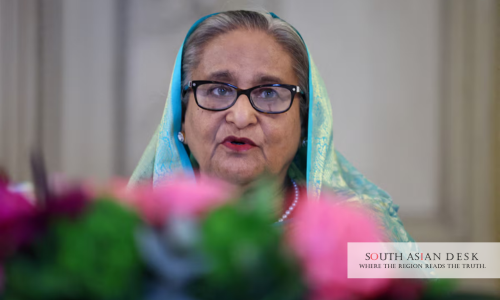
DHAKA, Bangladesh – A special tribunal on Monday sentenced ousted Prime Minister Sheikh Hasina death sentence for crimes against humanity linked to a brutal crackdown on student protests. The verdict, read at 4:35 PM local time, marks a dramatic turn in Bangladesh’s post-uprising politics. Hasina, who fled to India last year, faces execution in absentia. The ruling stems from orders that led to 1,400 deaths during the July-August 2024 unrest.
Tribunal Verdict Seals Hasina’s Fate
The International Crimes Tribunal (ICT) in Dhaka convicted Sheikh Hasina on charges of genocide and crimes against humanity. A panel of three judges, chaired by Justice Golam Mortuza Mozumder, delivered the verdict in the Bangladesh tribunal case against Hasina after a six-month trial. Prosecutors presented evidence of Hasina’s direct commands to security forces. These forces used lethal tactics, including helicopters and snipers, against unarmed demonstrators.
Witness testimonies described mass shootings and enforced disappearances. The court heard from over 50 survivors and families of victims. “The accused prime minister committed crimes against humanity by her order,” Justice Mozumder stated during the reading. No defence appeared for Hasina, who remains in exile. The sentence calls for hanging, Bangladesh’s standard method for capital punishment.
This outcome concludes a probe launched by the interim government under Chief Adviser Muhammad Yunus. Yunus assumed power after Hasina’s ouster in August 2024. The trial focused on the uprising that began as quota reform protests but escalated into a nationwide revolt. Security forces killed at least 1,400 people, according to a United Nations report from February 2025. Thousands more suffered injuries or arrests.
Awami League Shutdown Disrupts Nation
The Awami League, Hasina’s party, branded the Sheikh Hasina death sentence a “political witch hunt.” Supporters launched a nationwide shutdown in response. Protests erupted in Dhaka and Chittagong, resulting in clashes with the police. Demonstrators torched buses and hurled bombs at stations. No fatalities occurred by evening, but transport halted across major cities.
Sajeeb Wazed, Hasina’s son and adviser, warned of escalating violence. “Supporters will block February elections if the party ban persists,” he told Reuters. The Awami League faces a de facto ban under Yunus’s administration. Hasina herself dismissed the process in a recent interview. “The ICT is not justice; it’s revenge,” she said. Party leaders vowed to challenge the verdict internationally.
Authorities imposed shoot-to-kill orders in volatile areas. Soldiers and border guards patrolled the streets of Dhaka. Internet speeds slowed amid fears of coordination among protesters. The shutdown echoes the 2024 turmoil that led to the downfall of Hasina.
Hasina Extradition from India in Focus
Bangladesh now presses India for Hasina’s return. The interim government formally requested extradition months ago. New Delhi rejected it, citing insufficient evidence at the time. Officials plan renewed diplomatic efforts post-verdict. “We will pursue all channels to bring her to justice,” a foreign ministry spokesperson said.
Hasina arrived in India on August 5, 2024, hours after fleeing Dhaka by helicopter. She resides in a secure compound in Delhi. Ties between Dhaka and New Delhi soured since her exit. India views Hasina as a key ally in the fight against regional extremism. Yunus’s government accuses her of authoritarian rule. The extradition standoff tests bilateral relations, vital for trade and border security.
South Asia watches closely. Bangladesh shares a 4,096 km border with India. Any unrest risks triggering refugee flows and a surge in smuggling. Pakistan and China, as well as Hasina’s critics, may exploit these divisions.
Ripples Across South Asia
The Sheikh Hasina death sentence exposes fractures in Bangladesh’s democracy. It validates the 2024 uprising that ended 15 years of Awami League dominance. Yet, it risks civil strife, delaying Yunus’s reform agenda. For South Asia, stability hinges on calm transitions. India faces pressure to balance extradition demands with alliance legacies. Pakistan eyes opportunities amid Dhaka’s isolation. The verdict could ignite proxy conflicts or economic slumps in a region prone to volatility.
Background: The 2024 Uprising
Protests ignited in July 2024 over civil service job quotas favouring freedom fighters’ kin. Students demanded merit-based reforms. Hasina’s government labelled them “terrorists.” Police fired on crowds, killing hundreds. By August 1, the death toll hit 300. Military defections followed. On August 4, Hasina resigned and fled the country. Yunus, a Nobel laureate, formed the interim setup on August 8.
The crackdown drew global condemnation. Human Rights Watch documented 600 extrajudicial killings. Hasina’s regime suppressed the media and opposition. The Awami League won four consecutive elections amid claims of vote rigging. Her ouster ended that era.
Tribunal’s Role in Justice
The ICT, established in 2010, targets war crimes and atrocities. It previously convicted Islamist leaders in 1971. Critics call it biased against the opposition. Defenders praise its victim focus. This trial featured video evidence of orders from Hasina’s office. Co-accused, including former ministers, received life terms. Appeals loom, but enforcement depends on Hasina’s capture.
What’s Next for Hasina Verdict
Yunus pledged to hold elections by February 2026. The Awami League shutdown has tested that timeline. Protests could force delays. Dhaka renews extradition bids at upcoming SAARC forums. Hasina’s camp eyes UN appeals. India may host her indefinitely, citing humanitarian grounds. Bangladesh risks sanctions if violence surges. Regional powers urge restraint. The Sheikh Hasina death sentence hangs over a nation rebuilding from ashes, with extradition from India as the next flashpoint.
Published in SouthAsianDesk, November 17th, 2025
Follow SouthAsianDesk on X, Instagram, and Facebook for insights on business and current affairs from across South Asia.