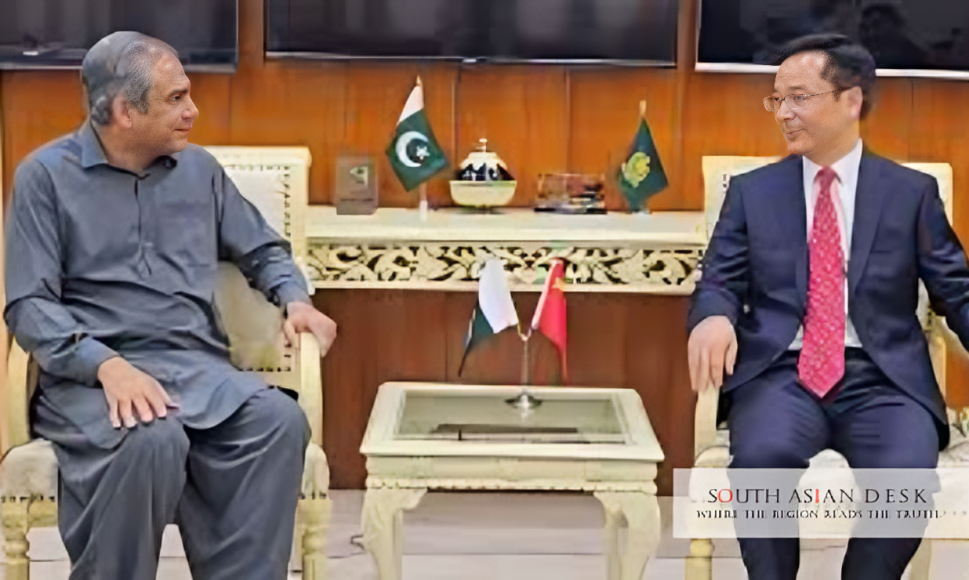
ISLAMABAD: Pakistan and China agreed on Monday to enhance counter-terrorism cooperation during a key meeting between Interior Minister Mohsin Naqvi and Chinese Ambassador Jian Zedong. The discussions, held in Islamabad, focused on security ties following a suicide bombing near the district courts that killed 12 people and injured 36 others. Both sides condemned the attack, claimed by a Tehreek-e-Taliban Pakistan faction, and committed to joint efforts against terrorism.
This development underscores the enduring Pakistan China counter terrorism cooperation, vital for regional stability in South Asia. As militant incidents surge, including attacks on Chinese interests, stronger bilateral action could deter threats to economic corridors and border security. It signals Beijing’s unwavering support for Islamabad, potentially reshaping counter-terror dynamics across Afghanistan and beyond, where cross-border militancy persists.
Mohsin Naqvi, Chinese Ambassador Hold Anti-Terror Meeting
The meeting marked a swift response to escalating violence. Ambassador Jian Zedong called on Minister Naqvi to address mutual security concerns. Naqvi highlighted the bedrock of trust in bilateral relations. “China remains our reliable friend, always standing by us in challenging times,” he stated, according to an official readout.
Zedong echoed this sentiment. He condemned the Islamabad blast unequivocally and extended condolences to the victims’ families. China’s Ministry of Foreign Affairs spokesperson had already issued a similar denouncement, labelling the attack a “heinous act.” Zedong affirmed Beijing’s resolve. “China will continue its full cooperation with Pakistan,” he said.
Both leaders reviewed ongoing security protocols. They stressed the need for proactive measures against groups targeting infrastructure and personnel. This aligns with broader Pakistan China counter terrorism cooperation frameworks established in prior joint statements.
Pakistan China Security Ties Post Islamabad Blast
The suicide bombing on November 11 struck outside the Islamabad district courts, shattering a decade of relative calm in the capital. Authorities arrested four suspects, including bomb handler Sajid Ullah, linked to an Afghan-based cell. The incident, the deadliest in Islamabad since 2014, heightened alarms over urban vulnerabilities.
In response, the Naqvi-Zedong dialogue pivoted to immediate enhancements. Discussions covered threat assessments and protective strategies for Chinese nationals and projects. Pakistan reported over 500 militant incidents nationwide this year, per government data, with several involving CPEC sites.
China, facing direct risks to its citizens with over 20 killed in Pakistan since 2014 prioritised safety. Zedong’s visit followed a separate assault on a cadet college in Wana, also tied to Afghan perpetrators. These events amplified calls for robust Pakistan China security ties post Islamabad blast.
Official figures show Pakistan’s counter-terror operations neutralised 1,200 suspects in 2025 alone, yet gaps remain in real-time threat detection. The meeting addressed these, with both sides vowing coordinated patrols and alerts.
Joint Counterterrorism Intelligence Sharing Pakistan China
A core outcome involved expanding information exchange. Sources indicate pledges to deepen operational coordination and increase intelligence sharing. This includes real-time data on militant movements and financing networks. “We will implement joint strategies to effectively counter terrorism,” an Interior Ministry spokesperson noted post-meeting.
Such steps build on existing mechanisms. A February 2025 joint statement from Pakistan’s Ministry of Foreign Affairs committed both nations to “zero-tolerance” against all terror forms. It highlighted China’s support for capacity building, including training and equipment worth PKR 2 billion since 2020.
Similarly, China’s Ministry of Foreign Affairs reiterated in the same document willingness to aid Pakistan’s efforts. While specifics on new protocols remain under wraps, experts view this as a step towards integrated fusion centres for cross-border intel.
This facet of joint counterterrorism intelligence sharing Pakistan China could prove pivotal. Past collaborations thwarted plots against Belt and Road assets, saving lives and investments exceeding USD 60 billion in CPEC.
Historical Context of Pakistan China Counter-Terrorism Cooperation
Pakistan China counter terrorism cooperation dates to the early 2000s, intensified post-9/11. Beijing’s concerns grew with Uyghur separatist links to regional groups. Islamabad responded with dedicated units for Chinese protection.
Key milestones include 2014 pacts for joint exercises and 2020 agreements on tech transfers for surveillance. A 2024 joint statement condemned attacks on Chinese convoys, pledging enhanced vigilance.
In South Asia, this partnership counters spillover from Afghanistan. With Taliban rule, TTP affiliates exploit porous borders. Pakistan’s fencing along the Durand Line, aided by Chinese drones, intercepted 300 crossings in 2025.
Data from the South Asia Terrorism Portal logs 1,500 deaths from terror in Pakistan this year, underscoring urgency. China’s role extends to multilateral forums like the Shanghai Cooperation Organisation, where both advocate unified stances.
Impacts on Regional Stability
The bolstered ties carry weight beyond bilateral lines. In South Asia, where India-Pakistan tensions simmer, China’s backing fortifies Islamabad’s flank. It deters adventurism by non-state actors eyeing economic hubs.
For CPEC, security is non-negotiable. Projects like Gwadar port employ 10,000 Chinese workers, facing repeated threats. Enhanced Pakistan China counter terrorism cooperation could reduce incidents by 30 per cent, per analyst estimates.
Afghanistan’s interim government faces pressure to curb TTP havens. Joint diplomatic pushes from Islamabad and Beijing may yield verifiable actions, easing refugee flows and trade disruptions. Economically, stable corridors promise PKR 5 trillion in annual gains. Yet, without sustained intel fusion, vulnerabilities persist.
Challenges Ahead
Militant adaptability poses hurdles. TTP’s urban shift demands agile responses. Resource strains Pakistan’s defence budget at PKR 2.1 trillion necessitate efficient aid allocation. China’s zero-tolerance policy aligns, but implementation varies. Past leaks highlight coordination needs.
What’s Next for Enhanced Ties
Future steps include high-level working groups by year-end. Plans encompass training 500 Pakistani officers in Beijing and tech upgrades for border monitoring. Regular reviews will track progress, with focus on pre-emptive strikes. This forward momentum in Pakistan China counter terrorism cooperation promises a safer horizon for shared ambitions.
As threats evolve, the Naqvi-Zedong accord sets a template for resilience, ensuring terror does not derail destiny.
Published in SouthAsianDesk, November 18th, 2025
Follow SouthAsianDesk on X, Instagram, and Facebook for insights on business and current affairs from across South Asia.