Pakistan faces an imminent failure to meet the Paris Agreement’s 1.5°C target as global warming nears critical thresholds, with the nation submitting updated Nationally Determined Contributions (NDCs) at COP30 in Brazil. This development, reported on Monday, August 25, 2025, at 4:35 PM, highlights vulnerabilities in South Asia’s most climate-hit country. Who: Federal government led by the Ministry of Climate Change. What: Submission of NDC 3.0 targeting emissions cuts. When: During COP30, November 2025. Where: Belém, Brazil. Why: To align with Paris goals amid rising risks. How: Through international pledges and domestic policy shifts.
Pakistan’s Climate Commitments 2025 Under Scrutiny
Pakistan submitted its third Nationally Determined Contribution (NDC 3.0) in September 2025, marking a step toward fulfilling obligations under the Paris Agreement. The document outlines mitigation and adaptation strategies across energy, agriculture, water, health, and industry sectors. It sets an unconditional target to reduce projected emissions by 15 percent by 2030, from a 2025 baseline of 2,124 million tonnes of CO2 equivalent (Mt CO2e). This equates to emissions of 1,805 Million Metric Tons of CO2 Equivalent.
A conditional target raises ambition to a 33 per cent reduction, or 1,280 MtCO2e, contingent on international grants, technology transfer, and capacity building. The plan estimates a total investment need of US$150 billion from 2025 to 2030 to implement these measures. “This trajectory underscores Pakistan’s commitment to substantially curbing its emissions while highlighting the crucial role of global cooperation,” states the NDC 3.0 document.
The Ministry of Climate Change and Environmental Coordination prepared the update in line with the Enhanced Transparency Framework of the Paris Agreement. It builds on the 2021 revised NDC, which aimed for a 50 percent cut by 2030—15 percent unconditional and 35 percent conditional. Progress reports indicate partial achievement, with the renewable energy share reaching 10 percent by 2024, short of the 30 percent interim goal.
At COP29 in 2024, Pakistan stressed equity and common but differentiated responsibilities. Officials opposed prescriptive measures on fossil fuels, arguing they contradict the Paris Agreement’s flexibility for developing nations. The country’s greenhouse gas inventory for 2024 shows emissions at 1,200 MtCO2e, up 5 percent from 2020, due to industrial growth and increased energy demands.
Pakistan 1.5 Degree Celsius Warming Risks Escalate
The current global warming stands at 1.34°C above pre-industrial levels, according to the World Meteorological Organization’s 2024 report. Pakistan, ranked eighth on the Climate Risk Index 2025, faces amplified threats. Projections indicate a national temperature rise of up to 5.3°C by 2100, exceeding the global average of 3.7°C.
Every fraction of a degree beyond 1.5°C amplifies risks. A 0.4°C overshoot could render northern glaciers irrecoverable, triggering glacial lake outburst floods (GLOFs). In 2025 alone, 13,000 glaciers in Gilgit-Baltistan and Khyber Pakhtunkhwa melted at an accelerated rate, displacing approximately 50,000 people in the Roshan Valley. The 2022 floods, linked to 1.2°C of warming, caused US$30 billion in damages and affected 33 million people.
Heatwaves have intensified, with 2025 recording a temperature of 52°C in Jacobabad, Sindh, leading to 1,200 heat-related deaths. Agriculture, which employs 42 percent of the workforce, suffers yield drops of 10-15 percent per degree of warming. Water scarcity looms, with per capita availability projected to fall to 860 cubic metres by 2025, potentially shifting Pakistan into a water-scarce status.
Sea-level rise threatens Karachi, where 1.2 million could be displaced by 2100. The UNEP’s Emissions Gap Report 2025 warns that current NDCs limit warming to 2.3-2.5°C, but Pakistan’s vulnerabilities demand stricter adherence to 1.5°C. “Exceeding the 1.5°C limit poses severe risks for Pakistan, where every fraction of a degree leads to loss of livelihoods, ecosystems, and lives,” notes analyst Mariam Saleh Khan.
Pakistan COP30 Paris Goals: Ambition Meets Reality
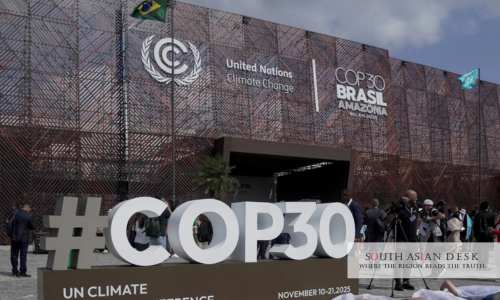
COP30 in Belém, Brazil, from November 10-21, 2025, focused on updating NDCs to align with Paris goals. Pakistan’s delegation, including Punjab Chief Minister Maryam Nawaz Sharif, presented provincial initiatives. “Punjab for Planet: From the Indus to the Amazon,” Sharif stated on X, emphasising resilience stories.
The conference saw 112 nations submit third-generation NDCs, targeting aggregate reductions from 2019 levels by 2035. However, analyses show an insufficiency of 1.5°C, requiring 60 percent cuts. Pakistan aligned with the Like-Minded Developing Countries (LMDC), advocating for grant-based finance in accordance with Article 9 of the Paris Agreement.
The Prime Minister’s office stated, “Pakistan remains committed to the Paris Agreement’s objectives, pursuing efforts to limit warming to 1.5°C through enhanced mitigation and adaptation.” This echoes the Ministry’s COP29 report, which rejected over-reliance on private finance.
Global progress includes US$2 trillion in annual clean energy investments, nearly double the amount invested in fossil fuels. Yet, emissions peaked without decline, making a 1.5°C overshoot inevitable without acceleration. For Pakistan, COP30 highlighted the operationalisation of the Loss and Damage Fund, with initial pledges of US$500 million.
Domestic barriers persist. Coal imports rose 20 per cent in 2024, locking in emissions. Rooftop solar adoption, aiming for 1 gigawatt by 2025, faces policy hurdles amid a PKR 2.5 trillion power sector debt. The National Climate Change Policy 2021 aims for 60 percent renewable energy by 2030, but implementation is lagging.
Background: A Decade of Paris Promises
The Paris Agreement, adopted in 2015, obliges nations to limit warming to well below 2°C, with the goal of pursuing 1.5°C. Pakistan ratified the Paris Agreement in 2016 as the 104th party, committing to the NDCs every five years. The initial 2016 NDC projected 1,600 MtCO2e by 2030 without action.
The 2021 update raised ambition amid 2022 floods, which PM Sharif called a “climate catastrophe.” Biennial Transparency Reports, submitted in June 2025, track progress, revealing 12 percent protected land coverage against a 15 percent goal.
Geopolitics influences stance. As an LMDC member, Pakistan prioritises the historical responsibilities of emitters. The International Court of Justice’s 2024 opinion lends support to these claims.
What’s Next: Pathways to 1.5°C Alignment
Pakistan must mobilize US$152 billion for NDC 3.0, according to UNDP estimates. Provincial plans, such as Punjab’s electric vehicle push to reach 30 per cent by 2030, offer models. International partners, including the UN and World Bank, pledge technical aid.
Experts urge reclaiming leadership. “The path to safety lies not in compensation alone, but in mitigation and collective emission reductions,” Khan writes. By 2030, annual NDC reviews will be resolved.
A failure of the Paris Agreement to limit global warming to 1.5°C would have cascading effects across South Asia. Still, a renewed focus on Pakistan’s climate commitments for 2025 offers hope for a reversal.
Published in SouthAsianDesk, November 19th, 2025
Follow SouthAsianDesk on X, Instagram, and Facebook for insights on business and current affairs from across South Asia.