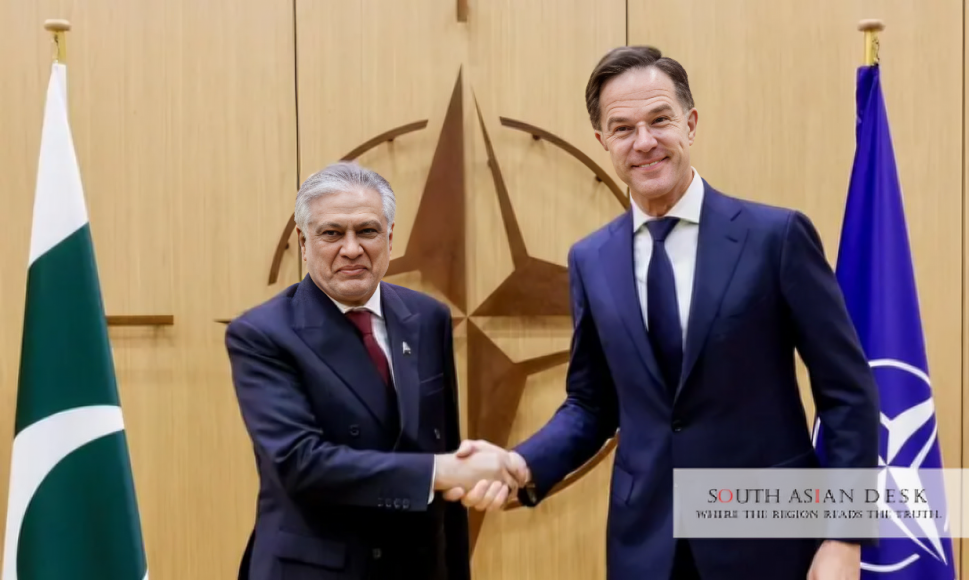
Pakistan’s Deputy Prime Minister and Foreign Minister Ishaq Dar met NATO Chief and Secretary General Mark Rutte in Brussels on Thursday, November 20, 2025, to discuss ways to advance Pakistan NATO closer security cooperation. The session at NATO headquarters addressed counterterrorism, regional stability, and global challenges. Officials from both sides attended. This marked the first such high-level dialogue since 2021. The talks highlighted potential for a stronger Pakistan NATO defence partnership.
The encounter underscores Pakistan’s strategic push to realign international partnerships in a volatile South Asian landscape. With militancy resurging along borders and geopolitical tensions escalating, deeper ties with NATO could bolster Islamabad’s counterterrorism capabilities and open doors to enhanced intelligence sharing. For South Asia, where instability spills across frontiers, this signals a pragmatic shift towards multilateral engagement, potentially easing pressures on bilateral relations strained by recent events. It matters because Pakistan’s role as a frontline state against extremism directly impacts regional trade routes, migration flows, and nuclear security dynamics.
Dar-Rutte Brussels Talks Focus on Counterterrorism Priorities
Ishaq Dar meets NATO chief Rutte to explore avenues for Pakistan NATO closer security cooperation, with counterterrorism at the forefront. The discussions delved into shared threats, including the resurgence of militant groups in Afghanistan and border regions. Dar emphasised Pakistan’s frontline role in combating terrorism, noting that over 80,000 lives have been lost since 2001 in related violence. He reiterated that the primary sources of militancy originate from external actors, a point echoed in prior official briefings.
Rutte acknowledged these sacrifices during the meeting. “Pakistan’s contributions to regional peace and stability are vital, and its counterterrorism efforts deserve recognition,” he stated in a post-meeting remark shared via NATO’s official channels. This aligns with NATO’s broader strategy to counter transnational threats, where South Asian inputs provide critical intelligence on networks linked to European security concerns.
The Brussels talks also touched on climate change impacts, which exacerbate instability in vulnerable areas. Pakistan, facing annual floods displacing millions, sees overlaps between environmental resilience and security. Both leaders agreed that integrated approaches could yield mutual benefits, such as joint capacity-building programmes.
Expanding Pakistan NATO Defence Partnership
A core element of Ishaq Dar meets NATO chief Rutte was the push for a robust Pakistan NATO defence partnership. Officials reviewed existing frameworks, including Pakistan’s historical role in NATO-led operations in Afghanistan until 2021. Dar highlighted ongoing military exchanges and training initiatives, which have trained over 5,000 personnel in recent years through NATO’s partnership tools.
Rutte expressed interest in revitalising these channels. “European and South Asian security are intertwined; close cooperation is essential for stability and prosperity,” he noted. This statement, posted on NATO’s X account following the session, underscores the alliance’s view of Pakistan as a key non-member partner.
Data from Pakistan’s Ministry of Foreign Affairs indicates that bilateral engagements have increased by 25% since early 2025, focusing on cybersecurity and maritime security. These efforts aim to address gaps in defence technology transfers, where NATO standards could enhance Pakistan’s interoperability with international forces. The talks signalled intent to formalise a new memorandum on defence collaboration, though specifics remain under negotiation.
In the context of South Asia, this Pakistan NATO defence partnership holds implications for balancing regional power dynamics. As India deepens ties with Quad partners, Pakistan seeks diversified alliances to safeguard its interests. Enhanced cooperation could facilitate access to advanced surveillance tools, crucial for monitoring porous borders spanning 2,600 km with Afghanistan.
Historical Context of Pakistan-NATO Relations
Pakistan joined NATO’s Partnership for Peace programme in 2015, fostering dialogue on security issues. Prior to Ishaq Dar meets NATO chief Rutte, the last major interaction occurred in 2021 between then-Foreign Minister Shah Mahmood Qureshi and former NATO Secretary General Jens Stoltenberg. That meeting laid groundwork for counterterrorism information sharing, which has since prevented several plots targeting European assets, according to declassified reports.
Tensions arose post-2021 Afghanistan withdrawal, with accusations of safe havens on Pakistani soil. However, recent diplomatic resets have prioritised pragmatism. The current administration under Prime Minister Shehbaz Sharif has prioritised economic recovery alongside security, viewing NATO as a bridge to Western aid. In 2024, Pakistan received EUR 150 million in humanitarian assistance channelled through NATO partners, underscoring the tangible benefits of sustained engagement.
Dar’s three-day Brussels visit, starting Wednesday, November 20, 2025, also included sideline meetings with EU officials on trade. This multifaceted diplomacy reflects Islamabad’s strategy to leverage security credentials for broader geopolitical leverage.
Challenges in Dar-Rutte Brussels Talks Counterterrorism Agenda
Despite optimism, hurdles persist in Dar-Rutte Brussels talks counterterrorism efforts. Divergent views on Afghanistan’s Taliban regime complicate joint operations. Pakistan advocates conditional engagement, while NATO maintains sanctions. Dar pressed for unified pressure on Kabul to dismantle terror sanctuaries, citing a 40% uptick in cross-border incidents in 2025.
Rutte committed to relaying these concerns to allies but stopped short of new pledges. Official readouts from Pakistan’s Foreign Office note agreement on enhanced intelligence fusion centres, potentially operational by mid-2026. Such centres could process data from drones and satellite feeds, improving response times to threats.
Broader geopolitical factors, including US-Pakistan relations amid South Asian instability, influenced the discourse. With Washington pivoting to Indo-Pacific strategies, NATO serves as a neutral forum for sustained dialogue. Analysts note that without progress here, Pakistan risks isolation in global counterterrorism financing forums.
Implications for South Asian Stability
The Ishaq Dar meets NATO chief Rutte dialogue extends beyond bilateral gains, influencing South Asia’s security architecture. Neighbouring countries monitor these developments closely, as stronger Pakistan NATO closer security cooperation could deter adventurism along disputed frontiers. It also aligns with UN resolutions on countering financing of terrorism, where Pakistan’s compliance has improved, lifting FATF grey-list status in 2024.
Economically, a fortified Pakistan NATO defence partnership might unlock defence exports worth PKR 50 billion annually, diversifying from traditional markets. Climate-security linkages, discussed in the talks, address how disasters fuel recruitment into extremist ranks, a phenomenon witnessed in 2022 floods that displaced 33 million.
What’s Next for Pakistan-NATO Engagement
Looking ahead, follow-up mechanisms from Ishaq Dar meets NATO chief Rutte include a joint working group on counterterrorism, slated for convening in Islamabad by Q1 2026. This could culminate in a comprehensive security pact, enhancing training and equipment sharing. Dar affirmed Pakistan’s readiness to host NATO experts for on-ground assessments, signalling proactive intent.
In a region fraught with uncertainty, these steps promise incremental progress towards a more secure South Asia.
Published in SouthAsianDesk, November 21st, 2025
Follow SouthAsianDesk on X, Instagram, and Facebook for insights on business and current affairs from across South Asia.