Dhaka earthquake vulnerability 95% unplanned buildings surfaced starkly after a 5.7-magnitude earthquake struck near the capital on Friday, November 21, 2025, killing 10 people and injuring over 100. The shallow quake, centred in Madhabdi 13km from Agargaon, rattled structures across Dhaka and districts like Narsingdi. Bangladesh Meteorological Department recorded it at 10km depth along the Burma-Indian Plate boundary. Aftershocks followed, including a 3.3-magnitude event. Rajuk officials inspected over 50 damaged sites by Monday.
Experts Warn Dhaka Major Quake Disaster After Recent Tremors
Experts warn Dhaka major quake disaster looms large. The November 21 event unlocked pent-up tectonic stress but released only a fraction of stored energy. Dr Syed Humayun Akhter, a geologist, stated: “This plate boundary had been locked for many years. The magnitude-5.7 event has unlocked it.” He added: “We are fortunate the quake was not magnitude 7 or 7.5. But such a major earthquake may happen in the near future.” Rubaiyat Kabir, acting head of Bangladesh Meteorological Department, noted: “This region has a history of large earthquakes. A major quake can occur at any time, but predicting the exact moment is impossible.”
Dhaka’s position near the Indian, Burmese, and Eurasian plates heightens risks. Subsurface soft sedimentary rocks amplify shaking. Md Mominul Islam, director at the department, explained: “Dhaka’s weak soil prolongs shaking.” The quake caused cracks in mid-rise buildings and wall collapses in areas like Rupganj, Narayanganj. Fire services reported three deaths from a roof railing fall in Old Dhaka’s Kasaituli. Hospitals treated injuries from falls during evacuations.
Rajuk data underscores the peril. The agency identified 3,382 illegal or non-compliant structures. A 2024 Urban Resilience Project study, funded by the World Bank, projects 864,619 to 1,391,685 buildings collapsing in a 6.9-magnitude event along the Madhupur Fault. This equals 40.28% to 64.83% of Dhaka’s 2.145 million buildings. Over 75,000 high-rises lack minimum standards. Between 2006 and 2016, 95,000 structures rose annually, but only 4,147 gained Rajuk approval, confirming 95.36% unauthorised.
Bangladesh Building Safety Earthquake Risks Exposed in Capital
Bangladesh building safety earthquake risks dominate discussions post-quake. Dhaka tops global vulnerability lists per earthquake disaster risk indices. A Housing and Building Research Institute study classifies 56.26% of concrete buildings as high-risk and 36.87% as medium-risk. Old Dhaka’s narrow lanes and congested multistoreys amplify threats. Dr Md Zillur Rahman, professor at Dhaka University, said: “Properly constructed buildings should withstand earthquakes of magnitude 7-7.5.”
Rajuk Chairman Engineer Md Riazul Islam inspected sites in Armanitola, Mugda, and Badda on Saturday. He ordered a risky Armanitola building sealed if owners miss a seven-day deadline for design submission. “This earthquake was a warning for us,” Islam stated. “If we do not remain vigilant, a major disaster awaits. Lists of earthquake-damaged buildings are being prepared.” The agency confirmed over 50 tilts or major cracks, with numbers rising. In 2022, Rajuk flagged 42 buildings for immediate demolition and 187 for retrofitting, many government-owned.
Enforcement gaps persist. Sophisticated World Bank equipment worth hundreds of crores sits unused due to bureaucracy. Md Nurul Islam, Rajuk chief engineer, said teams now monitor new high-rises for Bangladesh National Building Code compliance. Yet, vested interests manipulate approvals, per urban planners. Gas leaks could spark fires, ruptured lines disrupt water, and blocked roads hinder rescues. Shortage of open spaces cripples evacuations.
Unplanned Structures Dhaka Seismic Threat in High-Density Zones
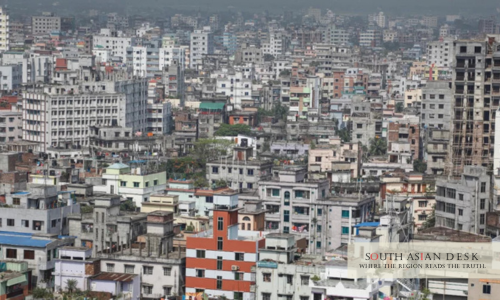
Unplanned structures Dhaka seismic threat stems from decades of lax oversight. Dhaka hosts 21.45 lakh buildings, with over 8 lakh (40%) at collapse risk in a magnitude-7 quake. The 5.7 event, the strongest in decades, caused a newborn’s death from a Rupganj wall collapse and panic evacuations in Gazipur garment factories. Dr Anwar Hossain Bhuiyan warned: “When the natural frequency of the ground matches the vibration frequency of buildings, the effects are devastating.”
Md Abdul Latif Helali, former Rajuk chief engineer, said: “A magnitude-5.7 earthquake already caused cracks in many buildings. A magnitude-7 quake would create unimaginable devastation.” M Shamimuzzaman Bosunia added: “Gas and electricity lines will ignite fires. Water and sewage systems will collapse. Survivors won’t even find a safe route to evacuate. Dhaka will become unliveable.” Areas like Bashundhara face extra peril from soft soil.
The first 72 hours post-quake prove critical. Ali Ahmed Khan urged: “More trained volunteers are urgently needed. Hospitals must have adequate emergency facilities and blood bank reserves.” Prof Mehedi Ahmed Ansary projected a magnitude-6 quake could flatten widespread structures. A 2018-2022 Rajuk survey estimates a Madhupur Fault rupture at 6.9 magnitude would kill over 200,000 and injure another 200,000.
Seismic Perils Echo Across South Asia’s Urban Centres
Dhaka earthquake vulnerability 95% unplanned buildings signals broader South Asian woes. Rapid urbanisation in megacities like Mumbai, Kathmandu, and Islamabad mirrors Dhaka’s code violations and informal settlements. Nepal’s 2015 magnitude-7.8 quake killed nearly 9,000, exposing retrofitting needs. Pakistan’s 2005 Kashmir tremor claimed 87,000 lives amid weak structures. India’s Gujarat 2001 event levelled 400,000 homes. These cases highlight shared tectonic exposure along Himalayan belts. Unplanned growth strains resources, delays responses, and inflates casualties. Regional cooperation on building norms could avert repeats, safeguarding 1.8 billion residents from economic fallout estimated at billions in damages.
Background: Tectonic History and Code Evolution in Bangladesh
Bangladesh records 20 quakes from 2015 to 2025, per Meteorological Department data. The 2023 Ramganj magnitude-5.5 ranked second to Friday’s. The Madhupur Fault, spanning 100km across Tangail, Gazipur, and Dhaka, drives local threats. Dhaka’s 5.14 lakh concrete structures sit on amplifying sediments.
The Bangladesh National Building Code, updated in 2020, mandates seismic designs, but compliance hovers low. Rajuk’s Detailed Area Plan aimed to curb encroachments, yet 90% of pre-existing builds lack resilience. World Bank allocated $180 million for preparedness, but utilisation lags. In 2010 and 2016, Rajuk listed risky sites, but actions stalled on government properties like universities and hospitals.
Urban density exacerbates issues. Dhaka’s 20 million residents navigate narrow roads and informal clusters. Mid-rise 4-8 storey blocks, common in Malibagh and Mohammadpur, vibrate most in shallow quakes. Prof Ansary classifies structures as weak (red), moderately weak (yellow), or strong (green) for triage.
What’s Next: Audits, Retrofitting, and Regional Drills
Rajuk forms an independent trust with Public Works Secretary as chair to deploy unused gear for risk mapping. Colour-coding rolls out using international tech. Officials eye third-party verifications and occupancy certificates post-inspection. Dr Akhter predicts no exact timing, but vigilance rises. Training expands for volunteers and hospitals. A white paper on corruption may emerge. Bangladesh building safety earthquake risks demand swift audits to shield unplanned structures Dhaka seismic threat.
Dhaka earthquake vulnerability 95% unplanned buildings demands action before the next jolt turns warnings into wreckage.
Published in SouthAsianDesk, November 23rd, 2025
Follow SouthAsianDesk on X, Instagram, and Facebook for insights on business and current affairs from across South Asia.