

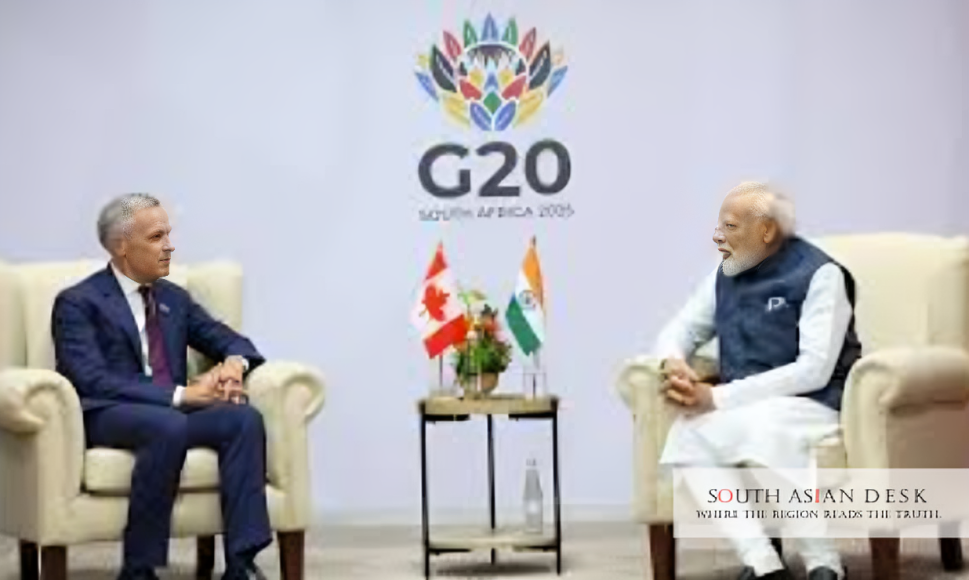
India-Canada trade talks resume negotiations for a comprehensive trade pact, Prime Ministers Mark Carney and Narendra Modi announced on the sidelines of the G20 summit in Johannesburg on 23 November. The move follows a two-year pause triggered by a diplomatic dispute and aims to double bilateral trade volumes.
This development signals renewed economic engagement between the two nations, offering South Asia expanded access to Canadian markets in services and resources. It could bolster India’s position as a global trade hub while diversifying Canada’s partnerships beyond North America, fostering stability in regional supply chains.
Modi-Carney Trade Agreement Takes Shape at G20
Prime Minister Mark Carney of Canada held a bilateral meeting with Prime Minister Narendra Modi of India during the G20 summit in Johannesburg, South Africa. The leaders focused on revitalising economic ties strained since 2023.
The Indian Prime Minister’s Office issued a statement confirming the agreement to launch talks on a high-ambition Comprehensive Economic Partnership Agreement. This pact seeks to enhance trade flows and investment opportunities.
Carney shared his perspective on the platform X, stating that the discussions marked the start of negotiations for a deal to more than double bilateral trade to over C$70 billion. He highlighted India’s status as the world’s fifth-largest economy and the potential benefits for Canadian workers and businesses.
Both leaders reaffirmed commitments to longstanding civil nuclear cooperation. They noted progress in discussions around expanding collaboration, including long-term uranium supply arrangements.
The meeting underscores Carney’s broader strategy to strengthen trade relations outside traditional partners. He has pledged to double Canada’s non-U.S. exports over the next decade, viewing India as a key pillar in this effort.
Earlier that day, Carney described India as a reliable trading partner. He acknowledged possible areas of friction but emphasised the strength of the existing commercial relationship. Scaling it up through a structured agreement would provide protections for businesses on both sides, along with clear rules and dispute resolution mechanisms.
CEPA Negotiations Resume After 2023 Setback
The restart of the CEPA negotiations resume comes after a suspension in 2023, when Canada halted broad trade pact discussions. This followed Ottawa’s allegations linking the Indian government to the killing of a Canadian Sikh separatist. New Delhi has consistently denied any involvement.
Despite the tensions, bilateral trade has continued to grow. In 2024, two-way goods and services trade reached about C$31 billion, equivalent to $21.98 billion. Canada holds a surplus, driven by C$16 billion in services exports. Experts note that this volume remains modest compared to India’s economic scale. For context, Canada’s total trade with China was nearly four times larger in the same year.
The G20 discussions build on earlier progress. Relations began to thaw following a Modi-Carney meeting on the sidelines of the G7 summit in Kananaskis, Alberta, in June. That encounter laid groundwork for renewed dialogue.
Carney’s engagement extends beyond India. At the same G20 summit, he met Brazilian President Luiz Inácio Lula da Silva. The two agreed to accelerate negotiations on a Canada-Mercosur free trade agreement, covering Brazil, Argentina, Paraguay, and Uruguay.
These steps reflect a concerted push to diversify trade networks. For Canada, reducing reliance on the U.S. market is a priority. For India, deeper ties with resource-rich nations like Canada promise steady supplies for energy and industrial needs.
India-Canada Trade Talks Goal Set for 2030
The core of the Modi-Carney trade agreement centres on ambitious targets. The proposed CEPA aims to double bilateral trade to USD 50 billion by 2030. This would represent a significant leap from current levels and align with both nations’ growth strategies. Trade experts anticipate gains in sectors like services, agriculture, and energy. Canada’s strengths in natural resources could complement India’s manufacturing and technology base.
Bilateral trade has shown resilience amid diplomatic challenges. The 2024 figures demonstrate steady expansion, even without a formal pact. Services dominate Canada’s exports, underscoring the potential for knowledge-based exchanges.
The leaders’ commitment to civil nuclear ties adds another layer. Ongoing talks on uranium supplies could secure long-term energy partnerships, vital for India’s expanding nuclear programme.
Carney’s vision for the agreement includes robust frameworks. These would safeguard investments, streamline customs, and resolve disputes efficiently. Such measures could attract more cross-border business activity.
In Johannesburg, the focus remained pragmatic. Carney stressed the need for a “sound footing” in commercial relations. This approach prioritises mutual benefits over past frictions.
The G20 provided an ideal forum for these advancements. With global leaders gathered, the bilateral push gained visibility and momentum.
Relations have evolved steadily since the June G7 summit. That meeting in the Rocky Mountains marked a turning point, with Modi receiving an invitation to the event hosted by Canada. Today’s announcements confirm a trajectory of cooperation. Both sides view the partnership as strategic, amid shifting global trade dynamics.
Background
Negotiations for a broad trade agreement between Canada and India stalled in 2023 amid a diplomatic row. Ottawa accused New Delhi of involvement in the assassination of a Sikh separatist on Canadian soil, charges India rejected outright. This led to a freeze in high-level economic talks.
Bilateral trade persisted, however, reaching C$31 billion in 2024. Canada’s services exports, valued at C$16 billion, tipped the balance in its favour. Compared to larger partners like China, the India trade remains underdeveloped.
A pivotal shift occurred in June 2025 at the G7 summit in Kananaskis, Alberta. Prime Ministers Carney and Modi met bilaterally, signalling intent to rebuild ties. This paved the way for the G20 discussions in Johannesburg.
Civil nuclear cooperation has remained a constant. Arrangements for uranium and technology sharing predate the spat and continue under review. Carney’s administration has prioritised export diversification. Pledges to double non-U.S. trade underscore this focus, with India positioned as a priority market.
What’s Next
Further rounds of CEPA talks are expected in early 2026, building on the Johannesburg commitments. Officials will address tariff reductions, investment rules, and sector-specific pacts. Success could position the India-Canada trade talks restart as a model for post-tension diplomacy.
The India-Canada trade talks restart promises to reshape economic links, potentially unlocking new avenues for collaboration by decade’s end.
Published in SouthAsianDesk, November 24th, 2025
Follow SouthAsianDesk on X, Instagram, and Facebook for insights on business and current affairs from across South Asia.
