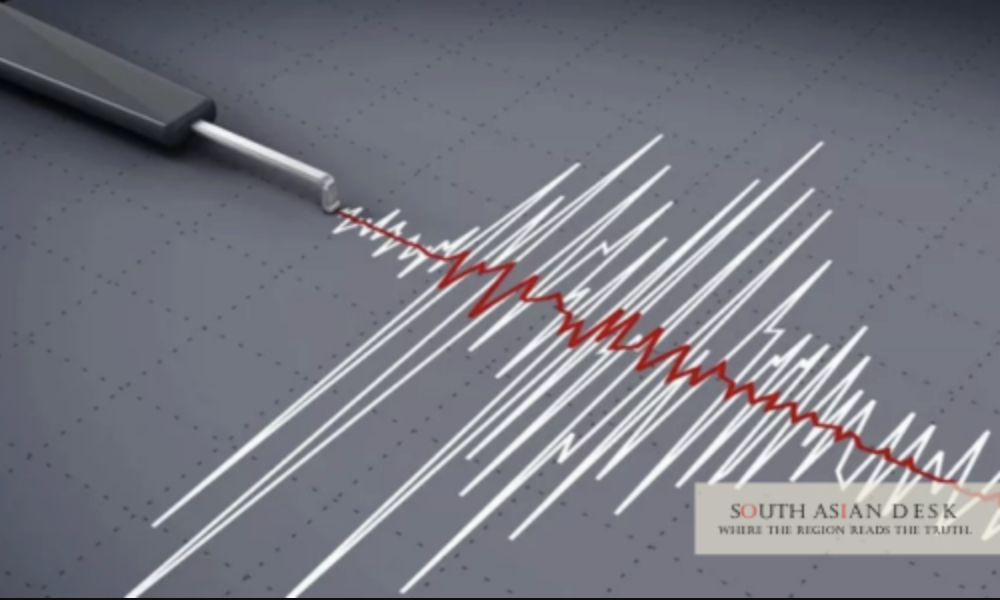
A Dhaka earthquake rattled the capital and surrounding areas at 6:14 am on Thursday, 4 December 2025. The Bangladesh Meteorological Department recorded a 4.1-magnitude event. Its epicentre lay in Shibpur upazila of Narsingdi district, 38 kilometres northeast of Dhaka’s Agargaon seismic centre. Tremors lasted seconds. No damage or injuries emerged immediately. The Euro-Mediterranean Seismological Centre placed the epicentre three kilometres north of Narsingdi at a 30-kilometre depth.
This Dhaka earthquake underscores seismic vulnerabilities in densely populated South Asia. Bangladesh sits at the Indian-Eurasian plate junction, where stress builds along faults like Madhupur. Dhaka, home to 20 million, ranks among the world’s 20 riskiest cities per global indices. The November 21, 5.7-magnitude quake killed 10 and injured 629, damaging over 50 buildings. Recent tremors, including this one, heighten anxiety. In India, Kolkata felt ripples, linking regional networks. Preparedness gaps affect trade hubs; garment factories in Gazipur halted briefly. Enhanced monitoring could avert USD 10 billion losses from a major event, per World Bank estimates.
Narsingdi Earthquake December 2025: Epicentre Details
The Narsingdi earthquake December 2025 originated at 6:14:45 am local time. BMD seismographs captured the signal instantly. Shibpur upazila, 50 kilometres east of Dhaka, hosts the fault line. Depth measured 30 kilometres, typical for shallow quakes that propagate widely. EMSC data aligned closely, noting 33 kilometres east-northeast of Tongi in Gazipur.
BMD Director General Md Abdur Rashid confirmed the readings in a morning bulletin. “The tremor registered 4.1 on the Richter scale,” he stated. “Epicentre in Shibpur, Narsingdi. No immediate reports of harm.” The department urged calm while advising structural checks. Over 10 million in greater Dhaka felt light shaking, per USGS models adapted for the region.
Narsingdi, with 300,000 residents, bore the strongest jolt. Power flickered in Palash upazila, echoing November blackouts. No ruptures surfaced yet. The district administration activated control rooms, distributing safety kits to 500 households.
Bangladesh Mild Tremor Dhaka: Resident Response
The Bangladesh mild tremor Dhaka prompted swift evacuations. Office workers in Motijheel fled high-rises. Students at Dhaka University paused lectures, recalling November injuries from panicked jumps. A garment worker in Mirpur said: “The floor swayed like a boat. I grabbed my child and ran.” Traffic jammed as drivers pulled over.
Fire services responded to 20 false alarms by 8 am. Hospitals treated five for anxiety attacks. No structural failures noted. Rajdhani Unnayan Kartripakkha teams surveyed 100 vulnerable sites. “Preliminary scans show stability,” a spokesperson reported. “But we recommend retrofitting.”
In Narsingdi, villagers gathered in open fields. Mosque loudspeakers broadcast BMD alerts. The tremor disrupted morning commutes; ferries on the Meghna River halted for 15 minutes. Social media buzzed with videos of swinging lamps. Hashtags like #DhakaTremor trended, amassing 50,000 posts by noon.
Aftershocks Narsingdi Dhaka: Sequence and Patterns
Aftershocks Narsingdi Dhaka continue post-November mainshock. This 4.1 event marks the fifth since 21 November. Prior jolts: 3.3 on 22 November in Palash; 3.7 in Badda; 4.3 west of Narsingdi; 3.6 on 1 December from Ghorashal. BMD logs 39 quakes nationwide from February 2021 to November 2025, 11 within 86 kilometres of Dhaka.
Rubayet Kabir, BMD Earthquake Observation head, analysed the pattern. “These releases indicate fault adjustment,” he said in a 25 November briefing. “Magnitudes below 4.5 pose low risk but signal activity.” USGS forecasts 18 per cent chance of a 4-plus aftershock weekly. Energy from the 5.7 quake equated Hiroshima’s bomb, per Kabir.
Narsingdi’s Daudkandi fault drives most events. Historical data shows 586 magnitude-4-plus quakes within 300 kilometres over 10 years, averaging 58 annually. Shallow depths amplify felt intensity. In Dhaka, 865,000 buildings risk collapse in a 6.9 scenario, projecting 210,000 deaths daytime.
Experts link surges to plate convergence at five centimetres yearly. Sylhet and Chattogram felt echoes, but central zones dominate. A 27 November 3.6 tremor from Ghorashal preceded this by days.
Impacts and Preparedness: Lessons from November
November’s Dhaka earthquake exposed gaps. Ten deaths: five in Narsingdi, four in Dhaka, one in Narayanganj. Injuries stemmed from falls and collapses. Over 100 hurt in epicentral zones; a newborn died in Narayanganj from wall failure. Six injured in Araihazar. Power outages hit seven stations, causing blackouts.
Dhaka University suspended classes till 6 December. Cricket matches paused; Ireland-Bangladesh Test halted three minutes. In India, West Bengal evacuated briefly. Chief Adviser Muhammad Yunus formed a taskforce on 24 November for resilience. It targets drills, codes enforcement.
RAJUK identified 50 tilted structures post-November. Urban Resilience Project surveyed 865,000 at risk. IPD blames lax zoning. Bangladesh signed a 2016 China pact for an operations centre, stalled since. Procurement for equipment advances, per Disaster Management Director General Rezwanor Rahman.
Environmental Adviser Syeda Rizwana Hasan noted: “We haven’t faced such power in five years.” Humayun Akhtar, quake expert, called November’s the strongest in 30 years. Public education ramps up; 1,000 kits distributed in Dhaka slums.
Background: Tectonic Context in Bangladesh
Bangladesh endures frequent quakes from Indo-Burman ranges. Five major events 1869-1930 topped magnitude 7. The 1999 Moheskhali 6.0 killed six. Central quiescence broke in 2025. Narsingdi’s proximity to Dhaka amplifies threats. Eurasian-Indian collision fuels reverse faulting.
BMD monitors via Agargaon centre. Global ties with USGS enhance data. Recent cluster: four in 31 hours late November. Sylhet averages higher activity, but Dhaka’s density elevates stakes.
What’s Next: Monitoring and Mitigation
Authorities plan weekly briefings. Taskforce eyes retrofits for 200 schools. Drills scheduled for 10 December in Gazipur. BMD upgrades sensors with Japanese aid. Residents stock kits; apps alert in real-time.
The Dhaka earthquake reminds of nature’s unpredictability. Vigilance ensures safety amid ongoing aftershocks Narsingdi Dhaka.
Published in SouthAsianDesk, December 4th, 2025
Follow SouthAsianDesk on X, Instagram, and Facebook for insights on business and current affairs from across South Asia.