

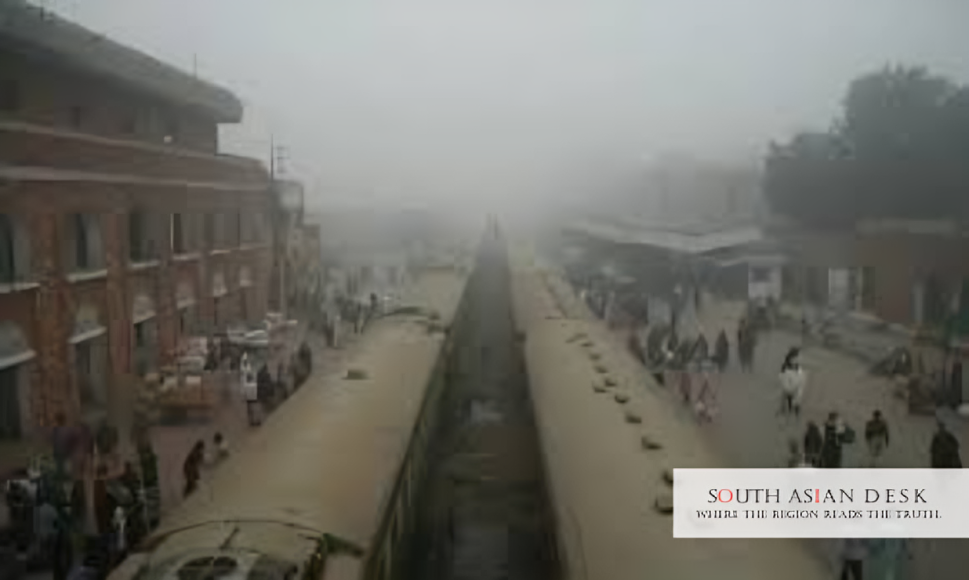
Transport and industry dominate urban pollution Pakistan, slashing average life expectancy by 3.9 years nationwide, a new Pakistan Air Quality Initiative (PAQI) report states. Released this week, “Unveiling Pakistan’s Air Pollution” maps emissions across five cities, Karachi, Lahore, Islamabad, Rawalpindi, and Peshawar using satellite data and local monitoring.
Local sources generate over 90% of hazardous PM2.5 particles, far exceeding World Health Organization (WHO) limits of 5 µg/m³ annually. In Lahore alone, residents face up to 5.8 years of lost life from chronic exposure. The study highlights transport emissions Pakistan as a prime driver in the twin cities, while industry pollution Karachi accounts for nearly half of fine particulates there. Health experts link these pollutants to 135,000 annual deaths, per federal planning minister Ahsan Iqbal.
This urban pollution Pakistan crisis amplifies South Asia’s vulnerability to climate extremes, where rapid urbanisation and fossil fuel reliance compound respiratory diseases and economic drags costing 6.5% of GDP yearly. Pakistan ranks third globally for pollution, with 12 cities exceeding safe PM2.5 thresholds by tenfold, straining regional healthcare amid shared airsheds with India and Afghanistan.
PM2.5 Sources Pakistan: City-Specific Threats Emerge
PM2.5 sources Pakistan reveal stark urban divides, the PAQI report shows. These cancer-causing microparticles, smaller than 2.5 micrometres, infiltrate lungs and bloodstreams, fueling heart disease and early mortality. In Peshawar, transit-trade activity and valley topography yield the highest per-capita exposure, though exact figures await further monitoring. Islamabad and Rawalpindi suffer transport-heavy profiles, with vehicles spewing 83% of Lahore’s total emissions in a parallel Urban Unit inventory for Punjab’s capital.
The Urban Unit’s 2023 Sectoral Emissions Inventory for Lahore quantifies PM2.5 at 1,120 tons annually, with agriculture residue burning (371 tons) and open waste (320 tons) trailing transport’s 397 tons contribution. Yet industry lags at 29 tons for PM2.5 but dominates sulphur dioxide (SO2) at 99% (11,050 tons), underscoring varied pollutant footprints. NOx from transport hits 53% (3,390 tons), while carbon monoxide (CO) reaches 92% (101,820 tons) from exhausts. Ground monitors in Lahore recorded 129-148 µg/m³ PM2.5 averages in 2022—26 times WHO guidelines classifying air as “very unhealthy” year-round.
Federal data aligns: The Ministry of Climate Change’s National Clean Air Policy (NCAP) notes Lahore’s 2019 PM2.5 at 123 µg/m³, with winter Air Quality Index (AQI) spikes over 400. “Vehicular emissions, industrial discharge, and low-quality fuels drive this,” Iqbal stated at a February symposium. PAQI founder Abid Omar emphasised: “This inventory ends speculation. Pakistan’s crisis is local and structural, we have the evidence for implementation now.”
Transport Emissions Pakistan: Vehicles Choke Urban Lungs
Transport emissions Pakistan propel urban pollution Pakistan, especially in densely trafficked hubs. The twin cities exemplify this, where PAQI modelling ties over half of PM2.5 to exhausts from ageing fleets. Lahore’s inventory echoes: Transport claims 83% of overall pollutants, amplified by two-stroke engines in motorbikes and rickshaws. Nationwide, vehicle numbers surged from 5.2 million in 2007 to 26.5 million by 2018, per NCAP baselines.
Enforcement gaps persist. Pakistan Environmental Protection Agency (Pak-EPA) tested 383 vehicles in Islamabad’s January 2024 campaign, fining 27% for exceeding National Environmental Quality Standards (NEQS) by over 40% on the Ringelmann smoke scale. Heavy diesel trucks topped violators, linking directly to smog formation in dry winters. “HTVs using diesel contribute most to urban pollution Pakistan,” the report details, with fines totalling undisclosed sums but targeting repeat offenders.
NCAP mandates counter this: Shift to Euro-5 fuels by 2025, mass transit in 10 cities by 2030, and electric vehicle subsidies. Yet progress lags, only partial fleet modernisations occurred by mid-2025. Punjab EPA spokesperson Sajid Bashir countered PAQI findings, claiming over 80% of Lahore industries adopted reduction tech, averting school closures this smog season. Lahore’s November 2025 PM2.5 peaked at 237 µg/m³, a 56% drop from 539 µg/m³ in 2024, Crediting such measures, though PAQI attributes gains to better monitoring.
Industry Pollution Karachi: Half of Emissions from Factories
Industry pollution Karachi forms a toxic core of urban pollution Pakistan, comprising nearly 50% of PM2.5 there, PAQI data reveals. Factories reliant on coal and diesel belch SO2 and particulates, worsening port-city haze. NCAP identifies industry alongside transport as top sectors, with inefficient furnaces and unchecked discharges inflating loads.
Karachi’s profile contrasts Lahore’s brick-kiln dominance (key PM2.5 sources Pakistan via crop ties). Federal policies push sectoral standards and particulate filters, banning tire pyrolysis by 2025. Economic stakes loom: Pollution erodes 6.5% GDP through healthcare and lost productivity, hitting export hubs hardest.
Omar of PAQI urged: “Target structural fixes, our airsheds trap these emissions locally.” Iqbal echoed, noting 235,000 premature deaths in 2019 alone from such sources.
Background: Rising Trends Fuel Policy Push
Urban pollution Pakistan traces to post-1990s motorisation and industrial booms. Urban Unit data shows Lahore emissions rose 48% from 2008-2018, dipping only in 2020’s COVID lull. NCAP, approved February 2023, baselines five high-impact sectors, transport, industry, agriculture, waste, residential for 38% PM2.5 cuts by 2030. Annual inventories now track progress, validating PAQI’s satellite-modelling hybrid.
What’s Next: Enforcement to Clean the Air
NCAP timelines demand action: Zigzag brick kilns nationwide by 2025, waste-to-energy in 10 cities by 2030. Provinces must devise plans within a year of approval, with federal oversight. PAQI calls for real-time enforcement, while Pak-EPA eyes expanded vehicle checks. Success hinges on funding PKR 500 million allocated initially for monitoring.
Urban pollution Pakistan demands resolve now. Cleaner air promises 3.9 recovered years, shielding South Asia’s beating heart from silent killers.
Published in SouthAsianDesk, December 10th, 2025
Follow SouthAsianDesk on X, Instagram, and Facebook for insights on business and current affairs from across South Asia.
