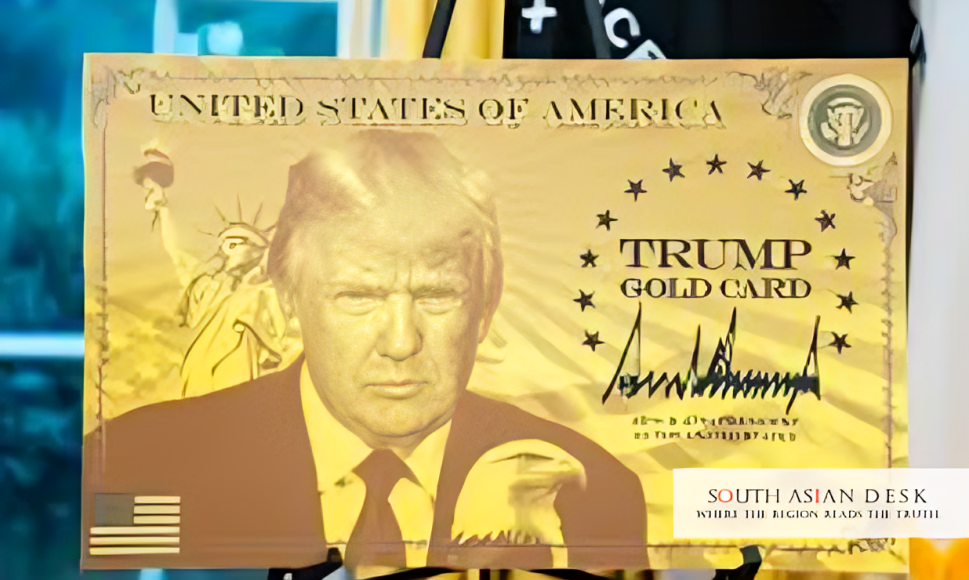
US President Donald Trump launched the Trump gold card visa programme on 10 December 2025. The initiative offers permanent residency and a fast-track to citizenship for a $1 million payment per person. Unveiled at the White House in Washington DC, it replaces the EB-5 investor visa system. Trump aims to draw top global talent and generate billions in revenue for the US Treasury. Commerce Secretary Howard Lutnick oversees the rollout.
This move signals a pivot in US immigration policy. It prioritises financial contributions over job creation mandates. For South Asians, the Trump gold card visa holds particular promise. India supplies over 70 per cent of H-1B visa holders, many facing barriers to stay after US studies. Graduates from Indian Institutes of Technology and similar institutions now see a clearer route. Pakistani professionals in tech and finance may also benefit, as the programme lacks annual caps. It counters brain drain back home, where economic pressures push talent abroad. Yet, the high cost raises questions on accessibility for middle-tier earners in the region.
Key Features of the Trump Gold Card Visa
The Trump gold card visa stems from Executive Order 14351, signed on 19 September 2025. It directs the Department of Commerce, alongside State and Homeland Security, to process applications. Individuals pay USD 1 million directly as an unrestricted gift to the US government. Corporations cover USD 2 million per foreign-born employee they sponsor. A USD 15,000 vetting fee covers background checks by the Department of Homeland Security.
Unlike the EB-5 programme, no job creation is required. EB-5 demanded USD 800,000 to USD 1.05 million investments in US projects employing 10 workers. The new system skips such hurdles. Approved holders gain EB-1 or EB-2 status, granting green card privileges. Processing takes weeks, though some nationalities face waits up to a year due to visa availability.
Trump hailed the launch during a Roosevelt Room event surrounded by business leaders. “Basically, it’s a green card but much better. Much more powerful, a much stronger path,” he stated. He added that funds would flow to the Treasury for national priorities. “We’re getting somebody great coming into our country because we think these will be some tremendous people.”
Commerce Secretary Lutnick emphasised quality. “Same visas, but now just full of the best people,” he said. He noted current green card holders often earn below the US average. The Trump $1 million visa seeks to elevate that standard. Lutnick confirmed the vetting ensures only qualified entrants. “It will make sure these people absolutely qualify to be in America.”
A dedicated application website activated on 10 December. US Citizenship and Immigration Services updated Form I-140G, Immigrant Petition for the Gold Card Programme, that day. No limits apply on issuances. Companies can secure multiple cards, one per individual.
Trump Gold Card India: Opportunities for South Asian Talent
The US gold visa programme resonates strongly in India. Tech giants like Apple and Google lobby for easier retention of Indian graduates. Apple CEO Tim Cook discussed the idea with Trump, stressing talent needs. Over 85,000 Indian students enrol in US universities annually. Many in STEM fields struggle with Optional Practical Training limits.
For Indian high-net-worth individuals, the Trump gold card India option simplifies relocation. It bypasses lottery-based H-1B draws, where Indians dominate but success rates hover at 30 per cent. Families in Mumbai and Bangalore eye the pathway for children studying abroad. “You can’t hire people from the best colleges because you don’t know whether or not you can keep the person,” Trump remarked.
In Pakistan, interest builds among Karachi-based entrepreneurs. The Lahore Chamber of Commerce tracks similar golden visa schemes in Europe. This Trump $1 million visa could funnel remittances back via investments. Yet, economic disparities limit uptake. Only 1 per cent of South Asians hold assets over USD 1 million.
Bangladesh and Sri Lanka report early queries. The programme joins global trends, like Portugal’s EUR 500,000 residency offer. South Asian applicants must navigate US consulate interviews in New Delhi or Islamabad.
Challenges in the Trump $1 Million Visa Rollout
Vetting poses the first hurdle. DHS screens for security risks, drawing on expanded measures post-2025 incidents. Applicants submit biometrics and financial proofs. Delays could arise from backlogs, though officials promise expedition.
Critics question equity. The cost excludes most skilled workers. Trump’s base, focused on border enforcement, views it as elite favouritism. Still, proponents cite revenue potential. Trump predicts “billions” for debt reduction.
Legal experts advise early filings. The 90-day implementation window from the executive order ends 18 December 2025. Post-deadline, EB-5 filers risk transition gaps.
Background: Evolution of the US Gold Visa Programme
The concept emerged in February 2025. Trump floated a USD 5 million card during trade talks. Feedback from CEOs like Cook prompted revisions. By September, the order formalised USD 1 million terms. It builds on EB-5, created in 1990 for economic stimulus.
Inter-agency coordination accelerated the launch. Commerce handles gifts under 15 USC 1522. Homeland Security vets. State manages visas. A White House fact sheet outlines no taxpayer costs for rollout.
South Asian media covered early buzz. Indian outlets reported thirst for such visas among NRIs. Pakistani sources linked it to diaspora remittances, topping USD 30 billion yearly.
What’s Next for the Trump Gold Card Visa
Applications pour in via the new portal. Officials monitor uptake from priority nations like India. Congress may review funding uses. Trump plans expansions, potentially lowering fees for STEM PhDs. The Trump gold card visa could redefine merit-based immigration, balancing security and economic gain.
Published in SouthAsianDesk, December 11th, 2025
Follow SouthAsianDesk on X, Instagram, and Facebook for insights on business and current affairs from across South Asia.