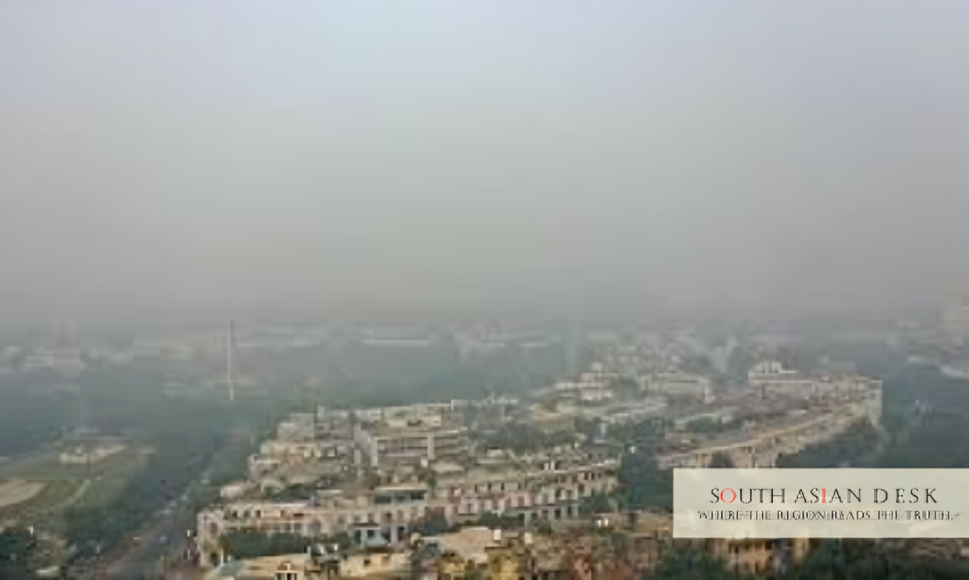
Delhi air pollution reached severe levels on Sunday, December 14, 2025, with the overall Air Quality Index (AQI) hitting 460. The Commission for Air Quality Management (CAQM) activated Stage IV of the Graded Response Action Plan (GRAP) late Saturday, banning construction and restricting trucks. This escalation affects Delhi and neighbouring areas, driven by stagnant winds and emissions from vehicles and stubble burning. Officials urge indoor stays to curb health risks.
The spike in Delhi air pollution underscores a recurring winter crisis that traps pollutants, exposing millions to respiratory threats. In South Asia, similar smog patterns strain regional health systems and economies, with cross-border winds carrying haze from Punjab’s fields to Pakistan’s borders, amplifying calls for joint action.
GRAP Delhi Activation Targets Immediate Relief
The CAQM invoked GRAP Stage IV across the entire Delhi-National Capital Region (NCR) effective immediately from 10:22 PM on December 13, 2025. This highest emergency level responds to AQI readings exceeding 450, the threshold for severe pollution.
Under GRAP Delhi protocols, authorities halted all construction and demolition activities, including public projects. Entry of non-essential polluting trucks into Delhi stands banned. Schools shifted to hybrid modes for classes up to IX and XI, blending online and physical sessions to protect students.
Central Pollution Control Board (CPCB) data shows 38 of 39 monitoring stations recorded severe AQI on Sunday morning. Anand Vihar clocked 488, Bawana 496, and Chandni Chowk 479 as of 7 PM Saturday. These figures mark the worst Delhi air pollution this winter season, surpassing 430 from the previous day.
Stagnant weather exacerbated the crisis. Low wind speeds below 5 km/h and high humidity trapped fine particulate matter (PM2.5) near the ground, forming dense Delhi smog 2025 layers visible across the capital.
India Pollution Curbs Extend to Broader NCR
India pollution curbs now cover Delhi and satellite cities like Noida, Ghaziabad, and Gurugram. The environment ministry’s advisory emphasises a five-point action plan under GRAP Stage IV.
Key measures include shutting down stone crushers and hot-mix plants in outlying districts. Coal-based power plants face mandates to switch to piped natural gas where feasible. The Delhi government directed odd-even vehicle rationing if AQI persists above 450, though not yet enforced.
Health advisories dominate responses. Officials recommend N95 masks outdoors and avoiding strenuous activity. Vulnerable groups, children, the elderly, and those with cardiac issues must remain indoors. Hospitals report a 20% rise in respiratory cases since early December, per CPCB-linked health bulletins.
Crop residue burning in neighbouring Haryana and Punjab contributes 30% to winter PM levels, per CAQM assessments. Enforcement teams deployed 500 additional patrols to curb stubble fires, but satellite imagery confirms over 1,200 incidents last week.
Impacts of Delhi Smog 2025 on Daily Life
Delhi smog 2025 disrupts routines for 30 million residents. Visibility dropped to 200 metres in central areas, prompting flight delays at Indira Gandhi International Airport, where AQI hit 394.
Commuters face hybrid work advisories from private firms, echoing government calls. Public transport usage rose 15%, with metro ridership up amid truck bans.
Economic toll mounts. Construction halts idle 50,000 workers daily, per industry estimates. Small businesses in polluted zones like Sadar Bazaar report 25% sales dips due to reduced footfall.
Environmental experts link prolonged Delhi air pollution to climate patterns. A western disturbance forecast for mid-week could disperse toxins, but meteorologists warn of rebound if winds falter.
Regional ties bind this crisis to South Asia. Smog drifts southward, mirroring Lahore’s AQI spikes above 400 last month. Shared agricultural practices fuel the haze, prompting informal SAARC-level talks on emission controls.
Background: Recurring Delhi Air Pollution Cycles
Delhi air pollution follows a seasonal script. Winters since 2016 have triggered GRAP invocations, with Stage IV last enforced in November 2024 amid AQI over 500.
CPCB’s long-term data reveals PM2.5 averages 100 micrograms per cubic metre annually, 12 times World Health Organisation limits. Vehicle emissions account for 40%, industries 20%, and dust 15%.
Past India pollution curbs yielded mixed results. A 2023 ban on firecrackers cut Diwali AQI by 30%, but enforcement gaps persist. CAQM’s 2025 revisions added drone surveillance for fire detection, yet compliance lags at 60%.
This year’s Delhi smog 2025 stems from delayed monsoons, boosting stubble burnings. Haryana reported 40% fewer farm fires than 2024, but insufficient to offset urban sources.
What’s Next for GRAP Delhi and Beyond
Forecasters predict slight AQI relief by Tuesday, December 16, if winds strengthen to 10 km/h. CAQM monitors hourly; de-escalation to Stage III requires sustained sub-450 readings.
Longer-term, the National Clean Air Programme targets 40% PM reduction by 2026 through electric vehicle subsidies and green corridors. Delhi plans 10,000 km of cycle tracks by 2030.
Yet Delhi air pollution demands regional pacts. South Asian nations eye a 2026 summit on transboundary haze, building on UN frameworks.
Authorities stress compliance to avert health emergencies. As GRAP Delhi holds, residents eye clearer skies, but vigilance defines the fight against India pollution curbs’ elusive wins.
Published in SouthAsianDesk, December 14th, 2025
Follow SouthAsianDesk on X, Instagram, and Facebook for insights on business and current affairs from across South Asia.