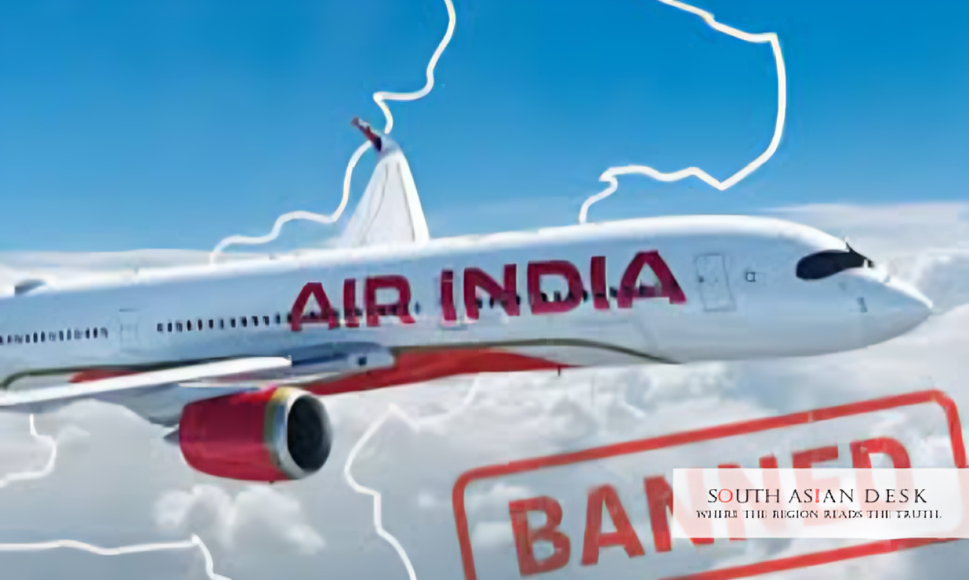
Pakistan has extended its airspace ban on Indian aircraft until 23 January 2026. The Pakistan Airports Authority issued a fresh Notice about Pakistan airspace ban to Airmen (NOTAM) confirming the continuation of restrictions that were due to expire on 24 December 2025.
The measure applies to all Indian-registered aircraft, including those owned, operated or leased by Indian airlines, as well as Indian military flights. Pakistan’s airspace, covering the Karachi and Lahore flight information regions, remains closed to these operators.
“Pakistan airspace will remain closed to Indian-registered aircraft, including all aircraft owned, operated, or leased by Indian airlines, as well as Indian military flights,” the authority stated in the NOTAM.
Pakistan Extends Indian Airspace Ban Amid Ongoing Tensions
The latest Pakistan airspace ban extension comes seven days before the previous restriction ended. Authorities notified airlines of the decision on 17 December 2025 to allow operational adjustments.
The Pakistan airspace ban India originated in late April 2025 following an attack in Pahalgam, occupied Kashmir, that killed 26 people. India alleged Pakistan supported the attackers. Pakistan rejected the claim and offered to conduct a neutral investigation.
Tensions escalated into intense military confrontation in early May 2025, the most serious in decades. Pakistan claimed it shot down seven Indian jets during the exchanges.
Since then, both countries have maintained reciprocal airspace restrictions. India continues to bar Pakistani-registered aircraft from its airspace in a tit-for-tat measure.
Impacts of Pakistan Airspace Closure January 2026
The prolonged Pakistan airspace closure January 2026 continues to disrupt Indian carriers significantly. Airlines must reroute flights westward, adding substantial time and fuel costs.
Routes from northern India to Europe, North America, and parts of the Middle East face the greatest impact. Flights that once overflew Pakistan now detour south over the Arabian Sea or seek alternative paths.
Indian carriers report mounting financial pressure from the Pakistan airspace ban India. Additional fuel consumption and longer flight durations have driven up operational costs. Some estimates suggest annual losses could reach hundreds of millions of dollars if restrictions persist.
Air India has explored options to mitigate the effects. Reports in November 2025 indicated the airline lobbied the Indian government to negotiate access to sensitive Chinese airspace in Xinjiang for shorter routes.
Pakistan also forgoes revenue from overflight fees that Indian aircraft previously generated. However, officials have prioritised security considerations over commercial income.
Regional connectivity suffers as well. Passengers face longer journeys and higher fares on affected routes. Central Asian destinations have seen schedule reductions or cancellations by some Indian low-cost carriers due to range limitations on detours.
Background to the Pakistan Airspace Ban India
The current Pakistan airspace ban India traces back to the Pahalgam attack on 22 April 2025. The incident prompted swift diplomatic fallout, including trade suspensions and visa restrictions.
Pakistan issued its initial NOTAM closing airspace to Indian operators on 24 April 2025. Extensions have followed regularly, typically for one-month periods in line with international aviation guidelines.
Previous renewals occurred in May, June, August, November, and now December 2025. Each Pakistan airspace ban extension has cited continuing security concerns.
India responded with matching restrictions on Pakistani aircraft from 30 April 2025 onward. Both sides have renewed their measures in parallel.
What’s Next for Pakistan-India Airspace Restrictions
No immediate talks appear scheduled to resolve the airspace impasse. The latest Pakistan extends Indian airspace ban suggests restrictions will continue into the new year absent diplomatic breakthrough.
Aviation authorities on both sides monitor developments closely. Any de-escalation would require coordinated NOTAM withdrawals to restore normal overflight rights.
Until then, the Pakistan airspace ban India remains a visible reminder of strained bilateral ties affecting travellers, airlines, and regional economies.
The ongoing Pakistan airspace closure January 2026 underscores the broader challenges facing South Asian aviation amid geopolitical friction.
Published in SouthAsianDesk, December 17th, 2025
Follow SouthAsianDesk on X, Instagram, and Facebook for insights on business and current affairs from across South Asia.