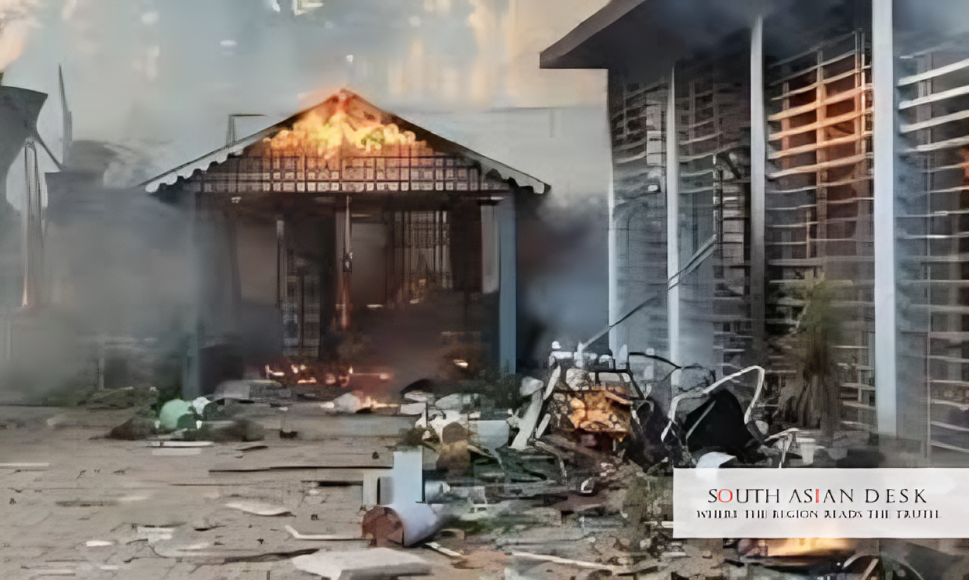
Authorities in Assam imposed Section 163 restrictions in West Karbi Anglong district after protesters from Assam protests demanding eviction of illegal encroachers torched a council leader’s house and clashed with police on December 22, 2025, injuring four people.
Violent clashes in Assam’s West Karbi Anglong district highlight ongoing tensions over land rights in India’s northeast, where indigenous communities often face encroachment issues that could escalate into broader ethnic disputes across South Asia.
West Karbi Anglong Violence Escalates
Protests in West Karbi Anglong turned violent on December 22, 2025, when demonstrators set fire to the ancestral residence of Karbi Anglong Autonomous Council Chief Executive Member Tuliram Ronghang in Dongkamukam near Kheroni. The mob also damaged around 15 shops in Kheroni Bazaar, several houses, a school bus, and other structures in a nearby basti area.
The unrest began after police attempted to disperse a group of protesters who had been on a hunger strike for 12 days, demanding the removal of illegal encroachers from Professional Grazing Reserve and Village Grazing Reserve lands. Protesters pelted stones at security forces, who responded with blank firing and live rounds to control the crowd. Three protesters and one policeman sustained injuries in the confrontation. The injured protesters were transferred to Gauhati Medical College Hospital for treatment.
A senior police official stated that additional forces were deployed from neighbouring districts to restore order. No arrests were made, but rumours of detentions fuelled the agitation. Chief Minister Himanta Biswa Sarma clarified in a statement that no one was arrested; the three hunger strikers were moved for medical care due to deteriorating health. He added that he remained in contact with district officials and protest leaders to manage the situation.
Inspector General of Police (Law and Order) Akhilesh Kumar Singh told ANI: “We are mobilising extra forces to bring the situation to normalcy. The mob also set ablaze the residence of the CEM of Karbi Anglong Autonomous Council. Some security personnel got minor injuries, and we are collecting the data.”
By December 23, 2025, no fresh incidents were reported, and the area remained under control. Senior Assam Minister Ranoj Pegu visited Kheroni on the night of December 22 to review the situation. He noted: “A section of the people are angry that the encroachers are settling on PGR and VGR land, and there was an attempt to evict them last year, but a petition was filed in the Gauhati High Court, which passed an interim order staying the eviction process. The matter can be resolved only through dialogue, and we are holding discussions with both protesters and the encroachers. Situation is under control.”
Section 163 Assam Imposed to Curb Unrest
In response to the West Karbi Anglong violence, District Magistrate Nirola Phangchopi issued a prohibitory order under Section 163 of the Bhartiya Nyay Suraksha Sanhita on December 22, 2025. The order, effective until further notice, aims to prevent anti-social elements from causing ethnic or communal disturbances and to protect public life and property.
Key restrictions include a ban on gatherings of five or more people, rallies, picketing, torch processions, dharnas, firearms, firecrackers, inflammatory speeches, posters, wall writings, and unauthorised use of loudspeakers or microphones. A night curfew prohibits movement of people or private vehicles from 5 PM to 6 AM, with exemptions for police, military, officials on duty, and medical emergencies. Schools, colleges for examinations, and government or private offices continue to operate normally.
Similar measures remain in force in the adjoining Karbi Anglong district, where protests have also occurred. The Karbi Anglong protests stem from the same demand for evicting encroachers, mostly from Bihar, who have settled on reserved lands.
Director General of Police Harmeet Singh rushed to the affected areas on December 22 to assess the law and order situation. Additional security personnel were mobilised to prevent further escalation.
Background to Karbi Anglong Protests
The Karbi Anglong protests have roots in a long-standing dispute over land encroachment. The Karbi Anglong Autonomous Council issued eviction notices in February 2024 to clear illegal settlers from Professional Grazing Reserve and Village Grazing Reserve areas. However, a petition filed in the Gauhati High Court led to an interim order staying the eviction, citing concerns over contempt of court.
Protesters, representing various political and social organisations, argue that the encroachments threaten indigenous land rights. The hunger strike in Kheroni began 12 days before the violence, pressing for immediate action. Local residents blocked roads and marched to Dongkamukam after reports of police intervention, leading to the arson and clashes.
This incident reflects broader challenges in Assam, where land disputes involving indigenous tribes and settlers have sparked periodic unrest. In South Asia, such conflicts often intersect with ethnic identities, potentially affecting regional stability. Government data from Assam’s revenue department indicates over 100,000 hectares of reserved land remain under encroachment statewide.
Tuliram Ronghang, the targeted council leader, clarified that the three hospitalised protesters were not arrested but admitted for health reasons. He urged calm amid the tensions.
What’s Next in Assam Protests
Authorities plan to continue dialogues with protesters and encroachers to resolve the underlying land issues. The Gauhati High Court case remains pending, which could influence future eviction efforts. Senior officials expect the situation to stabilise, but monitoring continues to prevent recurrence of West Karbi Anglong violence.
As Assam protests subside, focus shifts to legal and negotiated solutions to avoid further disruptions in the region.
Published in SouthAsianDesk, December 23rd, 2025
Follow SouthAsianDesk on X, Instagram and Facebook for insights on business and current affairs from across South Asia.