

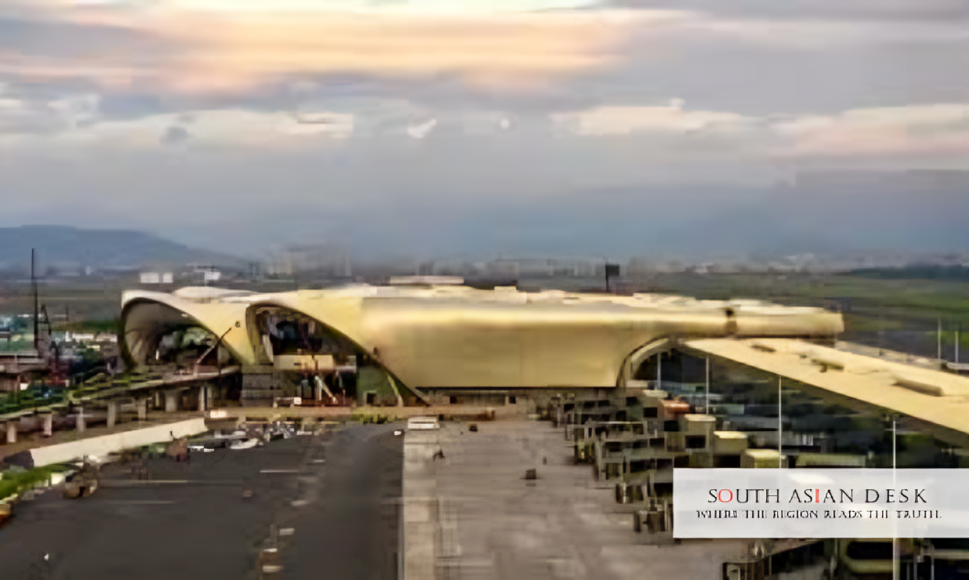
India’s newest aviation hub, Navi Mumbai International Airport, commenced operations on Thursday with 48 flights handling over 4,000 passengers, easing Mumbai’s air traffic burden.
Navi Mumbai International Airport began commercial operations in Maharashtra on Thursday, December 25, 2025. The first IndiGo flight from Bengaluru landed at 8:00 AM, marking a key milestone. Over 4,000 passengers used the facility on day one, with services from four airlines.
The Navi Mumbai International Airport addresses long-standing congestion at Mumbai’s Chhatrapati Shivaji Maharaj International Airport. It enhances connectivity in the Mumbai Metropolitan Region, supporting economic growth through improved logistics and trade links across South Asia. This infrastructure boosts regional air travel efficiency, facilitating faster movement of goods and people to neighbouring countries like Pakistan and Sri Lanka.
NMIA Opening Highlights
The NMIA opening featured a traditional water cannon salute for the inaugural IndiGo Airbus A320 arrival. Chairman Gautam Adani of the Adani Group welcomed passengers and staff. He stated: “NMIA stands as a promise of what the country can achieve when ambition is guided by purpose and delivered with speed and execution.” Adani also described it as “a proud day for Mumbai and for India.”
Operations started with 48 flights, including 24 departures to 13 domestic destinations. Airlines involved include IndiGo, Air India Express, Akasa Air, and Star Air. Initial services run from 8:00 AM to 8:00 PM, handling up to 10 aircraft movements per hour.
A special chartered aerial tour carried passengers from local farmer families, underprivileged groups, and individuals with disabilities. India Post issued a commemorative First Flight Carried Special Cover, flown to Goa on the inaugural day.
Background on Navi Mumbai International Airport Development
The Navi Mumbai International Airport project was conceived nearly three decades ago to decongest Mumbai’s existing airport. Developed by Navi Mumbai International Airport Ltd, a special purpose vehicle with Adani Group holding 74% stake and City and Industrial Development Corporation (CIDCO) at 26%, it represents a INR 19,650 crore investment.
Prime Minister Narendra Modi inaugurated Phase 1 on Wednesday, October 8, 2025. At the event, he remarked: “The Navi Mumbai International Airport is a project that exemplifies the vision of a developed India.” The airport spans 2,866 acres, equivalent to about 1,650 football fields.
Construction involved thousands of workers over years. The design draws inspiration from the lotus, incorporating sustainable features like 40 MW solar power capacity in the final phase, sufficient to power 70,000 average Indian households annually.
The facility aims to handle 90 million passengers per year upon full completion, positioning Mumbai alongside global cities with multiple major airports. This development aligns with India’s aviation growth, where passenger numbers have risen sharply in recent years.
NMIA Flights and Operational Details
NMIA flights commenced with IndiGo connecting to destinations such as Ahmedabad, Goa, Hyderabad, Indore, Jaipur, and Varanasi. Air India Express and others added routes to cities like Chennai and Kolkata. On day one, the airport managed over 4,000 passengers without reported issues.
The Navi Mumbai airport first flight from Bengaluru carried regular passengers, highlighting seamless integration into national networks. Capacity starts modest but scales up. Current setup allows 24 scheduled daily departures.
Infrastructure includes advanced passenger technology for efficient check-in and security. The airport integrates with regional transport via road and planned metro links.
Economic Impact in South Asia
The Navi Mumbai International Airport strengthens India’s role in South Asian aviation. It creates direct and indirect jobs, estimated at thousands in the initial phase. Enhanced capacity supports cargo operations, aiding exports from Maharashtra to regional markets.
For South Asia, this means better connectivity. Farmers in the region benefit from faster perishable goods transport, as noted by the Prime Minister: “Through this new airport, farmers of Maharashtra will now be connected to supermarkets in Europe and the Middle East.” While focused on domestic routes initially, future international NMIA flights could link to South Asian hubs.
The project overcame challenges like land acquisition and environmental clearances, completed in record time. It sets a benchmark for infrastructure execution in the region.
What’s Next for Navi Mumbai International Airport
Operations expand to 24-hour services from February 2026. IndiGo plans additional connections between December 25 and December 30, 2025. Full phases will add runways and terminals.
Future NMIA flights include international routes, targeting 90 million annual passengers. Sustainability remains key, with green initiatives embedded.
The Navi Mumbai International Airport paves the way for transformed regional travel.
Published in SouthAsianDesk, December 26th, 2025
Follow SouthAsianDesk on X, Instagram and Facebook for insights on business and current affairs from across South Asia.
