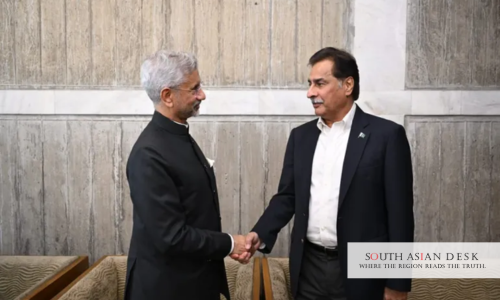
India’s External Affairs Minister S Jaishankar shook hands with Pakistan’s National Assembly Speaker Sardar Ayaz Sadiq in Dhaka on Tuesday, December 31, 2025. The Dhaka handshake occurred ahead of former Bangladesh Prime Minister Khaleda Zia’s funeral. This marked the first notable contact since the May 2025 aerial conflict, prompting queries on 2026 revival of India Pakistan ties.
The Dhaka handshake carries significance for South Asia, a region plagued by territorial disputes and economic interdependencies. Stable India Pakistan ties could foster trade resumption, reduce military tensions, and enhance cooperation on shared challenges like water resources under the Indus Waters Treaty, benefiting millions across borders.
Dhaka Handshake Details
The encounter took place in a waiting room at Bangladesh’s parliament. Sadiq attended to pay respects to Khaleda Zia. Jaishankar approached Sadiq, introduced himself, and shook hands with a smile. Sadiq noted Jaishankar recognised him without need for introduction.
In an official post from the National Assembly of Pakistan, the interaction was described as the first significant high-level contact initiated by the Indian side post the May 2025 conflict. It highlighted Pakistan’s stance on dialogue and restraint.
Pakistan’s Foreign Office spokesperson, in a press briefing on Thursday, January 1, 2026, deferred to Sadiq’s account. The spokesperson stated: “The Honourable Speaker has given a very detailed account of it, and I would not want to add a word or subtract a word out of what the Speaker said.”
Images of the Dhaka handshake circulated widely, shared by Sadiq’s office and Bangladesh’s Chief Adviser Muhammad Yunus on social media.
Prospects for 2026 Revival in India Pakistan Ties
Analysts view the Dhaka handshake as a potential signal for 2026 revival. Mustafa Hyder Sayed, a foreign policy analyst in Islamabad, called it a welcome development. He said: “I think that the interaction between Jaishankar and Ayaz Sadiq is a welcome development for the new year… basic normalcy of relations in which respect is accorded to officials and hands are shaken, it is the bare minimum which unfortunately was absent after the war between India and Pakistan.”
Sardar Masood Khan, former Pakistani envoy to the US, suggested the gesture required approval from Indian leadership. He stated: “One can’t imagine that the Indian foreign minister would greet Pakistan’s speaker spontaneously without the explicit permission of the Indian prime minister and senior leadership of the Bharatiya Janata Party… the handshake as a pleasant diplomatic gesture.”
However, Rezaul Hasan Laskar, foreign affairs editor at Hindustan Times, downplayed it. He said: “The two happened to be in the same room and did what senior leaders of two countries would do when they find themselves in such a situation. They shook hands and exchanged pleasantries… It is hard to see the two sides coming together in any way, given the growing trust deficit.”
For 2026 revival, experts propose minimal agendas with red lines and guardrails. Sayed added: “They can have a very basic, minimal agenda, in which they should define the rules, red lines and set guardrails. Once that is done, they can have a basic level of dialogue that is agreed upon with consent of both, and bring it to the table… it is in the ‘national interest’ of both countries to maintain at least minimal engagement.”
Laskar emphasised reviving back-channel contacts between national security advisers and intelligence officials.
Indus Waters Treaty Tensions
The Indus Waters Treaty remains a flashpoint in India Pakistan ties. Signed in 1960, it allocates water from six rivers: Indus, Jhelum, Chenab, Ravi, Beas, and Sutlej.
In April 2025, an attack in Pahalgam, Indian-administered Kashmir, killed 26 civilians. India blamed Pakistan and withdrew from the treaty.
Pakistan views this as an existential threat. Khan noted that reinstating the Indus Waters Treaty could be a confidence-building measure for 2026 revival.
In the January 1, 2026, press briefing, Pakistan’s spokesperson raised concerns over India’s Dulhasti Stage-II Hydroelectric Project on the Chenab River. He stated: “These reports raise serious concerns as no prior information or notification was shared with Pakistan with regard to this project as mandated under the Indus Waters Treaty of 1960. Such acts of commission and omission yet again exemplify a complete disregard of international law.”
Pakistan urged India to return to treaty compliance and reaffirmed commitment to peaceful resolution.
Background on India Pakistan Ties
India Pakistan ties have deteriorated since the 2008 Mumbai attacks, where gunmen linked to Pakistan killed 166 people. No sustained dialogue followed.
Tensions escalated in April 2025 with the Pahalgam attack, leading to India’s Indus Waters Treaty withdrawal. In May 2025, a four-day aerial conflict involved missile and drone strikes. Both claimed victory; ceasefire came via direct talks, with US involvement.
Post-conflict, both tested ballistic missiles and held exercises. In September 2025, during the Asia Cup in UAE, Indian cricket players refused handshakes with Pakistanis after the final.
Pakistan has strengthened ties with Bangladesh post Sheikh Hasina’s ouster, including high-level visits. It also signed a defence pact with Saudi Arabia and deepened US and China relations.
US tariffs hit both: 50% on India, 19% on Pakistan. Trump praised Pakistan’s army chief.
Kashmir remains central. Pakistan supports UN resolutions for plebiscite. The spokesperson stated: “Pakistan’s position on Jammu and Kashmir remains anchored in those UN Security Council Resolutions… Pakistan will continue to raise the issue of Jammu and Kashmir at relevant international fora.”
What’s Next for India Pakistan Ties
The Dhaka handshake might prompt discreet talks. Analysts suggest addressing Indus Waters Treaty as a start for 2026 revival.
Ongoing regional dynamics, including US policies and Bangladesh’s shifts, could influence progress. Without formal channels, trust deficit persists.
This moment tests if India Pakistan ties can move beyond rivalry toward stability.
Published in SouthAsianDesk, January 2nd, 2026
Follow SouthAsianDesk on X, Instagram and Facebook for insights on business and current affairs from across South Asia.