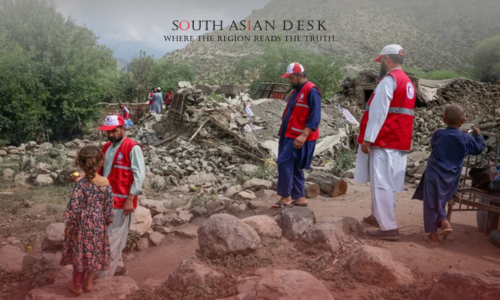
The death toll from a series of earthquakes in eastern Afghanistan has climbed to more than 2,200, with aid efforts intensifying amid challenging terrain and weather conditions.
A magnitude 6.0 earthquake struck eastern Afghanistan on Sunday, August 31, 2025, followed by two more tremors, killing over 2,200 people and injuring thousands in remote mountainous areas, as rescuers battle landslides and rain to reach survivors.
The earthquakes highlight Afghanistan’s vulnerability in the seismically active Hindu Kush region, shared with neighbouring South Asian countries like Pakistan and India, where tremors were also felt, underscoring the need for regional disaster preparedness amid ongoing humanitarian challenges.
Rescue Operations Underway
Rescue teams, including Taliban authorities and international aid workers, have been deployed to the hardest-hit areas in Kunar province. Helicopters have been used to airdrop commandos and evacuate the injured, while ground teams navigate blocked roads and landslides caused by heavy rains. The World Food Programme has reported using pack animals and small vehicles to deliver supplies to isolated villages.
According to UN reports, the death toll stands at more than 2,200, with at least 3,640 injured. Over 6,700 homes have been destroyed, leaving thousands homeless in the rugged terrain. Ehsanullah Ehsan, head of disaster management for eastern Afghanistan’s Kunar region, stated that accurate predictions of trapped victims remain difficult due to the remote locations.
Impact on Affected Provinces
The initial quake, centred 37 kilometres west-southwest of Asadabad in Kunar province at a depth of about eight kilometres, occurred at 11:47 PM local time. It was followed by a magnitude 5.5 aftershock on Tuesday, September 2, 2025, and a third magnitude 6.2 earthquake on Thursday, September 4, 2025. No additional deaths were reported from the latest tremor.
Kunar has borne the brunt, with villages like Wadir in Nugral district reduced to rubble. Neighbouring Nangarhar and Laghman provinces also reported casualties and damage. The United Nations Office for the Coordination of Humanitarian Affairs noted that women and children are particularly at risk, facing barriers to aid due to gender restrictions and the destruction of infrastructure.
International Response and Challenges
Several countries have pledged support. India has dispatched emergency supplies, while China and the United Kingdom have offered assistance. The UN has called for urgent funding to sustain operations, warning that current stocks may last only a few weeks.
Taliban spokesperson Hamdullah Fitrat announced that tents have been erected and emergency supplies are being distributed. However, the country’s isolation has complicated large-scale international involvement. John Aylieff of the World Food Programme described the scene as “utter devastation,” emphasising the catastrophe’s scale.
Background
Afghanistan lies on the boundary between the Indian and Eurasian tectonic plates, making it prone to frequent earthquakes. This latest series follows devastating quakes in 2023 in Herat province, which killed over 1,000. The current events compound existing crises, including economic hardship and restricted aid access under Taliban rule since 2021.
What’s Next
As search operations continue, experts warn of potential aftershocks in the coming days. The focus will shift to long-term recovery, including rebuilding resilient infrastructure in eastern Afghanistan. Humanitarian organisations urge sustained global support to prevent further loss of life as the Afghanistan earthquake death toll rises.
The series of earthquakes in eastern Afghanistan has exacerbated an already dire humanitarian situation in the country, where access to basic services remains limited. With over 2,200 lives lost and thousands injured, the immediate priority for rescuers and aid workers is to locate survivors trapped under debris in remote villages. However, heavy rainfall has triggered landslides, severing roads and complicating helicopter landings in the mountainous Kunar province.
The first quake, registered by the United States Geological Survey at magnitude 6.0, struck at a shallow depth, amplifying its destructive power. It occurred late on Sunday evening, catching many residents unprepared in poorly constructed homes typical of the region. By Tuesday, a 5.5-magnitude aftershock added to the chaos, and Thursday’s 6.2-magnitude event, while not causing new fatalities, heightened fears among the population.
UN agencies, including UNICEF, have highlighted the disproportionate impact on children, who make up a significant portion of the casualties. Reports indicate that hospitals in Jalalabad and surrounding areas are overwhelmed, with patients treated in open spaces due to structural concerns. The Taliban administration has appealed for international aid, acknowledging the strain on local resources.
In a statement, the Afghan Ministry of Foreign Affairs expressed gratitude for global sympathy and assistance, noting pledges from various governments. Despite these efforts, aid delivery remains hampered by the terrain and weather, with some villages accessible only on foot after hours of trekking.
Seismologists attribute the quakes to the ongoing tectonic activity in the Hindu Kush, a region that has seen multiple deadly events in recent decades. The 2022 earthquake in Paktika province, for instance, claimed over 1,000 lives, revealing persistent vulnerabilities in building standards and emergency response.
As the death toll climbs, questions arise about the adequacy of early warning systems in South Asia. Neighbouring Pakistan reported feeling the tremors in Islamabad and Lahore, while parts of northern India also experienced shaking, though no significant damage was reported there. This interconnected seismic risk emphasises the importance of cross-border cooperation in disaster management.
Humanitarian experts warn that without immediate and substantial aid, secondary crises such as disease outbreaks could emerge in makeshift camps. The World Health Organization has deployed teams to provide medical supplies, but funding gaps persist amid competing global emergencies.
Looking ahead, reconstruction will require not only financial support but also technical expertise to implement earthquake-resistant designs. The Taliban government has indicated plans to assess damaged structures, but international isolation limits access to advanced resources.
In the midst of this tragedy, stories of resilience emerge. Local communities have banded together to dig through rubble with bare hands, while aid workers recount the determination of survivors. Yet, the scale of loss—over 2,200 dead and entire families wiped out—underscores the urgent need for preventive measures in this volatile region.
As investigations into the full extent of the damage continue, the Afghanistan earthquake death toll rises, serving as a stark reminder of nature’s unpredictability and the human cost of inadequate preparedness.
Published in SouthAsianDesk, September 5th, 2025
Follow SouthAsianDesk on X, Instagram, and Facebook for insights on business and current affairs from across South Asia.