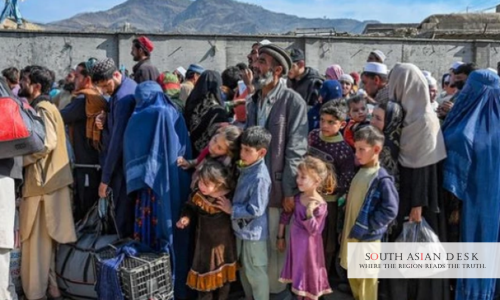
Kabul, Afghanistan – Millions of Afghans face starvation as the Afghanistan hunger crisis escalates amid harsh winter conditions and sharp Afghanistan aid reductions. Deportations from Iran and Pakistan have displaced over 2.5 million people since 2025, swelling the population and straining limited resources. The World Food Programme reports 17 million people now battle acute hunger, up three million from last year, with malnutrition cases surging.
This crisis grips Afghanistan at a critical juncture, threatening regional stability in South Asia. Neighbouring Pakistan and Iran, already hosting large refugee populations, risk further economic strain from potential reverse migrations. South Asian nations, including India and Bangladesh, monitor the fallout, as instability could fuel cross-border tensions and humanitarian spillover.
Afghanistan Winter Crisis Intensifies
Severe winters have compounded the Afghanistan hunger crisis, leaving families exposed in makeshift shelters. In Bamiyan province, deportees huddle in tents against freezing temperatures, with work opportunities vanishing as snow blankets the landscape. The Integrated Food Security Phase Classification report from December 2025 projects that from November 2025 to March 2026, acute food insecurity will rise by four percent, adding 2.6 million people to those in crisis.
Hunger in Afghanistan has reached dire levels, with clinics overwhelmed. At Kabul’s Qasaba Clinic, staff treat 30 malnutrition cases daily, double the pre-deportation numbers. Dr Rabia Rahimi Yadgari stated: “Compared to the time when there were no migrants, the number of our patients has now doubled.” Supplements fall short, forcing families to ration meagre supplies.
Deported families like that of Samiullah, a 55-year-old from Herat, illustrate the toll. Expelled from Iran after 20 years, he now lives in a tent with his wife, five children, and grandchild. “We have reached a point where we are content with death,” Samiullah said. “At night, when it gets very cold, my children say, ‘Father, I’m cold, I’m freezing.’ I hold them in my arms and say, ‘It’s OK.’ What choice do we have?”
Impact of Afghanistan Aid Reductions
Afghanistan aid reductions have deepened the hunger in Afghanistan, with funding shortfalls crippling response efforts. The World Food Programme halted emergency food distributions in May 2025 due to donor cuts, now assisting only one million people monthly against a need for nine million. The organisation requires US$568 million urgently for operations through February 2026.
John Aylieff, WFP country director, noted: “Last year was the biggest malnutrition surge ever recorded in Afghanistan, and sadly, the prediction is that it’s going to get worse.” Remittances, once a lifeline, have dried up as deportees return empty-handed, pushing three million more into acute hunger.
The Taliban administration provides limited support. Spokesman Zabiullah Mujahid said: “Migrants who are newly returning to the country receive assistance as much as possible, in areas from transport to housing, healthcare and food.” He added: “It was impossible to eradicate poverty quickly in a country that suffered 40 years of conflict and the loss of all its revenue and resources.”
Iran’s deportations accelerated amid domestic unrest, with over 2,000 killed in protests. Pakistan cited security concerns, alleging Taliban harbours militants. a claim denied by Kabul. These actions have inflated Afghanistan’s population by a tenth, overwhelming an economy still reeling from the 2021 US withdrawal.
Hunger in Afghanistan: Malnutrition Surge
The Afghanistan hunger crisis disproportionately affects children and women. Projections indicate 200,000 more children will suffer acute malnutrition in 2026, with 3.7 million already impacted. Two-thirds of female-headed households cannot afford basic nutrition, per WFP data.
In Kabul, widowed mother Zahra Ahmadi, 50, manages eight children on sporadic aid. “I am forced to manage the winter with these supplies; sometimes we eat, sometimes we don’t,” she said. At distribution sites, queues stretch for rice and oil, but portions sustain families for mere weeks.
Earthquakes in 2025 further strained resources, destroying homes and livelihoods. Combined with drought, these shocks have left rural areas isolated, where snow blocks aid convoys.
Background
Afghanistan’s woes trace to the Taliban takeover in July 2021, following the US-led withdrawal. Economic collapse ensued, with job losses and frozen assets exacerbating poverty. Deportations began intensifying in 2025, with Iran expelling Afghans amid spying allegations and Pakistan accelerating returns over militant claims. International aid, once robust, scaled back under US President Donald Trump’s second term, with other donors following suit.
What’s Next
Humanitarian groups urge immediate funding to avert catastrophe. WFP aims to preposition supplies before deeper snowfalls, but shortfalls persist. Without intervention, the Afghanistan hunger crisis could claim more lives, with child mortality rising. Regional talks in South Asia may address refugee policies, but progress remains uncertain.
The Afghanistan hunger crisis demands global attention to prevent further deterioration.
Published in SouthAsianDesk, January 20th, 2026
Follow SouthAsianDesk on X, Instagram and Facebook for insights on business and current affairs from across South Asia.