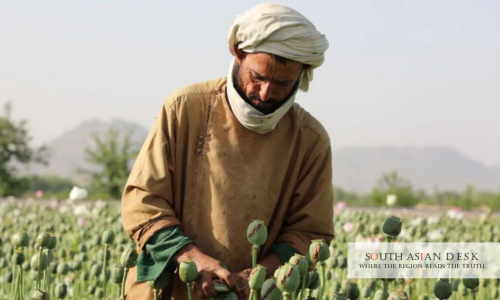
The United Nations Office on Drugs and Crime released its Afghanistan Opium decline Survey on Thursday, November 6, 2025, detailing a 32% drop in opium production to 296 tonnes following the Taliban ban. Cultivation decreased to 10,200 hectares, a 20% decline from 2024. The de facto authorities enforced the 2022 prohibition rigorously, eradicating over 4,000 hectares of land. How this shift alters regional drug flows remains unclear, with methamphetamine seizures surging 50%.
The decline in Afghanistan opium, the Taliban ban, and the UN report expose deep rifts in South Asia’s narcotics landscape. Pakistan, absorbing 80% of Afghan heroin, faces reduced inflows yet rising synthetic threats from border labs. India reports fewer opium seizures but more meth busts in Punjab. The ban starves rural economies, potentially sparking migration and unrest that spill across porous frontiers. Global markets see heroin prices climb 20%, squeezing users from Karachi to Kolkata.
Taliban Poppy Ban Impact 2025 Hits Farmers Hard
The Taliban poppy ban’s impact in 2025 intensified after a 2024 cultivation spike to 12,800 hectares. De facto officials destroyed 34,000 fields, targeting holdouts in Badakhshan and Helmand. Protests erupted in north-eastern provinces, with clashes killing at least five farmers last spring.
UNODC data show that four provinces have been declared poppy-free: Balkh, Farah, Laghman, and Uruzgan. South-western regions bore 60% of the remaining cultivation at 1,294 hectares. Yields fell to 29 kg per hectare due to drought and heat. Rainfall deficits hit 30% in key growing months.
Farmers lost $126 million in opium revenue, down 48% from 2024. Alternative crops, such as wheat, yielded 40% less profit. Over 40% of arable land lies fallow. Returnee migrants, numbering 1.2 million since 2021, have further strained resources.
One Helmand farmer told BBC Pashto service: “If we violate the ban, we face prison. If we comply, we face destitution.” Another added: “What should I do? I’m forced to do this. I have nothing else. I can’t even provide food for my family.” These voices echo surveys of 500 rural households, in which 70% reported experiencing hunger risks.
Enforcement teams used drones for surveillance, uprooting 80% of detected plots. The ban aligns with religious edicts, but experts note uneven application in remote areas.
UNODC Afghanistan Opium Survey Exposes Regional Shifts
The UNODC Afghanistan opium survey charts a post-ban trajectory. Production reached 296 tonnes, the lowest since 2000, excluding drought years. Eastern cultivation dropped 52% to 252 hectares. Northern fields shrank 37% to 566 hectares. Western areas saw a 55% reduction to 756 hectares.
Maps highlight Badakhshan as the hotspot, accounting for 40% of the national total. Farah province contributed 25%. Eradication focused on high-density zones, clearing 1,200 hectares there alone.
Climate factored heavily. Temperatures rose 2 degrees Celsius above average. Irrigation failures affected 60% of fields. Solar pumps, installed in 2023 aid programmes, covered only 15% of needs.
The survey warns of ecological fallout. Soil degradation from fallow land risks desertification, impacting 2 million hectares. Aid groups distributed seeds for cumin and saffron, but uptake lags at 20%.
South Asian ties amplify concerns. Afghan opium fuels 90% of Pakistan’s heroin market, valued at $1 billion annually. Declines cut supply lines through Balochistan, but traffickers pivot to synthetics. Indian customs seized 15% less heroin in 2025’s first half, yet meth hauls tripled.
Afghan Synthetic Drugs Surge Fills Opium Void
The Afghan synthetic drugs surge accelerates as poppy fields vanish. Methamphetamine seizures within 3,000 km of Afghanistan jumped 50% in late 2024. Prices have halved to $500 per kilogram, signaling an oversupply.
The UNODC tracked 200 labs in border provinces, which produce 40 tonnes of drugs annually. Precursors were smuggled from China via Iran. Output rivals pre-ban heroin volumes.
This shift burdens South Asia. Pakistan’s anti-narcotics force raided 50 labs in Khyber Pakhtunkhwa, netting PKR 2 billion in assets. Users in Lahore clinics rose 30%, with meth overdoses up 25%.
Global patterns mirror this. European heroin purity fell 15%, per EMCDDA data. Afghan groups fund operations through meth exports to Australia, fetching AUD 200,000 per kg.
The survey urges expanded monitoring. “Shifting patterns demand agile responses,” states the executive summary. No official Taliban comment surfaced on the 2025 surge.
Background of Afghanistan Opium Decline
Afghanistan dominated 80% of the global opium before 2022. Cultivation peaked at 233,000 hectares that year, yielding 6,200 tonnes. The ban, decreed by supreme leader Hibatullah Akhundzada, invoked Islamic prohibitions.
Early compliance reached 95%, but the rebound in 2023, which hit 10,800 hectares, occurred amid lax enforcement. The 2024 rise from 19% to 12,800 hectares drew crackdowns. Satellite imagery confirmed 70% destruction rates.
Economic context deepens woes. GDP contracted by 5% after the ban, according to the World Bank. Opium funded 10% of rural GDP. Women, barred from markets, face compounded poverty.
Regional production stirs elsewhere. Myanmar’s fields expanded by 15% to 40,000 hectares, according to the UNODC. Laos reported 20% gains. These offset Afghan shortfalls minimally.
South Asian states bolster borders. Pakistan fenced 1,200 km along the Durand Line. India deployed 500 drones for surveillance. Bilateral pacts with UNODC train 2,000 officers yearly.
What’s Next: Aid and Enforcement Horizons
Donors pledged $500 million for alternatives at the 2025 Geneva conference. Saffron trials in Herat yield 25% higher returns. Irrigation revamps target 100,000 hectares by 2027.
De facto authorities plan digital tracking for crops. UNODC eyes 2026 surveys for meth baselines. International monitors call for farmer amnesties to boost compliance.
This Afghanistan opium decline, Taliban ban, and UN report signal a narcotics pivot. A sustained decline could stabilize South Asian routes, but unchecked synthetics threaten health crises. Policymakers must bridge enforcement with livelihoods to avert humanitarian tides.
Published in SouthAsianDesk, November 7th, 2025
Follow SouthAsianDesk on X, Instagram, and Facebook for insights on business and current affairs from across South Asia.