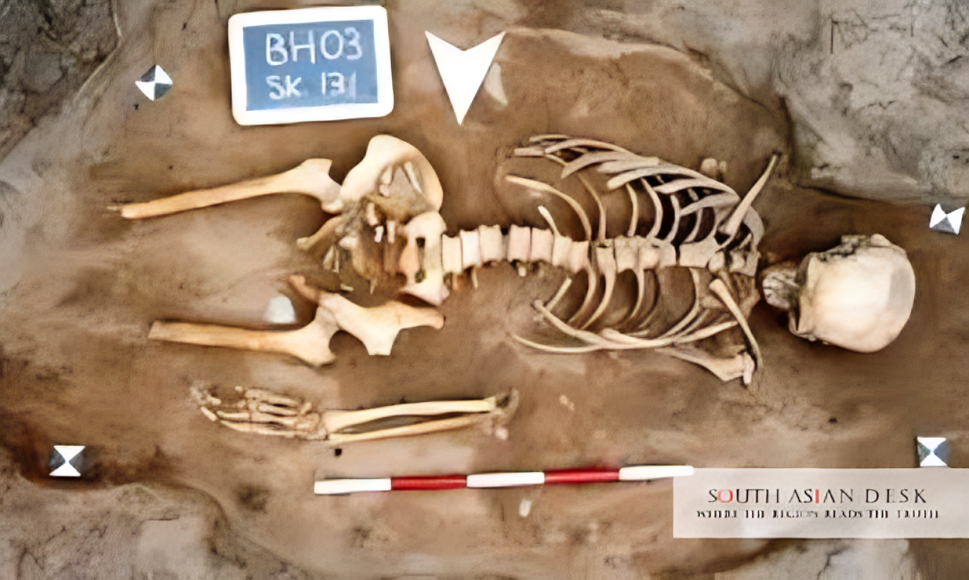
Explorers found ancient skeletons discovered at Banbhore ruins in Sindh, Pakistan. A joint team unearthed more than a dozen human remains during the Banbhore ruins excavation 2025. The find occurred at the UNESCO tentative site in Thatta district. Officials from the Sindh Archaeology Department oversaw the work. Italian experts joined local university students. The discovery happened on Monday, November 24, 2025, at 10:15 AM. It highlights the site’s role as an ancient port.
This breakthrough in ancient human remains Sindh Pakistan boosts understanding of South Asia’s maritime past. Banbhore served as a key link between the Indus Valley and the Indian Ocean trade routes. Finds like these connect to the arrival of Islam in the region via Arab conquests in 711 CE. For Pakistan, the site reinforces cultural identity and tourism potential. It draws parallels to global heritage efforts, such as UNESCO listings. Scholars see it as a window into pre- and post-Islamic life. The excavation could attract international funding and expertise. Local communities in Thatta gain pride in their history. Overall, it underscores Sindh’s enduring archaeological value amid climate threats to coastal sites.
Team Details in Banbhore Ruins Excavation 2025
The Banbhore ruins excavation 2025 involved a collaborative effort. Local university students from Sindh University joined officials from the Sindh Archaeology Department. Italian archaeologists provided specialised skills. The international team included Dr Agnese Fusaro, an expert in bone studies. Quaggio Sara handled photography. Furno Luca focused on topography. Damiano Daniele specialised in glasswork. Marco Vilory worked on pottery analysis. Site in-charge Saleem Palijo coordinated daily operations.
The team targeted deeper layers of the citadel. Skeletons emerged from stratified soil near the eastern wall. Pottery vessels accompanied the remains. Experts noted the bones’ position suggested burial practices. All items transferred to the department for lab work. Carbon dating and DNA analysis will follow. The Sindh Archaeology Department confirmed receipt in a statement dated November 25, 2025. “These ancient human remains Sindh Pakistan represent a significant addition to our collection,” the department said in its release. No immediate health risks arose during handling.
Significance of Ancient Skeletons Discovered Banbhore
Ancient skeletons discovered Banbhore offer clues to daily life 1,000 years ago. The site dates to the 1st century BCE. It flourished as a port under Scytho-Parthian, Hindu-Buddhist, and Islamic phases. Historians link it to Debal, the entry point for Muhammad bin Qasim’s forces in 711 CE. This event marked Islam’s spread in South Asia. The skeletons, likely from the Islamic era, show diverse diets via associated animal bones. Elephant tusks from prior digs hint at African or Indian imports.
The Directorate General of Antiquities, Government of Sindh, describes Banbhore as “an early Islamic archaeological site with a sequence from 1st century BC to 13th Century AD.” Its strategic spot at the Indus mouth facilitated trade in ceramics and metals. Industrial zones outside the citadel produced luxury goods for export. Earthquakes in 893 CE and 977 CE damaged structures, per epigraphic evidence. Literary sources note rebuilds under local emirs. These details frame the new find.
Explorers find skeletons Banbhore site during routine probes. The 2025 season built on 2024 efforts. Last year yielded human bones, pottery shards, brass coins, and an 80kg metallic drum with ivory. Over 12,000 artefacts emerged in earlier Italian-Pakistani digs. The Sindh Culture, Tourism and Antiquities Department leads such projects since 2011 devolution. It emphasises preservation amid silt buildup from creek changes.
Historical Layers at the Site
Banbhore’s mounds, or bhits, hide layers of history. Early digs from 1958 to 1965 by Dr F.A. Khan exposed a fortified city. Walls enclosed eastern and western sections. A central stone barrier divided the citadel. Three gateways led to an anchorage for boats. A mosque ruin bears a 727 CE inscription, the region’s earliest known.
The site shifted with the Indus River’s course in the 11th century CE. Silt from Gharo Creek buried it. This preserved artefacts but challenges modern access. The 2025 excavation reached substrata from Italian 2015 trenches. Findings align with reports of urban evolution. Wealth indicators include imported goods and workshops.
The department’s bi-annual journal, Sindh Antiquities Vol-5 No:02 (2019), discusses transitional phases. It debates Debal’s identification with Banbhore using literary and excavation data. Recent seasons unearthed a specialised workshop in the citadel’s centre.
Challenges in Preserving Ancient Human Remains Sindh Pakistan
Preservation poses hurdles for ancient human remains Sindh Pakistan. Coastal erosion and floods threaten the site. The department established an Emergency Response cell at nearby Makli with PDMA Sindh aid. Artifacts undergo scientific examination for age and origin. Storage at Antiquities House in Karachi ensures security.
Funding supports ongoing work. The Culture Department allocates resources for surveys and documentation. International partners like Italian teams enhance techniques. Local curator Irshad Ali Rind noted in 2018 reports the site’s “invaluable” potential. Community involvement includes training for Thatta residents.
Explorers find skeletons Banbhore site amid these efforts. The discovery revives interest in folklore, like the Sassi Punnu tale tied to the region. It positions Banbhore as a “place of memory” for Pakistan.
Background
Banbhore’s story spans millennia. As Barbarikon in ancient texts, it traded with Rome via Red Polished Ware. Post-conquest, it hosted Abbasid coins from the 9th century. Decline came with invasions, including Jalaluddin Khwarzam Shah in the 13th century. Excavations since the 1920s confirm its port role. The site museum displays finds chronologically. UNESCO’s tentative list status highlights global value. South Asia’s heritage ties to such hubs, influencing art and faith.
What’s Next
Excavation continues for months. Deeper probes may reveal more ancient skeletons discovered Banbhore. Lab results will clarify timelines. The department plans conferences, like the 2012 event. Tourism upgrades could follow, with guided tours. International collaboration may expand. Officials eye full UNESCO inscription.
Published in SouthAsianDesk, December 1st, 2025
Follow SouthAsianDesk on X, Instagram, and Facebook for insights on business and current affairs from across South Asia.