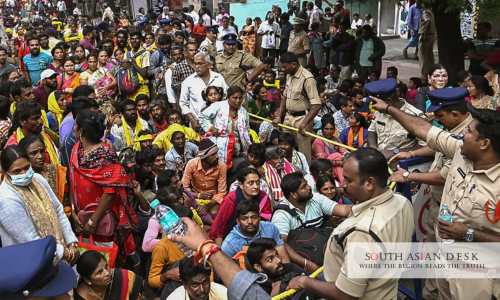
Visakhapatnam, Andhra Pradesh – At least nine devotees died and over 25 others suffered injuries in the Andhra Pradesh temple stampede at the Sri Venkateswara Swamy Temple in Kashibugga, Srikakulam district, on Saturday, November 1, 2025, during a major Hindu festival.
The incident unfolded around 10:30 AM local time when thousands of worshippers gathered for the Karthika Pournami rituals. Local police and temple staff struggled to control the throng after a temporary railing gave way, triggering panic and a deadly crush at the narrow entrance.
This Andhra Pradesh temple stampede underscores the perils of unchecked crowds at private religious venues across South Asia, where devotion often collides with inadequate infrastructure. In a region home to over 1.4 billion people, such events expose systemic gaps in safety protocols, amplifying risks during peak festival seasons and eroding public trust in local governance.
Eyewitness Accounts from the Andhra Pradesh Temple Stampede
Survivors described a scene of utter pandemonium as the crowd, estimated at over 15,000, pushed towards the temple’s single entry point. “People were climbing over each other to reach the inner sanctum,” said one devotee treated at a nearby hospital. The temple, perched on an elevated platform, lacked separate entry and exit routes, exacerbating the bottleneck.
The Srikakulam Venkateswara temple deaths stemmed from this design flaw. A weak grill collapsed under the weight of eager pilgrims, many carrying offerings for the full moon ceremony honouring Lord Venkateswara. Eyewitnesses reported no visible security personnel or barriers to manage the flow, allowing the surge to build unchecked.
Emergency services rushed to the site within minutes, airlifting critically injured victims to government hospitals in Srikakulam and Visakhapatnam. Medical teams confirmed eight women and one 13-year-old boy among the deceased, with most fatalities due to asphyxiation and crush injuries. Families waited in anguish outside overcrowded wards, where doctors battled to stabilise the wounded.
Cause of the Andhra Pradesh Temple Stampede Deaths
Investigators point to multiple lapses in the lead-up to the 9 killed in India temple crowd surge. The temple, a private initiative built a decade ago by a local landlord denied access to the famed Tirumala shrine, operates without formal ties to the state endowments department. Authorities received no prior notification of the event’s scale, preventing deployment of additional police or medical units.
“Narrow gates and fragile structures turned a joyous gathering into horror,” a district official noted in preliminary reports. The venue’s capacity stands at around 5,000, yet festival hype drew far more, fueled by social media promotions and word-of-mouth among rural communities.
This Andhra Pradesh temple stampede mirrors broader vulnerabilities. In 2025 alone, three major temple tragedies in the state claimed 22 lives and injured nearly 100, highlighting recurring issues like poor planning and enforcement. Experts call for mandatory risk assessments at all such sites, especially during lunar festivals that swell attendance.
Official Responses to the 9 Killed in India Temple Crowd Surge
Andhra Pradesh leaders swiftly condemned the lapse and vowed accountability. Deputy Chief Minister Pawan Kalyan announced an immediate inquiry, stating, “An inquiry will be conducted into the tragic incident.” He emphasised the temple’s private status and lack of approvals, adding that disciplinary measures target those who failed to inform officials.
Chief Minister N. Chandrababu Naidu expressed profound sorrow during a public address. “Deeply saddened by the tragic loss of lives in the stampede at the Kashibugga Venkateswara Swamy Temple in Srikakulam, Andhra Pradesh,” he said, pledging strict action against the responsible parties. State relief teams distributed initial aid, including temporary shelters for displaced families.
At the national level, Prime Minister Narendra Modi conveyed his distress via an official statement. “Pained by the stampede in Venkateswara Swamy Temple in Srikakulam, Andhra Pradesh. My thoughts are with those who have lost their near and dear ones,” he posted on X. The Prime Minister’s Office approved ex gratia payments of Rs 200,000 (about $2,380) to each deceased’s kin and Rs 50,000 ($595) for the injured.
Vice-President C. P. Radhakrishnan echoed the sentiment in a formal release from the Press Information Bureau. “Deeply pained by the tragic stampede at the Sri Venkateswara Swami Temple at Kashibugga in Srikakulam district, Andhra Pradesh. The loss of lives in the unfortunate incident is extremely distressing,” he said, extending condolences and prayers for recovery. President Droupadi Murmu and Governor S. Abdul Nazeer also issued messages of grief, urging enhanced safety measures.
These responses form the backbone of the government’s strategy, blending immediate relief with long-term probes into the Srikakulam Venkateswara temple deaths.
Background: A Pattern of Peril at Indian Religious Sites
The Andhra Pradesh temple stampede fits a grim pattern of crowd disasters in India. This year, similar surges at festivals have repeatedly tested emergency systems. In September, a Karur event in neighbouring Tamil Nadu killed several, while earlier incidents in Bengaluru claimed more lives.
Private temples like this one, often born from personal devotion, skirt regulations. The Kashibugga shrine’s founder, a 94-year-old landowner, constructed it after facing barriers at larger venues, drawing locals seeking affordable worship. Yet, without oversight, such sites amplify risks in a country where religious tourism generates billions annually.
South Asia’s dense populations and fervent traditions demand robust reforms. Data from the National Crime Records Bureau shows over 50 stampede-related deaths yearly, mostly at faith-based events. The 9 killed in India temple crowd surge serves as a stark reminder, prompting calls for tech like AI-monitored barriers and drone surveillance.
What’s Next for Preventing Andhra Pradesh Temple Stampede Recurrences
Authorities plan a high-level committee to review the incident by mid-November, focusing on licensing for private venues. Enhanced training for temple staff and mandatory evacuation drills top the agenda. Community leaders advocate for awareness campaigns, urging devotees to heed capacity limits.
As investigations unfold, the focus shifts to healing. Counselling services roll out for traumatised survivors, while reconstruction at the site incorporates wider access points. This Andhra Pradesh temple stampede may catalyze stricter norms, ensuring future festivals honour faith without fear.
The tragedy leaves a void in Srikakulam, but resolve grows to safeguard sacred spaces. Officials monitor recovery efforts closely, with full reports expected soon.
Published in SouthAsianDesk, November 2nd, 2025
Follow SouthAsianDesk on X, Instagram, and Facebook for insights on business and current affairs from across South Asia.