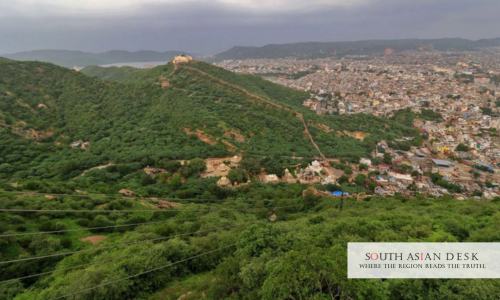
Aravalli hills protests gained momentum on Wednesday, December 24, 2025, as environmentalists and citizens demonstrated across Rajasthan and Haryana. Demonstrators opposed a Supreme Court order from November 20 that adopted a uniform definition limiting the Aravalli hills to landforms rising at least 100 metres above local relief. Critics argue this excludes over 90 percent of the range from protections, heightening the Aravalli mining threat.
Protests erupted in Gurugram, Udaipur, Sikar, and Alwar. Activists held placards reading “Save Aravalli” and “No Aravalli, No Life”. Some clashes occurred between police and protesters in Udaipur, resulting in brief detentions. The Save Aravalli movement gained widespread attention on social media, with petitions garnering thousands of signatures.
Environment Minister Bhupender Yadav defended the ruling. He stated more than 90 percent of the region remains protected. Yadav added that no new mining leases will be granted until a sustainable plan is prepared.
Supreme Court Aravalli Definition Sparks Debate
The Supreme Court Aravalli definition aims to standardise identification across Delhi, Haryana, Rajasthan, and Gujarat. The court accepted recommendations from a committee of the Ministry of Environment, Forests, and Climate Change.
Under the new criteria, an Aravalli hill requires an elevation of 100 metres or more above the surrounding terrain, including slopes. An Aravalli range comprises two or more such hills within 500 metres, plus intervening land.
The court banned the issuance of new mining leases pending the development of a Management Plan for Sustainable Mining by the Indian Council of Forestry Research and Education. Existing operations must follow norms. Mining remains prohibited in core areas, including protected forests, eco-sensitive zones, and wetlands, except for the extraction of critical minerals.
Activists claim the height-based rule fragments the ecosystem. Internal Forest Survey of India assessments indicate only about 8-9 percent of mapped hills qualify, leaving lower ridges vulnerable.
Aravalli Mining Threat Fuels Outrage
The Aravalli mining threat dominates concerns. The range, one of the world’s oldest, is over two billion years old and acts as a barrier against the expansion of the Thar Desert. It supports groundwater recharge, biodiversity, and air quality in the Delhi-NCR region.
Past illegal mining destroyed significant portions. A 2018 Central Empowered Committee report noted a 25 percent loss in Rajasthan. Unregulated activity lowered water tables and increased the frequency of dust storms.
Protesters demand that the entire range be declared an ecologically critical zone. They call for halting stone crushing near habitations and promoting alternatives to Aravalli-sourced materials.
Former Rajasthan Chief Minister Ashok Gehlot criticized the definition as a “death warrant.” Opposition leaders warn of grave consequences for water security and public health.
The government rejects claims of relaxation. Officials emphasise the freeze on new leases and enhanced monitoring with drones and surveillance.
Save Aravalli Movement Gains Traction
The Save Aravalli movement unites residents, farmers, lawyers, and groups like People for Aravallis. Online petitions target decision-makers, seeking the recall of judgment and stricter safeguards.
Protests include human chains, fasts, and climbs on peaks like Harsh Parvat in Sikar. In Gurugram, demonstrators gathered outside the minister’s residence.
Environmentalists highlight the range’s role in recharging aquifers and preventing desertification. Lower hills provide vital scrub cover and wildlife corridors.
The court recognised uncontrolled mining as a national ecological threat. It directed geo-referenced mapping for inviolate zones.
Background of Aravalli Hills Protests
Aravalli protection dates back to the 1990s, with petitions by M.C. Mehta. The Supreme Court imposed bans in Haryana districts and monitored the situation in Rajasthan.
States used varying criteria, causing ambiguity. Rajasthan alone had a formal definition banning mining on hills and slopes.
The 2025 committee consulted experts from the Forest Survey of India, the Geological Survey of India, and state departments. It sought a balance between ecology and sustainable resource use.
The range spans 692 kilometres, covering 37 districts. Trade in minerals, such as sandstone, drives demand, but illegal operations persist.
What’s Next
Review petitions and legal challenges loom. Activists plan to continue demonstrations and pursue public interest litigation. The sustainable mining plan will determine permissible areas. District-wise maps of protected zones are expected to be released soon.
Dialogue between states and the centre could address concerns. Declaring more eco-sensitive zones offers additional safeguards. Aravalli hills protests highlight tensions between development and conservation. Resolution depends on scientific assessments and enforcement.
The Aravalli hills protests underscore the need for robust protection of this vital ecosystem.
Published in SouthAsianDesk, December 24th, 2025
Follow SouthAsianDesk on X, Instagram and Facebook for insights on business and current affairs from across South Asia.