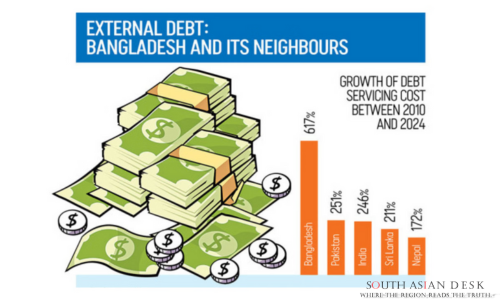
Bangladesh debt repayments increased to 617% from 2010 to 2024, reaching $7.3 billion last year. The World Bank flagged this as the fastest growth in South Asia. Exports failed to match the pace, resulting in a debt-to-exports ratio of 192%. The IMF downgraded Bangladesh’s risk from low to moderate in 2024. Officials warn of a debt trap without reforms. This surge squeezes fiscal space for development in the post-uprising economy.
Bangladesh’s debt repayments increase exposes vulnerabilities in South Asia’s debt crisis, where regional repayments totalled $95 billion in 2024, up 253%. Pakistan and Sri Lanka face similar strains, with ratios of 315% and 280%. As Bangladesh aims to achieve upper-middle-income status by 2031, unchecked borrowing risks defaults and higher import costs. Neighbours like India, at 82%, fare better, but shared supply chains amplify contagion. Reforms here could stabilise trade flows across the Bay of Bengal, bolstering collective resilience against global shocks.
Bangladesh External Debt 2025: $104 Billion Stock Rises 42%
Bangladesh’s external debt projections for 2025 are based on a $104 billion stock at the end of 2024, representing a 42% increase from the previous five years. Net inflows reached $5.8 billion last year, but disbursements slowed to $11.1 billion from $12.8 billion in 2023. Interest payments climbed to $2.4 billion, or 16% of exports.
The World Bank noted that South Asia’s external debt reached $896 billion in 2024, representing an 8.4% increase. Bangladesh sourced 26% of its debt from the lender, followed by the Asian Development Bank and Japan. Public and publicly guaranteed debt dominates, with private sector shares growing.
Prof. Mustafizur Rahman, Executive Director of the Centre for Policy Dialogue, addressed the trend at a Dhaka event on December 8, 2025. “If the trend continues, Bangladesh is poised to fall into a ‘debt trap’.” National Board of Revenue Chairman Md Abdur Rahman Khan echoed concerns. “We have already fallen into a debt trap; unless we acknowledge this truth, it will not be possible to move forward.”
Zahid Hussain, a former World Bank economist, blamed “irresponsible borrowing.” He stressed that loans must be tied to prepared projects with repayment plans. The report highlighted moderate ratios, but also noted emerging stress signals.
For 2025, repayments could exceed $8 billion under IMF caps. The lender set an $8.44 billion borrowing ceiling for FY26, with quarterly limits of $1.91 billion in Q1 and $3.34 billion in H1. This stems from Debt Sustainability Analyses, which mark moderate risk for FY23 and FY24.
South Asia Debt Crisis: Regional Repayments Hit $95 Billion
The South Asian debt crisis deepened in 2024, with collective repayments reaching $95 billion, a 253% increase from 2010. Bangladesh led growth at 617%, followed by Pakistan at 251% to $13.82 billion, India at 246% to $82.06 billion, and Sri Lanka at 211% to $4.17 billion.
The World Bank’s International Debt Report 2025, released on 7 December, pinpointed South Asia as having the fastest public and publicly guaranteed interest payment growth globally. Bangladesh and Sri Lanka drove the trend. Regional debt-to-exports averaged 93%, but Bangladesh’s 192% exceeds the IMF’s 180% threshold.
Pakistan’s 315% ratio signals higher distress, while Nepal’s 234% adds pressure. India’s lower 82% reflects stronger exports. Vietnam, outside the region, stands at 31%. Arrears grew at a rate of 25% per year over the decade to 2021, although Bangladesh stopped reporting in 2015.
The Asian Development Bank reported that Bangladesh’s government debt has tripled in 13 years, outpacing its South Asian peers. Total government debt reached Tk2,144,340 crore in June 2025, a 14% increase year-over-year. The tax-to-GDP ratio lingers at 7-7.5%, the lowest among regions, amid business uncertainty.
IMF staff noted in June 2025 reviews that fiscal consolidation lags, with subsidies straining budgets. Growth slowed to 3.7% in FY25 from 4.2%, hit by uprising delays and tighter policies.
IMF Debt Risk Bangladesh: Moderate Rating Prompts Caps
The IMF’s debt risk assessment for Bangladesh rose to moderate in 2024, prompting increased borrowing limits. The external debt-to-exports breach of 180% triggered the downgrade from low risk. Staff reports from June 2025 urged safeguarding sustainability amid adjustment pressures.
The IMF’s third and fourth reviews under ECF, EFF, and RSF, completed 23 June 2025, augmented access by SDR 567.19 million. This brings the total ECF/EFF to SDR 3,035.65 million ($4.1 billion), plus RSF at SDR 1 billion ($1.3 billion). Immediate disbursements: $884 million ECF/EFF and $453 million RSF.
Mission chief Chris Papageorgiou stated after the November 2025 visit: “Delayed or inadequate policy action in addressing fiscal and banking challenges would weaken growth, raise inflation, and increase risks to macro-financial stability.” Inflation remained at 8.2% in October 2025, projected to be 8.8% in FY26 before easing to 5.5% in FY27.
The IMF tied ceilings to DSA, monitoring quarterly. Options include VAT hikes on non-essentials and corporate minimum taxes. Structural reforms focus on governance, youth employment, and diversification to promote inclusive growth.
In May 2025, a staff-level agreement was reached, in which the IMF emphasized the importance of financial sector stability through asset reviews and bank restructuring. Bangladesh Bank independence reforms aim to curb vulnerabilities.
Background of Bangladesh Debt Repayments
Bangladesh’s debt trajectory accelerated after the 2022 crisis, with external debt increasing from $26 billion in 2010 to $104 billion by 2024. The 2024 uprising disrupted recovery, inflating the need for $5.5 billion in IMF support.
IDA loans favoured Bangladesh and Pakistan, with $5.3 billion in 2021 and $2.7 billion in 2022 combined. Bilateral ties, including the $1.2 billion owed to India by the end of 2022, grew from $0.5 billion in 2019.
Finance Division bulletins show that revenue deficits have widened the gaps. ERD projects sharp repayment hikes from FY27 on projects like Rooppur, lasting to 2034. An integrated Debt Management Office is formed, as advised by the IMF and World Bank.
What’s Next: Reforms to Ease Pressure
The IMF’s fifth review is expected to focus on November 2025 outcomes, with tranche releases following the elections. A unified debt office could curb risks by FY27. Export diversification and FDI reforms target thresholds.
World Bank urges climate-resilient spending. Growth forecasts: 5.6% in 2025 for South Asia, but 3.8% for Bangladesh.
Bangladesh’s debt repayments increase demands for swift action to avert a more profound South Asian debt crisis.
Published in SouthAsianDesk, December 10th, 2025
Follow SouthAsianDesk on X, Instagram, and Facebook for insights on business and current affairs from across South Asia.