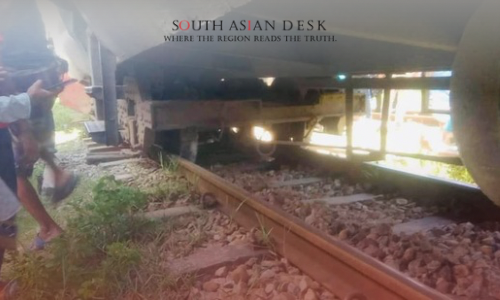
A commuter train derailment in Brahmanbaria halts Dhaka–Chattogram and Dhaka–Sylhet rail services, with no casualties reported.
On Thursday, September 4, 2025, at 12:30 PM, a bogie of the Titas Commuter Train derailed near Talshahar Railway Station in Brahmanbaria’s Ashuganj upazila, disrupting rail services to Dhaka, Chattogram, and Sylhet, railway officials confirmed.
The Brahmanbaria train accident highlights ongoing safety and infrastructure challenges in Bangladesh’s railway system, critical for millions of commuters and regional connectivity in South Asia.
Details of the Brahmanbaria Train Accident
The incident occurred when one wheel of a bogie on the Dhaka-bound Titas Commuter Train veered off the tracks near Talshahar Railway Station, according to Brahmanbaria Railway Station Master Md Nazmul Hossain. One wheel of a bogie went off the tracks, causing the derailment. No casualties or injuries were reported, but the derailment disrupted train services on the down line of the Dhaka–Chattogram and Dhaka–Sylhet routes, stranding passengers and delaying schedules.
Ashok Chandra Das, an official at Brahmanbaria Railway Station, noted that the derailment involved the coach immediately behind the engine, leading to the suspension of rail communication on the affected line. A rescue train from Akhaura Junction was dispatched to recover the derailed bogie, and operations to restore the line were ongoing as of September 1, with authorities yet to announce a specific timeline for full service restoration.
Impact on Regional Connectivity
The Brahmanbaria train accident caused significant disruptions to two of Bangladesh’s busiest rail corridors. The Dhaka–Chattogram route connects the capital to the country’s main port city, vital for trade and commerce, while the Dhaka–Sylhet line serves as a key link for passengers traveling to the northeastern region. Passengers reported delays, with some trains halted at nearby stations like Akhaura Junction. The incident underscores the fragility of Bangladesh’s rail infrastructure, where single-line disruptions can have widespread impacts.
Background: Bangladesh’s Railway Safety Challenges
Bangladesh’s railway system, spanning over 3,000 kilometres, has faced recurring accidents, with derailments being the most common. According to a 2023 report by the Shipping and Communications Reporters Forum, 131 people were killed and 110 injured in 137 railway accidents in the first six months of that year, primarily due to dilapidated tracks, poor signaling, and inadequate maintenance. Efforts to modernise signaling systems, but implementation remains incomplete. Past incidents in Brahmanbaria, such as the 2019 collision that killed 16 people, have raised concerns about systemic issues, including outdated infrastructure and human error.
Experts, including Professor Hadiuzzaman from BUET’s Accident Research Institute, have noted that 70% of Bangladesh’s railway tracks have exceeded their operational lifespan, increasing the risk of derailments. The Brahmanbaria train accident follows a pattern of similar incidents, including a freight train derailment in the district in November 2024, which also disrupted connectivity. Railway officials have stated that the specific cause of the Titas Commuter Train derailment is still under investigation, with preliminary findings pointing to track-related issues.
Response and Mitigation Efforts
Railway authorities acted swiftly, dispatching a rescue train from Akhaura Junction to address the Brahmanbaria train accident. The focus is on clearing the derailed bogie and repairing any track damage to resume services. The Bangladesh Railway has faced criticism for slow progress in upgrading infrastructure, with only partial implementation of safety measures like automated signaling and track rehabilitation. The government has allocated BDT 20 billion (approximately USD 167 million) for railway modernisation in the 2025–26 budget, but stakeholders argue that implementation lags behind.
Local communities and passengers have called for stronger safety protocols, including regular track inspections and better maintenance. The absence of casualties in this incident is a relief, but it highlights the need for proactive measures to prevent future disruptions.
What’s Next
Railway officials are working to restore services, with the rescue operation expected to conclude within hours. The Brahmanbaria train accident serves as a reminder of the urgent need for infrastructure upgrades to ensure safe and reliable rail travel. Authorities are likely to investigate the cause of the derailment, with findings expected to inform future safety measures. As Bangladesh continues to grapple with railway safety challenges, the Brahmanbaria train accident underscores the importance of sustained investment in modernising the nation’s rail network.
Published in SouthAsianDesk, September 4th, 2025
Follow SouthAsianDesk on X, Instagram, and Facebook for insights on business and current affairs from across South Asia.