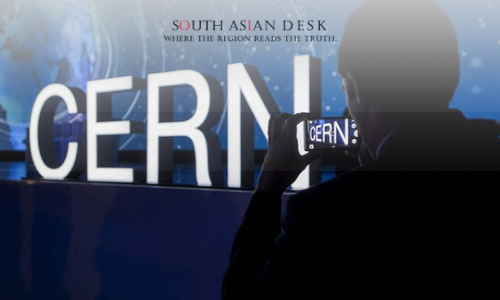
A CERN delegation assessed Pakistan’s advancements in science and technology during a visit from August 24 to 28, 2025. A high-level delegation from the European Organisation for Nuclear Research (CERN) visited Pakistan from Saturday, August 24, to Wednesday, August 28, 2025, to review the nation’s progress in science and technology as an associate member, meeting with key institutions and officials to strengthen collaboration.
Why it Matters
Pakistan’s associate membership with CERN, a globally renowned scientific research body, underscores its growing role in advancing particle physics and technological innovation, fostering opportunities for South Asian scientists and engineers to contribute to global research.
CERN Visit Highlights Pakistan’s Scientific Institutions
The visitors comprising five top experts, engaged with the Pakistan Atomic Energy Commission (PAEC) chairman and toured several leading science and technology institutions. According to a Foreign Office statement posted on X, the visits aimed to assess Pakistan’s contributions to CERN’s projects and its advancements in scientific research. The delegation visited the National Centre for Physics (NCP), Heavy Mechanical Complex-3 (HMC-3), Pakistan Institute of Engineering and Applied Sciences (PIEAS), Pakistan Institute of Nuclear Science and Technology (PINSTECH), Institute of Nuclear Medicine and Oncology (INMOL), and National Institute for Laser and Optronics (NILOP).
The Foreign Office highlighted that Pakistan’s associate membership, secured on Friday, July 31, 2015, has enabled significant contributions to CERN’s initiatives, including detector technology and heavy mechanical parts fabrication. The visit reinforces Pakistan’s role as a “significant partner” in CERN’s mission of “science for peace,” established in 1954.
Benefits of CERN Collaboration for Pakistan
Pakistan’s collaboration with CERN, formalised in 1994, has yielded substantial benefits. The associate membership has facilitated access to CERN’s training and career-development programmes, allowing Pakistani scientists to join CERN’s staff and participate in its governance through the CERN Council. Additionally, Pakistani industries, such as HMC-3, have secured engineering contracts, boosting the industrial sector and fostering technology transfer. A 2022 CERN task force review, conducted virtually, further solidified this partnership by engaging with PAEC, NCP, and universities like COMSATS. The 2025 visit builds on these efforts, with the delegation expressing satisfaction with Pakistan’s progress, according to PAEC’s official statement on X.
Regional Impact of Pak-CERN Collaboration
Pakistan’s deepened ties with CERN position it as a leader in scientific research within South Asia. The collaboration enhances human resource development, with institutions like PIEAS training a new generation of scientists. The partnership also opens avenues for Pakistani industries to bid for CERN contracts, promoting technological advancements that could benefit the broader region. For instance, expertise gained in particle physics and accelerator technology could have applications in medical imaging and cancer treatment, as demonstrated by INMOL’s facilities.
The visit also highlights Pakistan’s commitment to peaceful nuclear research, aligning with CERN’s ethos. This collaboration could inspire other South Asian nations to pursue similar partnerships, fostering regional scientific cooperation.
Historical Context of Pak-CERN Ties
Pakistan’s engagement with CERN dates back to the 1960s, with formal cooperation established through a 1994 agreement. Key milestones include the 2006 protocol signed by PAEC and CERN, which expanded technical support, and Pakistan’s associate membership in 2015, making it the first non-European country to achieve this status. Pakistani scientists have contributed to major CERN experiments, including ALICE and CMS, and provided critical equipment like the 25-ton support feet for the CMS detector’s magnet.
The 2024 CERN70 event in Islamabad, held on Monday, June 24, to Tuesday, June 25, celebrated 30 years of this collaboration, with seminars highlighting Pakistan’s contributions to particle physics and technological advancements.
Looking Ahead: CERN Delegation Visits Pakistan August 2025
The recent CERN visits to Pakistan in August 2025 mark a pivotal moment for deepening scientific ties. Continued engagement with CERN is expected to drive innovation, enhance Pakistan’s global scientific standing, and create opportunities for its youth in cutting-edge research fields.
Published in SouthAsianDesk, August 29th,2025
Follow SouthAsianDesk on X, Instagram, and Facebook for insights on business and current affairs from across South Asia.