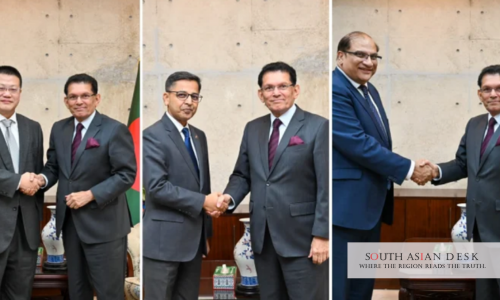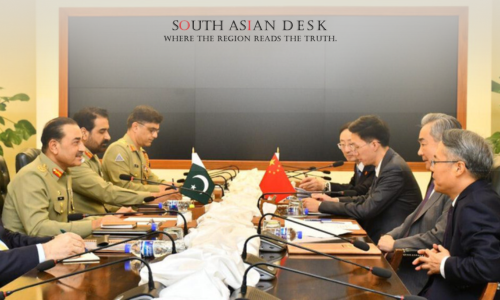
China Foreign Minister Wang Yi and Field Marshal Munir bolster ties to enhance regional security and counter terrorism. China’s Foreign Minister Wang Yi met Pakistan’s Field Marshal Syed Asim Munir, Chief of Army Staff (COAS), in Islamabad on Thursday, August 21, 2025, to discuss regional security, counter-terrorism, and bilateral ties, strengthening the strategic partnership, according to the Inter-Services Public Relations (ISPR).
Why It Matters in South Asia
The meeting between the Chinese Foreign Minister and Field Marshal Munir highlights the growing China-Pakistan alliance, a pivotal force in South Asia’s geopolitics. Amid tensions with India, instability in Afghanistan, and rising terrorism, their focus on security and economic projects like the China-Pakistan Economic Corridor (CPEC) could reshape regional dynamics.
China’s Foreign Minister Strengthens Strategic Ties
The discussions, part of the sixth Pakistan-China Strategic Dialogue, saw China Foreign Minister Wang Yi and Field Marshal Munir reaffirm their “all-weather strategic partnership.” ISPR reported that Wang expressed China’s unwavering support for Pakistan’s sovereignty and development, while Munir thanked Beijing for its consistent backing. The talks emphasized deeper coordination in regional and global forums.
Wang stressed enhancing security dialogue and law enforcement cooperation to counter transnational terrorism. He reiterated China’s commitment to supporting Pakistan’s efforts to address conditions fostering extremism, a shared priority given recent regional security challenges.
Regional Security and Counter-Terrorism
The Chinese Foreign Minister and Field Marshal Munir addressed critical regional security issues, including Afghanistan’s evolving situation and broader South Asian concerns. Wang, who visited Kabul on Wednesday, August 20, 2025, to meet Afghan officials, underscored China’s opposition to external interference and support for regional stability. This aligns with Pakistan’s focus on countering cross-border terrorism, particularly from groups like the Tehreek-i-Taliban Pakistan (TTP) operating from Afghanistan.
Both leaders discussed the China-Pakistan Economic Corridor, a cornerstone of China’s Belt and Road Initiative (BRI). Wang highlighted the “high-quality development” of CPEC projects, such as Gwadar Port and the Karakoram Highway realignment, vital for regional connectivity and economic growth.
Field Marshal Munir’s Counter-Terrorism Focus
Counter-terrorism was a key focus, with the Chinese Foreign Minister praising Pakistan’s “tireless efforts and sacrifices” in combating terrorism. Wang emphasized China’s support for protecting Chinese personnel and CPEC projects, amid concerns over recent security incidents targeting Chinese nationals.
Field Marshal Munir underscored Pakistan’s role as a “bulwark against terrorism,” echoing sentiments from his July 2025 visit to Beijing, where Chinese leaders commended the Pakistan Army’s contributions to regional peace. The discussions built on prior talks, such as those in May 2023, focusing on coordinated responses to hybrid and transnational threats.
Background
The China-Pakistan relationship, often termed an “all-weather friendship,” has deepened through decades of cooperation in diplomacy, economics, and defence. The CPEC, launched in 2015, has driven over USD 60 billion in investments in infrastructure and energy. However, security challenges, including attacks on Chinese workers and regional tensions, have necessitated stronger collaboration. Pakistan’s strategic location and counter-terrorism efforts make it a key partner for China in stabilizing South Asia.
Recent developments, such as India-Pakistan tensions and Afghanistan’s instability, have amplified the need for such dialogues. In May 2025, a trilateral meeting in Beijing involving Pakistan, China, and Afghanistan agreed to extend CPEC to Afghanistan, fostering regional economic integration.
What’s Next
The commitment by the Chinese Foreign Minister and Field Marshal Munir to enhance security and counter-terrorism efforts will likely lead to increased military and intelligence cooperation. CPEC projects, including the ML-1 railway and Gwadar Port, will test this partnership’s ability to balance economic goals with security needs. The upcoming sixth Trilateral Foreign Ministers’ Meeting in Kabul will further shape regional security strategies.
Published in SouthAsianDesk, August 22nd, 2025
Follow SouthAsianDesk on X, Instagram, and Facebook for insights on business and current affairs from across South Asia.