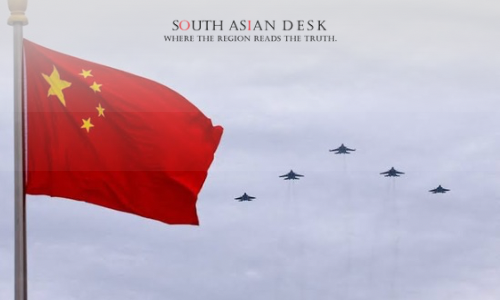
China’s largest-ever military parade on September 3, 2025, will showcase advanced weaponry to deter regional rivals amid rising tensions. China will hold its largest military parade on Tuesday, September 3, 2025, in Beijing to mark the 80th anniversary of World War II’s end, displaying advanced weaponry like hypersonic missiles and undersea drones to deter rivals, particularly the U.S. and its allies, amid tensions over Taiwan and the South China Sea.
Why This Matters in South Asia
China’s military display has profound implications for South Asia, where regional powers like India closely monitor Beijing’s growing influence. The parade, showcasing cutting-edge technology and nuclear capabilities, signals China’s intent to assert dominance in the Indo-Pacific, potentially escalating tensions with India over border disputes and prompting regional nations to bolster their own deterrence strategies.
China’s Military Showcase: Scale and Scope
The parade, set to feature 45,000 troops, 45 contingents, and hundreds of aircraft, will take place along Chang’an Avenue and Tiananmen Square. According to China’s state-run Xinhua news agency, the event will display “new fourth-generation equipment” including advanced tanks, fighter jets, and hypersonic missiles, all domestically produced and in active service. Military official Wu Zeke, at a press conference on Wednesday, August 20, 2025, stated, “The parade will demonstrate our military’s robust ability to adapt to technological advancements and win future wars”.
Among the highlights are the KJ-600 early warning aircraft, YJ-17 and YJ-20 cruise missiles, and a new torpedo-shaped undersea drone, which analysts suggest mirrors U.S. underwater drone programs.
Strategic Deterrence Amid Regional Tensions
China’s parade is more than a ceremonial display; it is a calculated move to project power and deter adversaries. The U.S., Japan, and Taiwan are expected to closely scrutinize the event, particularly for advancements in China’s missile arsenal, including the DF-41 intercontinental ballistic missile and nuclear-capable H-6N bombers. Drew Thompson, a senior fellow at Singapore’s S. Rajaratnam School of International Studies, noted, “While the parade showcases advanced systems, it doesn’t fully reflect China’s ability to integrate them in a conflict scenario”.
The event coincides with heightened tensions over Taiwan, with the People’s Liberation Army (PLA) conducting exercises like “Strait Thunder-2025A” in April 2025. India, a key South Asian player, is particularly wary, given recent border clashes and China’s growing ties with Pakistan.
Technological Advancements and Global Reactions
The parade will feature battlefield sensors, air defence lasers, and early warning radars, emphasizing China’s focus on integrating cyber, space, and electronic warfare capabilities. The Global Times reported that the display will include “joint armament formations” reflecting real-combat scenarios, showcasing system-based combat capabilities. Ben Lewis of PLATracker noted the undersea drone’s potential to “complicate a Taiwan scenario if produced at scale”.
The U.S. and its allies, including Japan and Australia, view the parade as a signal of China’s nuclear and conventional buildup, with concerns about its shift from a “minimum deterrent” to a force challenging U.S. dominance. India’s tentative attendance by Prime Minister Narendra Modi at the parade, alongside leaders like Russia’s Vladimir Putin, reflects delicate diplomatic balancing.
Background
The September 3, 2025, parade commemorates the 80th anniversary of Japan’s surrender in 1945, termed the “War of Resistance Against Japanese Aggression” by China. It is the second such parade since 2015, following a period of rapid PLA modernization under President Xi Jinping, who has directed the military to prepare for a potential Taiwan conflict by 2027. China’s nuclear arsenal expansion, including DF-41 missiles and Type 094A submarines, has raised concerns among U.S. Strategic Command and arms control experts.
Since August 2025, Beijing has enforced strict security measures, diverting traffic and closing businesses to ensure a smooth rehearsal process. The parade’s proximity to the 2025 Tianjin SCO summit, attended by leaders from Azerbaijan, Belarus, and Iran, amplifies its geopolitical significance.
What’s Next
As China prepares for the parade, regional powers and the U.S. will assess its military advancements for strategic implications. The display could prompt India and other South Asian nations to accelerate their own military modernization, while China’s growing arsenal may further strain U.S.-China relations, impacting global and regional security dynamics.
Published in SouthAsianDesk, August 25th, 2025
Follow SouthAsianDesk on X, Instagram, and Facebook for insights on business and current affairs from across South Asia.