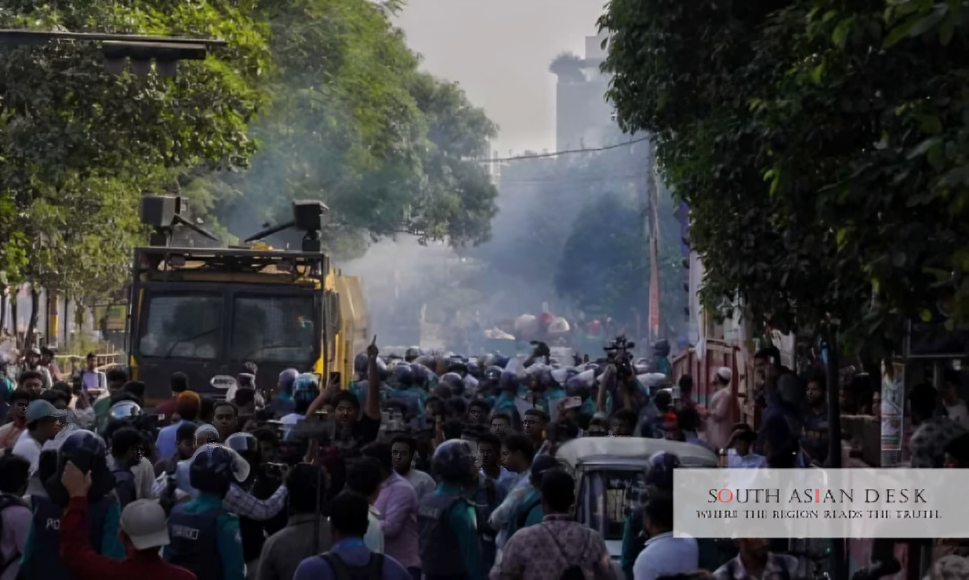
Clashes after Hasina verdict in Bangladesh erupted in Dhaka’s Dhanmondi area on Monday when Dhaka College students arrived with bulldozers to raze the former prime minister’s family home, only to face police batons and sound grenades that dispersed the crowd. The unrest spread nationwide, with nearly 50 arson attacks reported.
The clashes after Hasina verdict in Bangladesh underscore the nation’s deep divisions 13 months after Sheikh Hasina’s ouster, amplifying risks of renewed instability that could ripple across South Asia. With elections looming, such violence threatens investor confidence in a region already strained by political upheavals in neighbouring countries, potentially disrupting trade corridors and refugee flows.
Bangladesh Protests Post Hasina Trial Erupt in Capital
Protests surged across Dhaka following the International Crimes Tribunal’s death sentence for Sheikh Hasina on charges of crimes against humanity linked to last year’s student uprising crackdown. Security forces sealed off key roads around Dhanmondi 32, the site of Sheikh Mujibur Rahman’s historic residence, which protesters targeted amid chants for demolition.
Around midday, a group of Dhaka College students pushed two bulldozers toward the barricades, announcing over loudspeakers their intent to tear down the structure. Police intervened swiftly, charging with batons and firing sound grenades to scatter the demonstrators. Army troops reinforced the perimeter, ensuring no breach occurred.
By evening, approximately 300 protesters regrouped near the site, igniting tyres in the street to press their demands. Fire service units later cleared the debris, restoring partial access. The confrontations left police vehicles vandalised, with reports of stones hurled at law enforcement lines.
A local police officer stated: “Students of Dhaka College have brought two bulldozers… announcing they will demolish the Dhanmondi 32 house after the verdict.” This marked the first major flashpoint in the capital, where tensions had simmered for days.
Awami League Violence, Hasina Death Sentence Fuels Nationwide Blockades
Beyond Dhaka, Awami League violence Hasina death sentence triggered blockades and arson in multiple districts. In Gopalganj’s Kashiani upazila, banned Chhatra League activists felled trees to obstruct the Dhaka-Khulna highway at Tilchara Bazar around 7:45am. The blockade stranded hundreds of vehicles for nearly 20 minutes before police cleared the route.
Similar disruptions hit Moulvibazar, where unidentified groups toppled trees two kilometres north of Rajnagar Police Station, blocking the Rajnagar-Fenchuganj-Sylhet regional highway. Fire service personnel arrived by 7:30am to remove the obstacles, allowing traffic to resume.
In Gazipur’s Kaliakair upazila, a crude bomb exploded at the Grameen Industrial Park around 4:45am, followed by arson on a nameplate. Separately, in the Medi Ashulia area, miscreants set fire to an excavator. These incidents formed part of a broader wave, with dozens of crude bombings recorded nationwide in the lead-up to the verdict.
Authorities reported nearly 50 arson attacks, primarily targeting buses, across urban and rural areas. Sporadic blasts occurred in parts of the capital and other cities, prompting heightened alerts. No fatalities emerged from these events, but the scale evoked memories of the 2024 uprising that claimed over 1,000 lives.
Hasina Supporters Clash Sparks Security Response
Hasina supporters clash Dhaka verdict incidents drew sharp rebukes from officials. In Dhanmondi, demonstrators vowed persistence, with one protester declaring: “Our struggle is not over; we will return home only after the execution of Hasina’s death sentence.” Such rhetoric heightened fears of escalation, especially with the Awami League facing a participation ban ahead of February elections.
Police maintained a firm stance, dispersing crowds at multiple sites. The Financial Express reported that officers fired sound grenades and charged with batons to break up gatherings at Dhanmondi-32 in the afternoon. Reinforcements included rapid action battalions, underscoring the government’s resolve to contain unrest.
The verdict itself stemmed from evidence of Hasina’s direct commands for lethal force against protesters, as detailed in tribunal proceedings. Prosecutors presented documents showing coordinated security operations that resulted in mass casualties. Hasina, exiled in India, rejected the charges, calling them the work of “extremist figures in an unelected government.”
Human Rights Watch urged restraint, stating: “Awami League leaders should discourage violence by party supporters opposing the tribunal verdict.” This call aligned with UN reports documenting systematic abuses during the crackdown.
Background of Clashes after Hasina Verdict
Sheikh Hasina’s 15-year rule ended in August 2024 amid student-led protests that paralysed the nation. The uprising, initially over job quotas, morphed into a broader anti-corruption movement, forcing her flight to India. Over 1,400 deaths were later attributed to state forces, per UN estimates.
The International Crimes Tribunal-1, established post-ouster, fast-tracked cases against Hasina and allies. Monday’s ruling marked the first conviction, sentencing her in absentia to death by hanging. Co-defendants received varying terms, intensifying partisan divides.
Pre-verdict tensions included planned Awami League lockdowns, now thwarted by the party’s disbandment. Security remained on maximum alert, with checkpoints multiplying in Dhaka.
What’s Next
Interim leaders face mounting pressure to stabilise the polity before polls. Analysts predict appeals could prolong the saga. Dialogue initiatives may emerge to bridge divides, but Awami League violence Hasina death sentence risks derailing progress.
Clashes after Hasina verdict in Bangladesh serve as a stark reminder that justice, while pursued, must navigate a landscape scarred by loss. As the nation edges toward elections, sustained calm will define its democratic trajectory.
Published in SouthAsianDesk, November 18th, 2025
Follow SouthAsianDesk on X, Instagram, and Facebook for insights on business and current affairs from across South Asia.