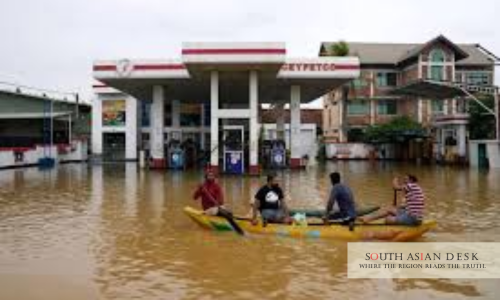
Colombo, Sri Lanka (South Asian Desk) – Cyclone Ditwah Sri Lanka’s struck eastern and central regions on Friday, unleashing floods and landslides that killed 153 people and left 176 missing as of Saturday evening. The Disaster Management Centre (DMC) reported the crisis displaced 78,000 residents into temporary shelters, with nearly 15,000 homes destroyed. Prime Minister Harini Amarasuriya appealed for urgent foreign assistance during a meeting with diplomats in Colombo on Saturday. Relief teams from India and Pakistan arrived with supplies, targeting flood-hit areas around the Kelani River. Operations continue at 4:35 PM local time.
The storm dumped over 300mm of rain in 24 hours, bursting river banks and submerging roads in Kandy district and Colombo suburbs like Kaduwela and Malwana. Evacuations saved lives but strained resources for 500,000 affected individuals. Armed forces deployed 5,000 personnel for rescues, pulling survivors from mudslides in the central hills. Cyclone Ditwah’s path now shifts northwest toward India’s Tamil Nadu coast, but Sri Lanka bears the brunt of its fury.
This disaster compounds Sri Lanka’s economic woes, where recovery from 2022’s crisis lingers. In South Asia, it tests regional ties, with India and Pakistan stepping in via rapid aid corridors. Such events highlight vulnerabilities to climate shifts, urging coordinated defence mechanisms across the Bay of Bengal nations. For Pakistan and India, involvement signals diplomatic goodwill amid shared monsoon threats, potentially easing bilateral tensions through joint relief.
Cyclone Ditwah Sri Lanka: Scale of Destruction
Cyclone Ditwah formed in the southwest Bay of Bengal on November 27, intensifying into a severe cyclonic storm by Friday morning. It made landfall near Trincomalee with winds of 120 km/h, triggering the worst flooding since 2019’s eastern deluge. The DMC’s latest bulletin at 2 PM Saturday pegged the death toll at 153, up from 132 reported Friday night. Most fatalities stemmed from landslides in Kandy and Badulla districts, where hillsides collapsed onto villages.
Infrastructure buckled under the assault. The Kelani River overflowed, flooding 20km of the Colombo-Kandy highway and isolating 12,000 families. Power outages hit 40% of the western province, delaying communications. Agriculture suffered too: 5,000 hectares of tea plantations in the central highlands drowned, threatening exports that form 12% of GDP. Fishermen lost 200 boats off the eastern coast, stranding communities reliant on seafood.
DMC Director-General Sampath Kotuwegoda addressed reporters in Colombo. “Relief operations with the help of the armed forces are under way,” he said. “We have distributed 100,000 food packets, but needs escalate as waters recede slowly.” The centre activated emergency protocols, declaring a state of disaster across nine districts. Navy divers scanned submerged vehicles for the 176 missing, many swept away during Friday’s peak rains.
In Colombo’s outskirts, volunteers navigated waist-deep waters in Kaduwela to deliver medicines. One resident, Priya Fernando from Malwana, described the chaos. “The river rose at dawn; we climbed roofs until boats came,” she told local crews. Such accounts underscore the human cost, with children and elderly hit hardest in informal settlements.
Sri Lanka International Aid Cyclone: India Leads Response
Sri Lanka’s call for help drew swift replies from neighbours. India launched Operation Sagar Bandhu on Friday, dispatching three air force planes with 27 tonnes of aid by Saturday noon. The consignment included tents, blankets, water purifiers and ready-to-eat meals for 50,000 people. An IL-76 aircraft landed at Bandaranaike International Airport carrying two National Disaster Response Force (NDRF) teams, 80 personnel equipped for urban search and rescue.
External Affairs Minister S Jaishankar confirmed the deliveries on social media. “Operation Sagar Bandhu unfolds with another IL-76 to Colombo bearing 9 tonnes of relief and NDRF teams,” he posted. Indian Navy ship INS Sukanya departed Visakhapatnam with additional rations, set to dock Monday. Prime Minister Narendra Modi offered condolences. “We stand ready to provide more aid and assistance as the situation evolves,” Modi stated.
Pakistan joined the effort via naval channels. The Pakistan Navy’s PNS Saif delivered emergency suppliestents, medical kits and generators, off Colombo’s coast Saturday afternoon. The shipment, valued at PKR 500 million, targeted northern flood zones still lashed by showers. Director General Public Relations (Navy) highlighted the gesture. “This swift support underscores Pakistan Navy’s commitment to international obligations and solidarity with friendly nations,” the official note read.
Sri Lanka Red Cross Society Secretary-General Mahesh Gunasekara welcomed the inflows. “Relief needs have been increasing. After two days, water has still been swelling,” he noted. “Although the cyclone is slowly moving away, it is not over for us yet.” The society’s warehouses in Batticaloa processed Indian consignments, distributing them to 10,000 families by evening.
These contributions fill gaps in Sri Lanka’s stockpiles, strained by fiscal constraints. India’s aid totals USD 5 million so far, focusing on reconstruction blueprints for damaged bridges. Pakistan’s input bolsters coastal defences, drawing on its 2022 flood expertise. Together, they mitigate secondary risks like disease outbreaks in shelters.
Background: Cyclone Ditwah’s Regional Ripple
Cyclone Ditwah echoes past storms in South Asia’s volatile weather patterns. Similar to 2021’s Cyclone Tauktae, which killed 200 across India and Pakistan, Ditwah exploits warming seas for rapid intensification. Sri Lanka’s vulnerability stems from deforestation in hill country, exacerbating landslides. The 2004 tsunami scarred collective memory, but climate change amplifies annual threats, rains 20% heavier since 2000, per UN data.
India’s Tamil Nadu braces for Ditwah’s landfall early Monday, with 50,000 evacuated along Puducherry coasts. The India Meteorological Department forecasts 150mm rains, risking flash floods. Pakistan monitors Arabian Sea branches, though direct hits remain unlikely. Regionally, the storm disrupts trade: Colombo port, a Belt and Road hub, halted operations for 12 hours, delaying 20 container ships.
Economic fallout looms large. Sri Lanka’s tourism, rebounding post-2022 unrest, faces cancellations, hotel occupancy in Galle dropped 30%. Tea yields may halve next quarter, spiking global prices. For South Asia, Ditwah spotlights the need for a unified early-warning system, as proposed in the 2023 SAARC climate pact.
What’s Next: Recovery Amid Ongoing Threats
Rescue teams target the 176 missing by Tuesday, using drones over Kandy’s debris fields. The DMC plans to lift evacuation orders in low-risk zones Wednesday, pending river gauging. International aid pledges could reach USD 20 million if UN appeals activate Monday.
Prime Minister Amarasuriya convenes a cabinet briefing Sunday to allocate funds, LKR 2 billion for immediate rebuilds. India eyes evacuation flights for stranded citizens, while Pakistan offers technical aid for flood barriers. As Cyclone Ditwah Sri Lanka fades, focus shifts to resilience: rebuilding homes with climate-proof designs and expanding shelter networks.
In the end, Cyclone Ditwah Sri Lanka exposes fractures but forges bonds, with regional aid proving a lifeline for the island’s swift rebound.
Published in SouthAsianDesk, November 30th, 2025
Follow SouthAsianDesk on X, Instagram, and Facebook for insights on business and current affairs from across South Asia.